


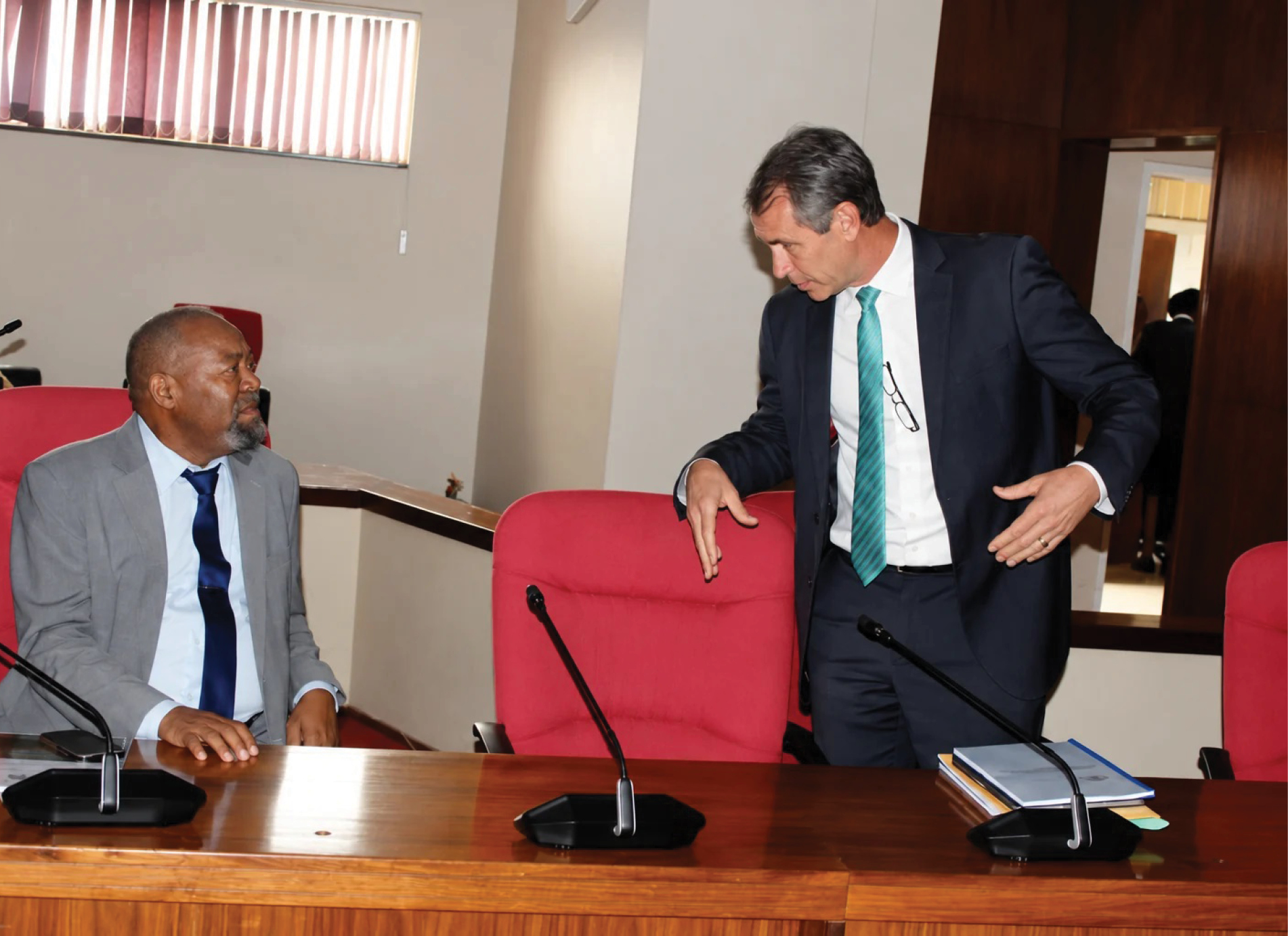
SENATORS have adopted three finance bills seeking loans for government, including funding to close a budget shortfall of approximately E3 billion and finance the next phase of infrastructure development under the Mkhondvo-Ngwavuma Water Augmentation Programme.
These are the African Development Bank (Enhancing Economic Resilience and Competitiveness Programme Phase II) Loan Bill No.18 of 2026, the Arab Bank for Economic Development in Africa (BADEA) (Mkhondvo-Ngwavuma Water Augmentation Programme) Loan Bill No.19 of 2026 and the Standard Bank of South Africa Limited Loan Bill No. 20 of 2026.
Minister of Finance Neal Rijkenberg, while explaining the importance of the loans, said two of these loans would provide budget support to address a funding gap created by the last financial year’s supplementary budget.
Government had increased its annual budget from E32 billion to approximately E35 billion through the supplementary budget, but had a cash-flow shortfall of about E3 billion.
Rijkenberg explained that nearly E1.5 billion of the supplementary budget went towards the salary review, while approximately E905 million was used to complete the International Convention Centre (ICC). Other pressures included a shortfall in tax revenue and additional travel expenditure. He said government had since secured E1.1 billion from the African Development Bank and E1.6 billion from Standard Bank of South Africa to close the funding gap. The minister said the money was needed because the expenditure had already been incurred, leaving government in arrears and affecting the commencement of capital projects.
“Because that cash was spent, which we didn’t have, we’ve now gone into arrears,” he said.
The BADEA loan, Rijkenberg said the US$60 million (approximately E990 million) would finance the infield infrastructure required to irrigate land under the Mkhondvo-Ngwavuma Water Augmentation Programme.
This was the final loan required for Phase 1 of the project, which comprises the construction of Mpakeni Dam, the main canal, infield dams and the irrigation infrastructure.
The minister reported that construction of Mpakeni Dam was approximately 58% complete, while funding for the main canal and infield dams had already been secured. He said the infrastructure would enable approximately 4 600 hectares, or up to 5 000 hectares, to be irrigated once the dam was completed and the necessary funding was available.
Rijkenberg described the project as a major economic driver, citing its potential to support agricultural production through irrigation.
He further disclosed that government would still need to raise additional loans to address the current financial year’s funding gap, as there could also be a shortfall in tax revenue.
The minister said the latest borrowing would increase the country’s debt but maintained that the debt-to-GDP ratio remained at approximately 45%.
He, however, said government needed to ensure that future expenditure was kept within available resources.