



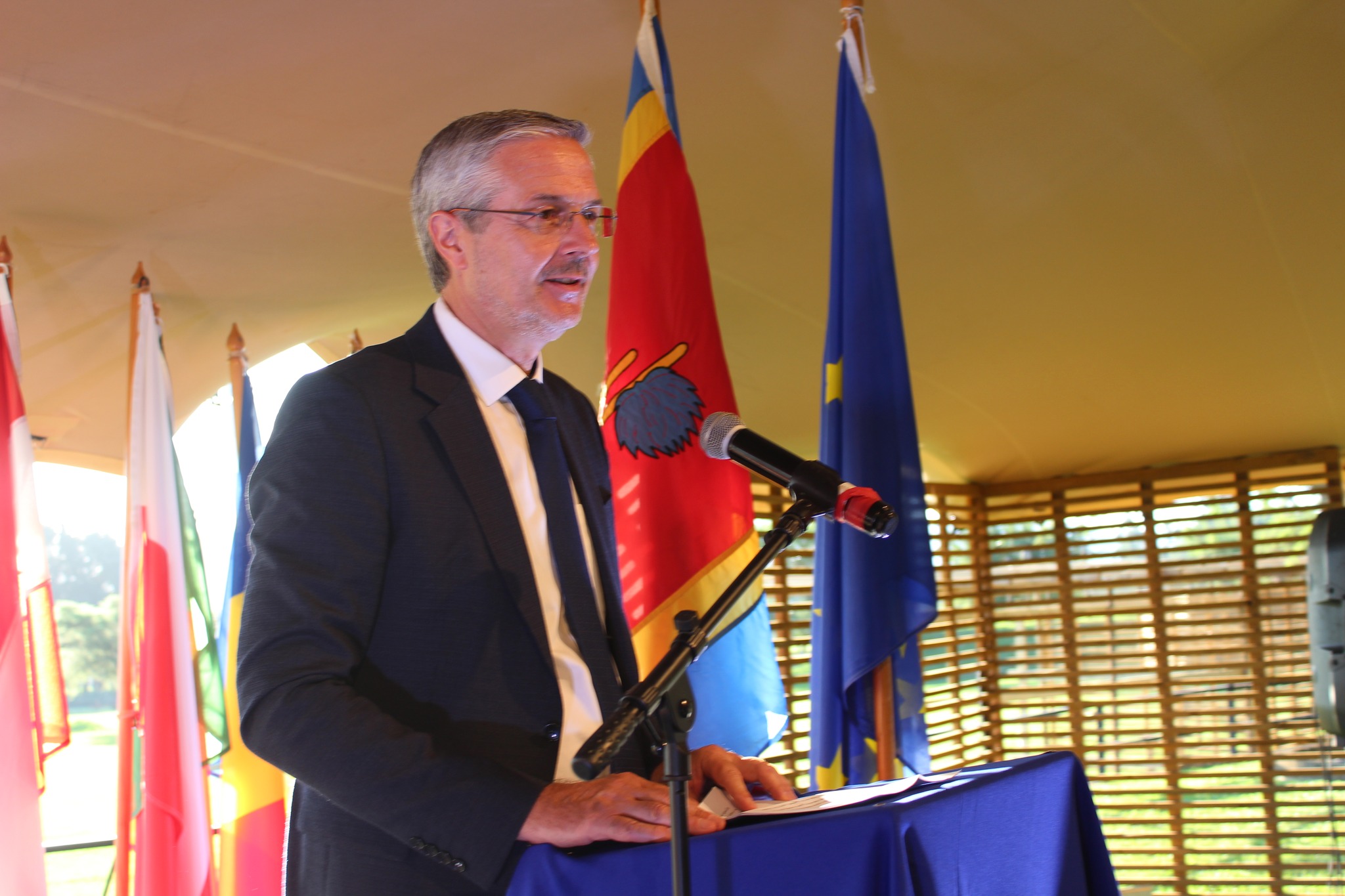
The European Union (EU) has called upon the country to remain committed to multilateralism as the global order faces mounting pressures from conflict, economic coercion, and political fragmentation.
Multilateralism is used in international relations and diplomacy to describe a system in which multiple countries work together on a given issue, usually through cooperation, negotiation, or formal institutions, rather than acting unilaterally or in small, exclusive groups (bilateral agreements).
EU Ambassador to Eswatini Karsten Mecklenburg highlighted the EU’s unwavering dedication to international cooperation, shared prosperity and the promotion of universal values, emphasising that the EU and Eswatini are natural allies in safeguarding these principles.
“Peace in Europe is at risk. The global balance of power is being contested by revisionist powers. The international rules-based system is under attack,” said Ambassador Mecklenburg.
“In a world of war, hybrid threats, and economic coercion, the EU must act in order to defend its citizens, its democracy and values. Europe’s security is shared security. By working with partners including in Africa, we build a safer world for all.”
The ambassador’s remarks came during the celebration of Europe Day, which commemorated the historic May 9, 1950 Schuman Declaration. That speech by French Foreign Minister Robert Schuman laid the foundation for European integration, originally uniting six founding countries in pursuit of peace and economic cooperation after the devastation of World War II. Today, the EU encompasses 27 Member States and over 450 million citizens, demonstrating the enduring power of collaboration.
Central to Ambassador Mecklenburg’s message was the call for the kingdom to uphold multilateralism.
He emphasised that political and economic progress in today’s interconnected world was no longer a zero-sum game, where the strongest prevail at the expense of others, but rather depended on cooperation, mutual support, and acceptance of shared challenges.
“EU is committed to peace, partnership and cooperation within our borders and worldwide. Even when faced with the greatest challenges, we stand for unity in diversity, working with our partners, including the Kingdom of Eswatini, to promote open dialogue, shared stability, prosperity and universal values,” he said.
Highlighting the EU’s active diplomacy, Mecklenburg referenced the recent European Political Community Summit in Yerevan, Armenia, where 40 leaders, including non-European participants such as Canada, convened under the theme ‘Building the Future: Unity and Stability in Europe’. The summit underscored that diplomacy, respect for international law and multilateral cooperation remained vital to conflict resolution, as evidenced by historic engagements involving Armenia, Türkiye and Azerbaijan, as well as ongoing discussions on Ukraine.
ALSO READ | PM appalled by Shiselweni govt offices
Ambassador Mecklenburg further noted the kingdom’s growing role on the international stage, particularly within the Organisation of African, Caribbean, and Pacific States (OACPS).
He stressed that through these collaborations, combined voting power across OACPS and EU member states represented a formidable influence in forums like the UN General Assembly.
Meanwhile, he also observed that bilateral cooperation between the EU and Eswatini yielded tangible results over the past five decades.
Investments had supported clean water, electricity, education, healthcare, climate-smart agriculture, roads, infrastructure and social protection.
Through the EU-SADC Economic Partnership Agreement, Eswatini enjoyed zero tariffs on exports to the EU, enabling local businesses to strengthen regional and international trade.
Renewable energy projects and technical and vocational education programs were also core elements of this partnership.
“The EU remains committed to supporting inclusive growth, empowering youth and women, strengthening skills development and ensuring that no one is left behind,” said Mecklenburg.
“Our programmes reflect a shared vision of prosperity, resilience, and sustainable development.”
The EU envoy reiterated the importance of maintaining a principled and predictable partnership, even amid a rapidly evolving global landscape.
“We have done a lot, but there is much more we can do together,” he said. “I assure His Majesty King Mswati III, government and the people of Eswatini that the EU will remain the same true and principled partner and friend to this beautiful country.”