
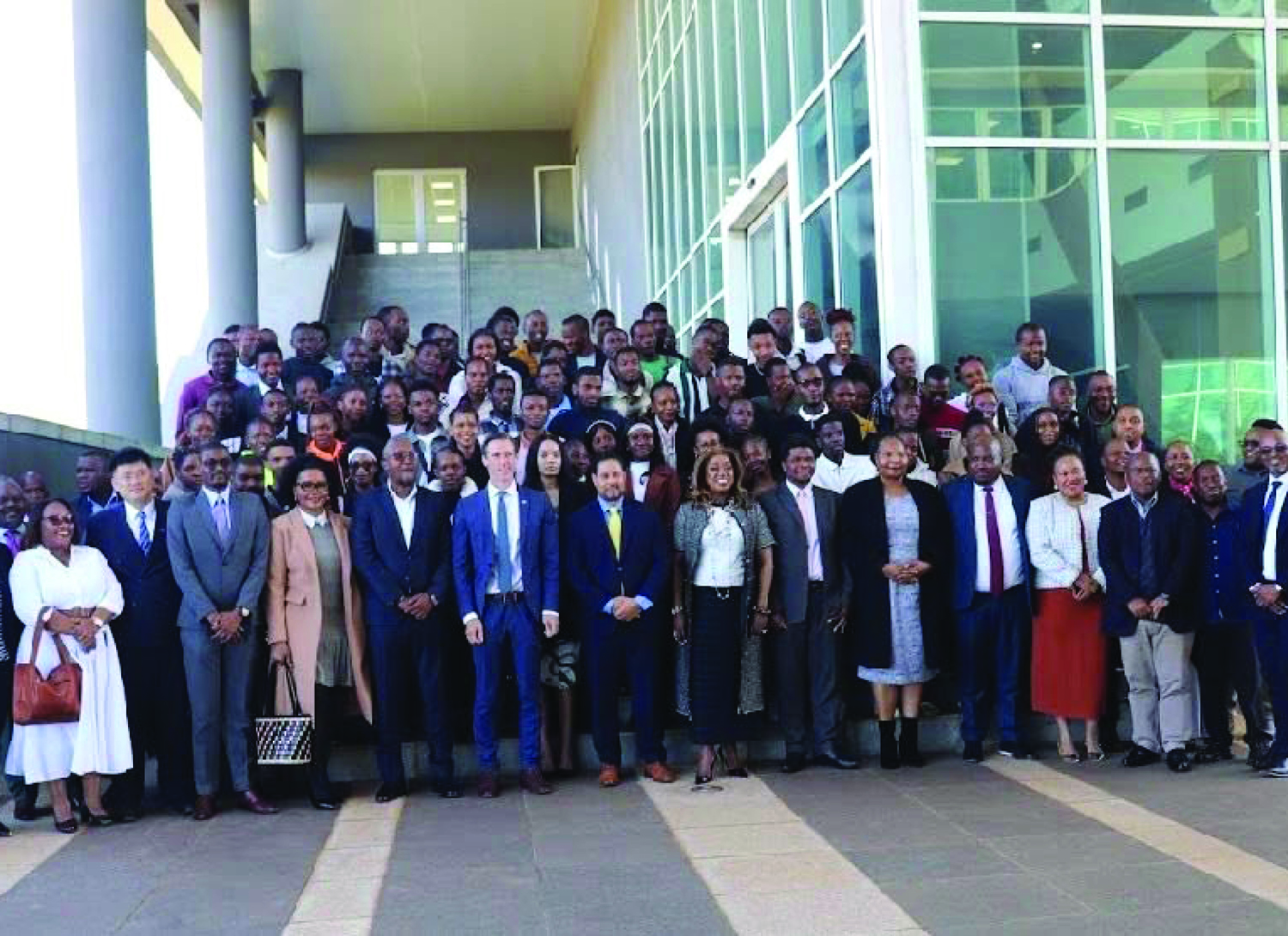
THE launch of the Start-up World Cup local edition should have been a momentous occasion. A moment to applaud progress, recognise ambition and welcome the idea that local start-ups now have a structured pathway into one of the most competitive innovation stages in the world. And in many ways, it was exactly that.
On the day government officials announced a new national selection process that will identify one start-up to represent the country at the global Start-up World Cup finale in Silicon Valley in November. The winning company will join a global field competing for a $1 million investment prize, in an event that brings together investors, founders and technology companies from across the world.
It is an important opportunity and it deserves recognition. But if we are honest with ourselves, the announcement also calls us into something deeper than the opportunity to participate in this global stage. It brings about a question that we often avoid in moments like this.
What exactly is our start-up ecosystem today and what do we want it to become? Because between the excitement of global access and the reality of local entrepreneurship, there is a gap that we cannot afford to ignore.
BETWEEN GLOBAL ACCESS AND LOCAL REALITY
Locally, as in much of the continent, entrepreneurship is not a new idea. It is already everywhere. It is just not always seen in the way global start-up language describes it. Most businesses here do not begin with investor decks, accelerator programmes or pitch competitions.
They begin with a deep necessity to survive or to escape unemployment. A young person who cannot find formal employment starts selling clothes through WhatsApp. A mother begins cooking meals for school children in her neighbourhood. A student offers design services from a phone, working late into the night to earn transport money.
A young man repairs electronics from a small space at home because renting a shop is out of reach. Such activities are not a side activity in the economy, they are the actual economy. Yet a majority of those involved in these activities still describe themselves as something smaller — a “side hustle.” And this is where the first problem begins.
WRONG LANGUAGE SHRINKS REALITY
Because the term itself, even when used casually, immediately reduces the seriousness of what is actually happening. It places real economic activity into a category that feels temporary, informal, almost optional. Something people do while waiting for a ‘real job’ to arrive.
The reality is that for most people involved in startup ventures there is nothing temporary about it. It is a mechanism for rent, for food and school fees.
It is survival carried month to month through small businesses that rarely appear in official statistics, but carry a large part of the country’s economic reality. Inside this survival economy, there is entrepreneurship in its earliest form. Not the polished version we see on global stages, but the raw beginning of it. Learning how to sell. How to negotiate. How to manage customers. How to understand value. How to turn small ideas into income.
The problem is not that this entrepreneurship exists. The problem is that it is not given a clear path to grow. And it is at this moment where Start-up World Cup launch becomes more than a competition announcement. It is an opportunity to sit down and genuinely reflect on whether we have genuinely invested into building a resilient and competitive start-up ecosystem in the country.
WHAT THE STARTUP WORLD CUP REALLY EXPOSES
In a few months when Eswatini steps into a global start-up competition, it will be stepping into a completely different definition of what a startup is expected to be.
In global innovation hubs such as Silicon Valley, start-ups are not measured by survival. They are measured by scale. The expectation is that an idea should grow beyond its immediate environment, attract investment, expand across markets and eventually become a company that competes internationally.
That expectation does not begin at the pitch stage during the national selection process or at the Start-up World Cup itself. It is built over years of endurance. In ecosystems that consistently produce globally competitive young founders — including the 22-year-old AI entrepreneurs now emerging in the United States — the journey starts early.
Their ecosystem is a mix of exposure to computers, coding and digital tools all forming part of learning, not something separate from it. Schools place strong emphasis on mathematics, science and problem-solving. Outside the classroom, young people are surrounded by hackathons, coding clubs, competitions, online communities and peers who are also building things.
By the time they reach university, many are already inside networks where entrepreneurship is not unusual. It is expected. There are mentors who have built companies before. There are investors actively looking for early-stage ideas. There are accelerators designed to refine and scale rough concepts. There is capital that understands and accommodates risk and accepts failure as part of the process.
So when a young founder succeeds, it rarely appears out of nowhere. It is the outcome of an environment that has been steadily preparing for it for years. This is where the comparison becomes uncomfortable, for the kingdom but still very necessary.
THE GAP THAT DEFINES ESWATINI
Local talent is not the issue. Ambition is not the issue. Work ethic is not the issue. The issue is the space between the idea and the system that is meant to support it.
That space is where most businesses stall. Not because they are weak, but because they are isolated. They remain small not because the idea is small, but because the support structures around them are limited or inconsistent.
Access to early-stage finance is difficult. Mentorship is often informal and fragmented. Business registration and compliance can feel complex for very small enterprises. Markets are limited.
And the transition from informal business to formal enterprise is often harder than it should be. The business ecosystem simply does not distinguish between a startup and a thriving business.
So many entrepreneurs remain in the “hustle” stage for years — not by choice, but by the limitations of structure. This is why the Start-up World Cup matters. But also why it is not enough on its own.
MORE THAN A COMPETITION
A competition can identify talent. It can give visibility. It can connect a few founders to global networks. It can open doors that were previously closed. But it cannot build the system that determines what happens after the door opens.
Because ecosystems are not defined by who can compete once. They are defined by who can grow consistently wherever they are. So the real question is not whether the kingdom can produce one start-up capable of reaching Silicon Valley.
The question is whether Eswatini can build an environment where producing start-ups at that level becomes normal, not exceptional, not an occasion.
EARLY SIGNS, BUT MORE WORK AHEAD
To be fair, there are early steps already visible. Youth enterprise initiatives exist in this country. Innovation programmes are emerging. Government and institutional support for entrepreneurship is growing, including efforts linked to ICT development and digital transformation.
The Start-up World Cup partnership itself connects the country to a global network of investors, mentors and platforms that span dozens of countries. But the deeper work is still ahead. It lies in turning entrepreneurship from a survival response into a structured pathway.
It lies in recognising that the “side hustle” is not outside the economy — it is the earliest stage of it. And it lies in building systems that allow that early stage to evolve naturally into formal, scalable businesses.
A DIFFERENT FUTURE IS POSSIBLE
Because if that shift happens, the entire conversation changes for the country. The street vendor becomes a supplier. The WhatsApp seller becomes a retail brand. The student freelancer becomes a digital agency. The phone repair table becomes a registered tech service company.
We need to transition from slogan through to systems that make growth possible. That is the real opportunity hidden inside this moment. Not just participation in a global competition, but reflection on what kind of economy we are actually building at home.
CONCLUSION
Because somewhere in Manzini, Mbabane, or in a room lit by a phone screen late at night, the next serious business idea is already taking shape. It is just not known, not supported nor aware of any pathway to take out of their small beginnings.
The only question that remains is whether there is an ecosystem ready to welcome it as it tries to grow.
Until next week,
God bless.