



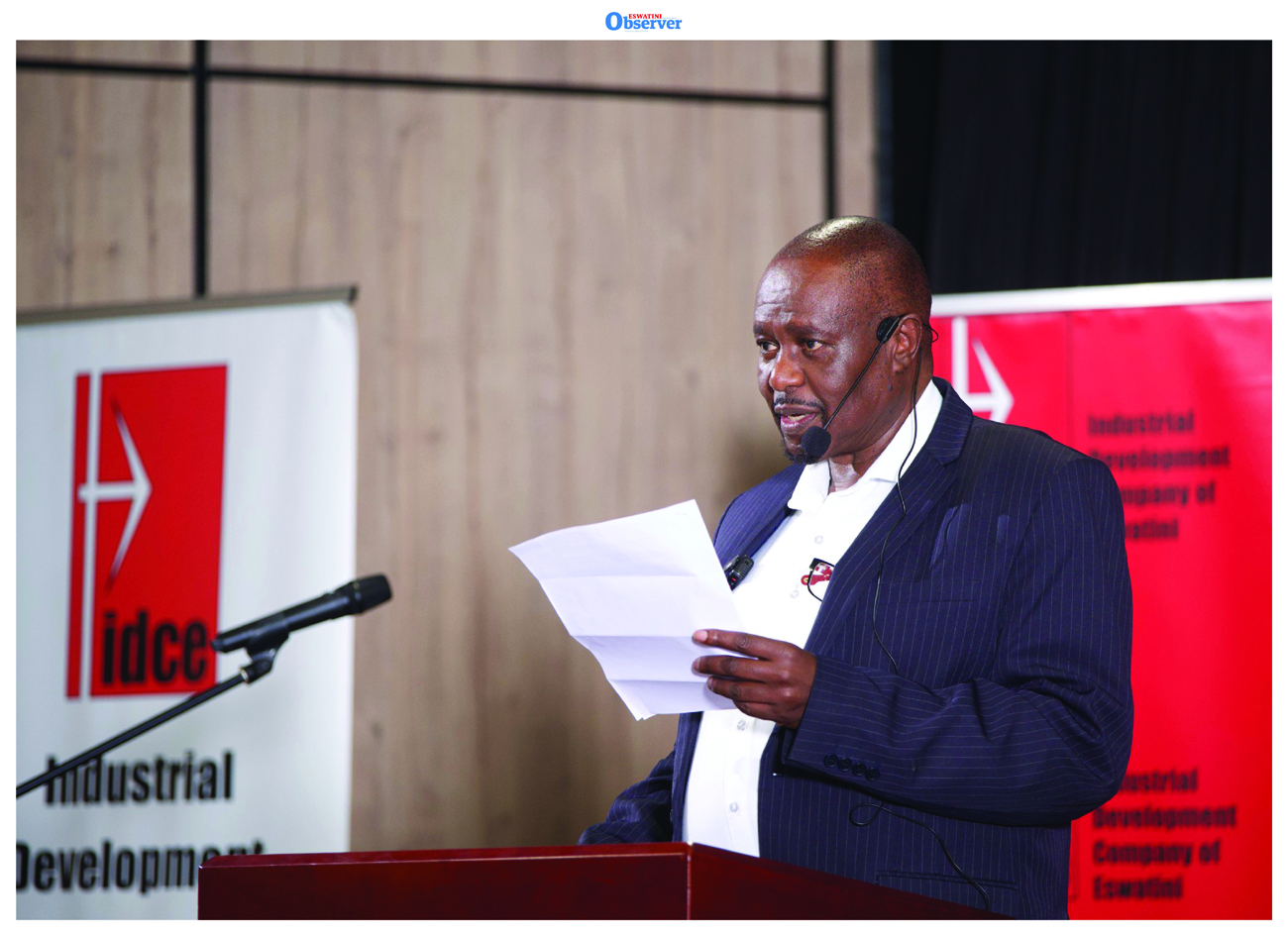
The Industrial Development Company of Eswatini (IDCE) declared a dividend payout of E14.5 million for the financial year ending June 30, 2025, last year.
This milestone payout followed a strong financial turnaround that saw the institution record a net profit of E103 million and grow its total group assets to E1.8 billion.
IDCE Chief Executive Officer Fairlie Mabuza noted that primarily they targeted businesses and agricultural enterprises seeking financial support and guidance.
Sharing on the organisation’s nuggets to success, he said turnaround time was very critical and the primary thing was to structure the product in such a way that it benefits the client.
He said when they do due diligence they pick projects that have a huge impact on society. He said they realised that if the whole community or society is impacted, they turn to buy-in and be involved which ensures sustainability.
He also advised clients against seeking a large amount of money they will not be able to manage and pay back when taking a loan.
IDCE granted the National Maize Corporation (NMC) a substantial E30 million loan, which they repaid in just six months. The parastatal had sourced the loan from the Industrial Development Company of Eswatini (IDCE) which the latter publicly acclaimed and praised for the impressive loan management.
Mabuza said with NMC, they had to be innovative in terms of strategising on collateral, to have them meet their need hence making a tailor-made offer for them.
“We avoided painting them with the same brush with everybody; understand the institution and convincing their board to say work with us as this is what we are doing,” said Mabuza.
READ MORE | ‘Women now account for 59% of country’s digital skills trainees’
Overall, Mabuza said IDCE’s success was influenced and informed by research. He said they conducted research about which sectors were underperforming and which ones delivered returns.
Growing up, he said general knowledge was that agriculture is a bad sector to grow and invest in, but later learnt that it is the safest in the country also given that fact that government supports it financially.
He said they also realised that if it is a community-based project it becomes successful because it drives employment. He emphasised the need for collaboration; he spoke against working in silos, but suggested bringing other players into the market.
“For example, in all our projects we bring in sugar association, Royal Eswatini Sugar Corporation (RES Corp) which helps to deliver the project. They also provide project management, all projects are driven by being on the ground, doing monitoring and evaluation with stakeholders and listen to what the community is saying,” added Mabuza.
Mabuza revealed that they were moving into the energy sector as an institution. He noted that they recently held a Solar Indaba because they saw the appetite and the direction of the country.
He said energy had an impact on farmers if they rely on the grid, stating how IDCE basically looks at the value chain that drives sugar and maize, the biggest factor is having a market maker.
If there is no market maker for Emaswati, he said then the project fails. He said market makers are the sugar association, National Maize Corporation and now considering Embiveni Meats.
“If there is an off-take of the product, it actually makes it easier for farmers to succeed. We are also engaging with poultry farmers, to supply them with chicks and the whole process will benefit Emaswati. If you create the market for Emaswati, they will succeed,” added Mabuza.