



WITH civil servants expecting their 85% salary review backpay next week, Parliament service staff will be smiling all the way to the bank as they continue to earn significantly more than their counterparts in the civil service.
Parliament service employees are among the highest-paid public workers in the country, with salaries and allowances placing them well above most civil servants.
In some cases, they earn about 70% more than employees in equivalent government positions.
A Parliament principal accountant will receive E29 629 more than a civil service counterpart through hardship and transport allowances. They will also receive E85 454 in salary review backpay, in addition to a basic salary of E42 328 under Grade E2.
A Parliament accountant will receive E23 274 in salary review backpay alongside other government accountants. However, they will also receive E14 408 in hardship and transport allowances, bringing their total earnings this month to E58 266, including a basic salary of E20 584 under Grade C5.
A Parliament clerk will receive E144 816 in salary review backpay alongside civil service clerks. In addition, Parliament clerks will receive E59 150 in hardship and transport allowances, bringing their total earnings this month to E288 466, including a basic salary of E84 500 under Grade F4.
A Parliament technician will receive E6 113 more than a civil service technician. Under Grade C3, the Parliament technician will receive E21 610 in salary review backpay alongside civil service technicians, in addition to a basic salary of E11 046.
Both Parliament service employees and civil servants are being covered by the national salary review.
While civil servants have welcomed the long-awaited salary review, many have argued that it has widened the gap between different categories of public workers instead of creating fairness.
According to the Parliament Establishment Circular, Parliament service staff earn significantly more than their counterparts in the wider civil service due to additional allowances and different salary structures.
Although Parliament employees fall under the national civil service salary review, their salaries are not negotiated through the Joint Negotiation Forum (JNF). Instead, their salary adjustments and internal structures are handled through coordinated engagements by the Parliament Service Board through the office of the clerk and Ministry of Public Service.
The latest Parliament Establishment Circular shows that Parliament employees receive a special allowance equivalent to 40% of their salaries. The allowance is meant to compensate staff members for the long working hours they often put in, particularly when Parliament is in session.
Senior Parliament staff also receive a transport allowance amounting to 30% of their salaries. The benefits have drawn attention at a time when many civil servants continue to express dissatisfaction with the implementation of the salary review, saying it has created disparities across the public service.
Following months of engagements between government and public sector unions (PSUs), government eventually confirmed the implementation of a salary increment for civil servants. The agreement followed prolonged negotiations after unions submitted a petition in July 2025 demanding a salary review to address the rising cost of living and inflation.
Government agreed to implement 100% of the basic salary scales recommended by the salary review consultants, Emergence Human Capital.
The agreement also included payment of 15% backpay and placement of employees on Notch One. The remaining 85% of the backpay, together with all consequential allowances, is expected to be paid this month.
Civil servants received their salary adjustments under Establishment Circular No. 2 of 2025, which formalised the adoption of the Paterson System of Job Evaluation.
The new salary structure took effect on April 1, 2025. Following the initial implementation, government received revenue from the Southern African Customs Union (SACU), allowing it to begin processing the remaining 85% of the outstanding salary review arrears.
The first 15% of the backpay and revised grading structures had already been paid shortly after the collective agreement was signed in October 2025.
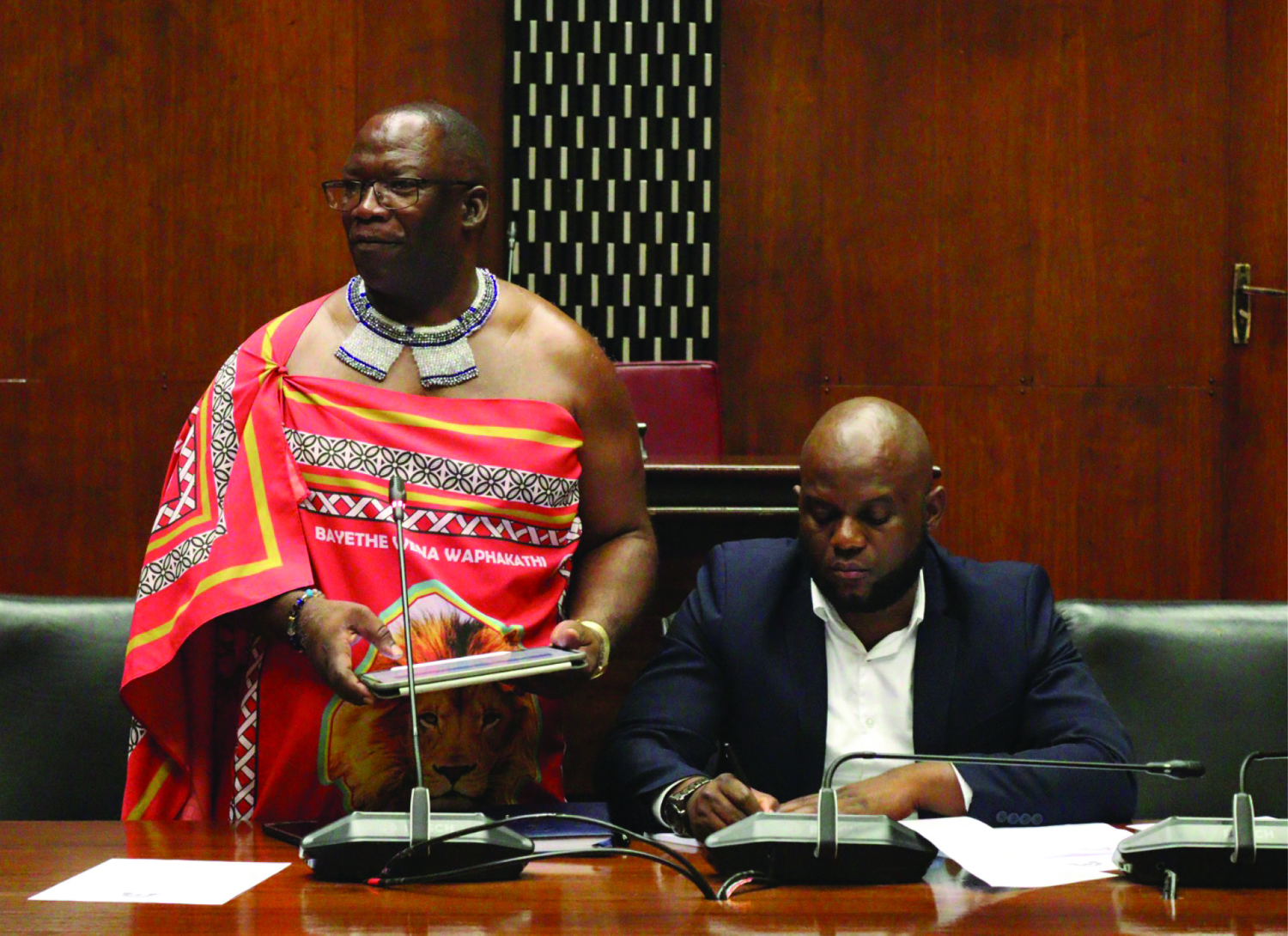
Commenting on the benefits enjoyed by Parliament service staff, Clerk to Parliament Benedict Xaba said the institution continued to face serious staffing shortages.
“Additional allowances are necessary for the staff because of the specialised nature of the Parliament work which Parliament successfully negotiated due to the long hours required during parliamentary sittings. The vision for the future is to separate the professional staff in such a way that each chamber has its own staff such as committee clerks, clerks at the table, researchers and others,” he said.
Xaba said since joining Parliament, he had prioritised investing in capacity building for Parliament staff. He said Parliament had made significant progress in improving the qualifications of its workforce.
“There were very few people with degrees and Master’s degrees. Now the number is encouraging because most of the Parliament staff responded positively to the call of going back to school to advance their education. Well-educated Parliament service staff will be able to advise and provide proper research to MPs before questions and motions are presented in the House,” he said.
Xaba added that there was a growing number of employees who had completed degree and Master’s programmes, while others were still studying to improve their qualifications.
“However, in any organisation there are a few who did not want to advance their education, but only asked for promotion due to different reasons such as age,” he said.
In general, he said he was happy with the capacity development initiative within the Parliament service.
Despite the improvements in staff qualifications, Xaba said Parliament remained critically understaffed, particularly in professional support positions that are essential for strengthening the work of Members of Parliament.
“Understaffing is a serious challenge as we do not even have researchers to assist MPs with evidence-based debates. Currently, no one assists MPs to analyse reports from ministries. In other Parliaments, each MP is assigned a minimum of three researchers. However, I have no power to create new positions in Parliament because that is done by the Ministry of Public Service,” he said.
The differences in salaries and allowances between Parliament employees and the wider civil service are expected to remain a topic of debate as public servants continue to push for greater equity across government institutions.