



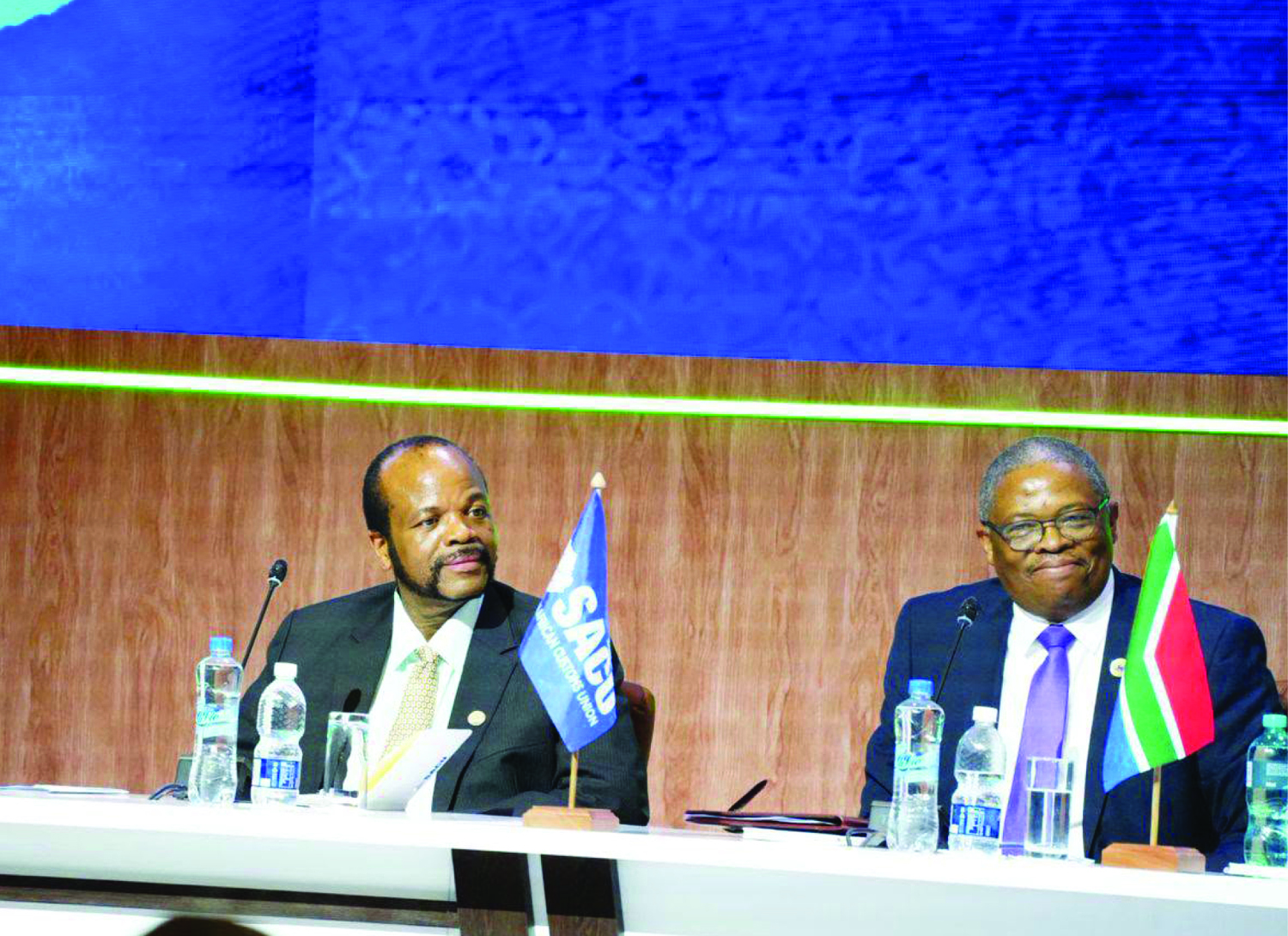
HIS Majesty King Mswati III used his address at the 9th Southern African Customs Union (SACU) Summit to challenge the organisation’s ideology and mandate.
He called for reforms that reflect the realities of an increasingly complex regional and global economic environment. The King urged SACU to embrace a new paradigm if it is to remain relevant and competitive in a rapidly changing global economy.
SARFED Senior Policy Advisor Dr George Choongwa said the message also carried important implications for the country, that government and development partners should fundamentally review and align the country’s trade and development strategies with current and emerging regional and global realities.
He said His Majesty’s strategic vision for SACU was strengthening regional competitiveness in a changing global economy. His Majesty emphasised that citizens judge regional integration by tangible outcomes rather than policy aspirations.
“Our citizens will ultimately measure the success of SACU not by the number of strategies we adopt, but by the industries established, investments mobilised, markets opened, borders modernised and jobs created,” the King remarked.
Dr Choongwa said this statement reflected the urgent need for SACU member states to address common socio-economic challenges, including high unemployment, persistent poverty and growing market uncertainty.
He said a central theme of the King’s address was the importance of policy coherence in advancing regional competitiveness. He argued that coordinated engagement with international trading partners strengthens SACU’s collective bargaining position, whereas fragmented negotiations by individual member states risk weakening the integrity of the Common External Tariff.
“Beyond sound policy, implementation remains one of the region’s greatest challenges. His Majesty observed that SACU has fallen short of fully implementing the objectives of its Strategic Plan (2022–2027), thereby supporting its extension to the 2028/2029 financial year.
However, extending the Strategic Plan should not merely prolong existing programmes; it should provide an opportunity to strengthen implementation mechanisms and ensure that the revised strategy delivers measurable benefits for both SACU and its member states,” said Dr Choongwa.
He noted that the King’s address also underscored the importance of ethics and good governance as drivers of regional competitiveness and resilience.
He highlighted progress made under SACU’s Trade Facilitation and Logistics Programme, particularly the expansion of the regional Authorised Economic Operator Programme (AEOP) and successful joint customs enforcement operations aimed at combating illicit trade through harmonised ethical standards.
Dr Choongwa said these initiatives supported fair and transparent trade practices that are consistent with the principles of the World Trade Organization under the General Agreement on Tariffs and Trade.
Although SACU’s trade performance between 2023 and 2026 reportedly maintained positive growth, Choongwa said they contributed approximately four per cent to regional gross domestic product (GDP).
He added that strategic reforms should therefore focus on improving competitiveness, diversifying production, strengthening regional value chains and expanding export markets.
For Eswatini, he said the King’s call to action presented several important policy implications. He said reforming SACU’s institutional structures through the extension of the Strategic Plan should position the country to maximise the benefits of regional integration and enhance its competitiveness within the customs union.
Dr Choongwa said the country should strengthen its export competitiveness to increase its share of SACU revenue receipts.
He also said the country should continue to develop a more diversified and resilient domestic economy that is less dependent on SACU revenue transfers. Building stronger productive sectors, promoting industrialisation, supporting value addition and expanding private-sector investment will reduce fiscal vulnerability while creating sustainable employment opportunities.
“Ultimately, His Majesty’s address at the 9th SACU Summit serves as a strategic call for policy reform, stronger implementation and greater regional cooperation. Aligning national development priorities with SACU’s evolving strategic direction will not only improve service delivery, but also strengthen the country’s long-term economic resilience and competitiveness within Southern Africa and the global economy,” added Dr Choongwa.