The Financial Services Regulatory Authority (FSRA) has maintained that Status Capital Building Society (SCBS) was a pyramid scheme that took money from investors, as the regulator opposed efforts to place the entity under judicial management instead of liquidation.
The allegation was made by FSRA’s lawyer Mangaliso Magagula during arguments before High Court Judge Mumcy Dlamini yesterday in an application concerning the proposed liquidation of SCBS.
Magagula told the court that investigations conducted by FSRA revealed that SCBS operated as a pyramid scheme and that the money received from members was not necessarily in the form of shareholding, but was invested through various financial products offered by the building society.
“After all, this was a pyramid scheme,” Magagula submitted.
He was responding to questions about whether people who put money into SCBS were shareholders or investors. Magagula explained that the regulator’s investigations had established that the money paid into the building society was linked to investment products rather than conventional shareholding.
Judge Dlamini questioned whether investors who were shareholders would not have been aware of the internal affairs of SCBS.
In response, Magagula said Nhlangano Town Board’s E10 million contribution, for example, was an investment and not a shareholding. He said the same applied to other members who had invested money in SCBS.
Magagula further submitted that the fixed-term products offered by SCBS had maturity periods, making the investors creditors of the building society.
Nhlangano Town Board invested E10 million in SCBS in October 2022, with the investment expected to mature on October 27, 2026, according to the town board’s lawyer Mxolisi Dlamini.
He, however, argued that FSRA had failed to comply with the Companies Act when bringing the liquidation application before court.
The judge questioned the position of the regulator, given the serious allegations against SCBS.
“The said company is said to be a pyramid scheme and FSRA says it has made its investigations. What is the balance now?” Judge Dlamini asked.
The court also heard that about E80 million had been recovered from approximately E200 million invested in SCBS.
Dlamini told the court that Nhlangano Town Board had raised concerns with FSRA, arguing that the regulator should have warned members of the public against investing in SCBS if it knew that the entity was allegedly operating as a pyramid scheme.
“Why did the regulator let Status Capital operate for a long time because they knew it was a Ponzi and that they did not comply with the conditions of the regulator but continued renewing their licence?” Dlamini asked.
He further submitted that SCBS should instead be placed under judicial management, arguing that this could allow the company to recover more money for investors.
Dlamini told the court that about E151 million could potentially be recovered if the company was placed under judicial management.
He asked the court to give the company six months to recover the money, arguing that FSRA would suffer no prejudice as it would remain the regulator.
“Can the court consider that companies in Eswatini do not survive liquidation?” Dlamini asked.
Magagula, however, opposed the argument, drawing a distinction between SCBS and the Eswatini Development Finance Corporation (SDF).
He submitted that SDF was a lender operating under a limited licence that allowed it to collect money lent to clients, but said this did not authorise it to take investments from the public in the same manner.
“There is no way the SDF could collect money close to E200 million because some of the money is in South Africa. They have never operated a business from the start. It has been more liabilities than assets,” Magagula submitted.
Meanwhile, Banele Ngcamphalala, who represents SCBS investors, argued that the matter was one of significant public interest, particularly because the alleged transgressions had been allowed to continue for about four years.
Ngcamphalala submitted that the investors should not be blamed for the circumstances surrounding the collapse of SCBS, arguing that their investments could have been protected had the alleged irregularities been stopped when they were first discovered.
He also questioned the evidence supporting the liquidation application, saying there was no report from the second curator or a confirmatory affidavit.
“There was no report from the second curator or confirmatory affidavit instead of Status Capital being liquidated.
“We cannot say the CEO knows everything,” Ngcamphalala submitted.
The arguments were centred on whether SCBS should be liquidated or placed under judicial management, with the parties differing on the best approach to recover money owed to investors and creditors.
SAFACATISWA LA – INVESTORS
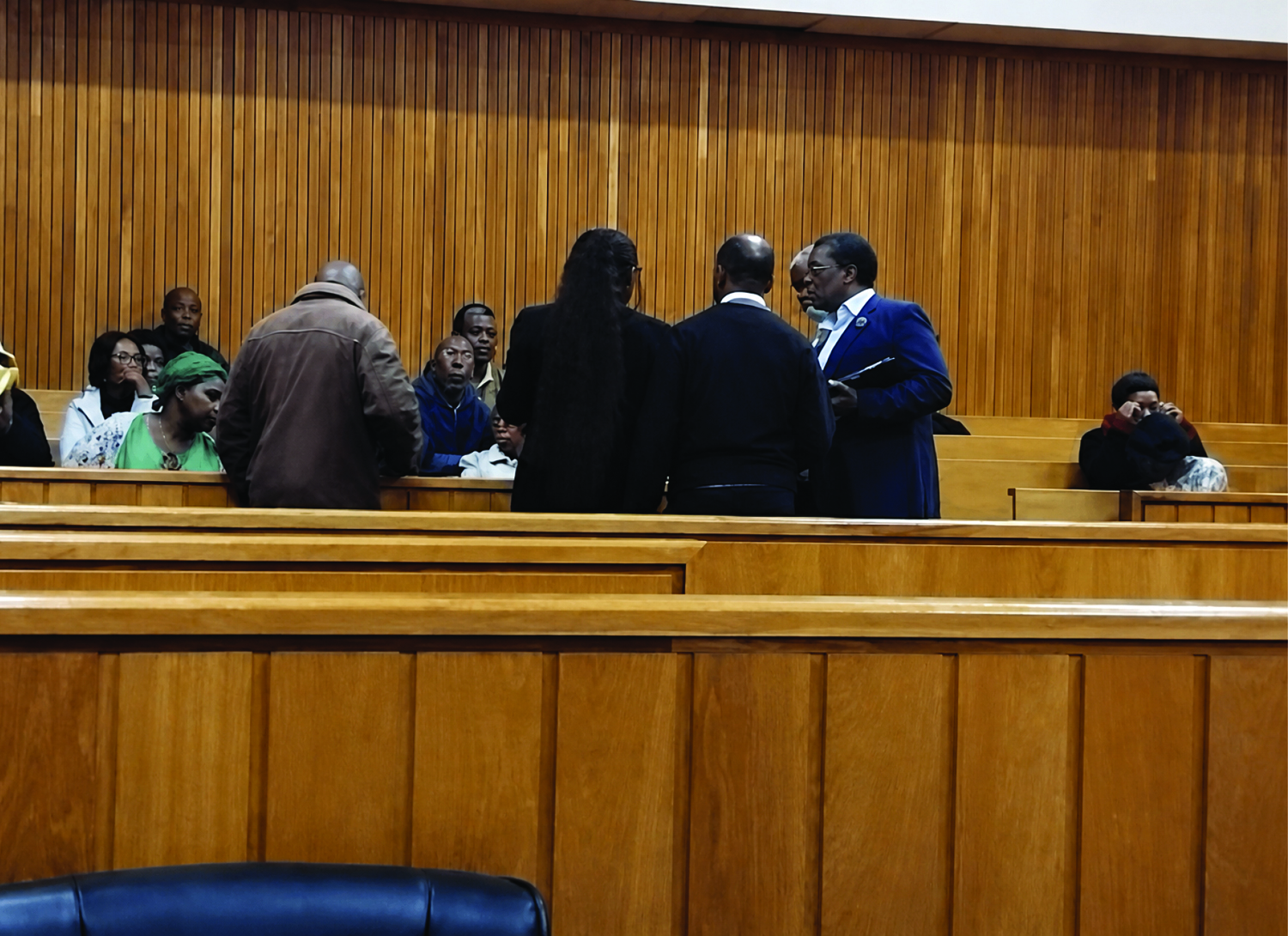
The High Court was packed with investors yesterday as anxious members of the public gathered to witness the legal battle surrounding the possible liquidation of Status Capital Building Society (SCBS).
The usually formal courtroom was filled with people who appeared eager to hear every argument as lawyers battled over the fate of the financial institution and, more importantly, the money entrusted to it.
At one point, a voice could be heard from among those gathered saying, “Safacatiswa”, a vernacular expression conveying the sentiment that people were scammed.
Among those seated with the investors was SCBS Managing Director Michael Mbetse, who was seen quietly following the proceedings from inside the courtroom.
His presence appeared to draw some attention as investors listened to the legal arguments surrounding the future of the building society and the money owed to those who had invested in it.
For many of those seated in the courtroom, the proceedings were more than just another court case. They were watching a matter that could determine the fate of their investments and possibly answer questions that have been troubling them for months.
Investors sat quietly as the arguments unfolded, with some attentively following the submissions while others exchanged whispers during breaks in the proceedings.
The courtroom atmosphere became particularly tense when the FSRA maintained that SCBS was a pyramid scheme that had taken money from investors.
The allegations and submissions made during the proceedings are yet to be determined by the court.