


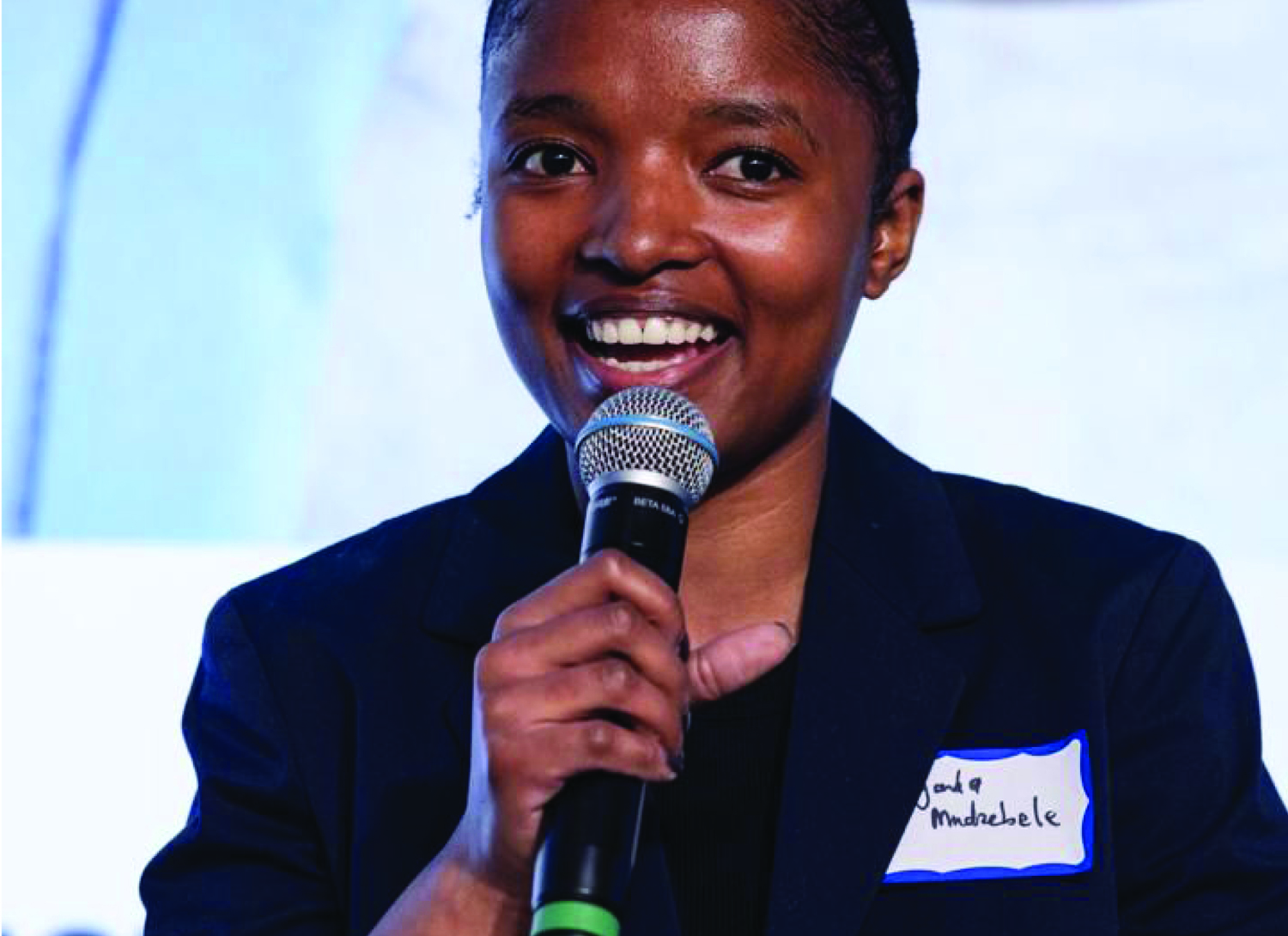
From growing vegetables in a backyard garden in Hlane to representing the kingdom at the United Nations General Assembly in New York, Luyanda Mndzebele’s interest in finding practical solutions to social and environmental problems has taken another international turn.
The young Liswati has joined the newest cohort of beVisioneers: The Mercedes-Benz Fellowship, a global programme supporting young environmental innovators to develop ideas into projects capable of producing measurable impact in their communities.
Behind the programme is one of the world’s best-known automotive companies. Mercedes-Benz Group AG, headquartered in Stuttgart, Germany, the company behind the Mercedes-Benz marque and operates a global business spanning premium passenger vehicles, vans and financial services. Its involvement gives the relatively young fellowship the backing of an established multinational company with one of the most recognisable names in the automotive industry.
Mercedes-Benz has supported beVisioneers since its launch in 2023 through donations to the non-profit organisation that runs it, The DO School Fellowships gGmbH. The programme was seeded by proceeds from the extraordinary €135 million (E2.51 billion) sale of a rare 1955 Mercedes-Benz 300 SLR Uhlenhaut Coupé in 2022, at the time the most expensive car ever sold.
The fellowship provides participants with structured training, mentoring, venture coaching and access to financial support to turn environmental ideas into working projects.
For Mndzebele, it also creates the possibility of securing substantial financial support to develop her own environmental project. Fellows who progress through the programme can compete for project scholarships of up to €20 000, approximately E371 000 at current exchange rates, to support the implementation and development of their projects. The funding is not automatically awarded to every fellow. Rather, it represents a further competitive opportunity within a programme designed to move young innovators from ideas towards implementation.
It is an opportunity that comes as Mndzebele is working at the intersection of economics, environmental sustainability and social entrepreneurship.
Currently studying economics in the United Kingdom, she has described her interests as spanning climate advocacy, education and economics, connected by one central question: who has access to opportunity, who does not and why.
Her latest environmental work includes E-Swati Textile Trace, which she described as a platform intended to connect informal second-hand clothing traders in the country with industrial recyclers as part of efforts to address textile waste. She has also been developing RefuPath, an initiative focused on expanding access to education for refugees.
The fellowship provides a platform through which ideas of this nature can be tested, developed and potentially scaled. Mercedes-Benz says beVisioneers supports environmental projects across areas including clean energy and energy access, alternative materials, waste and circularity, sustainable transport and mobility. For Mndzebele, however, the road to the programme began on a considerably smaller scale. She traces her environmental interests to growing vegetables in a small backyard garden in the kingdom.
“It was nothing fancy, just organic, small-scale, hands-on. That’s genuinely where this all started,” she wrote recently while reflecting on her journey.
That childhood interest eventually developed into an attempt to create a plant booster and promote climate-smart agriculture in her community. The work contributed to her becoming a Rise Fellow in 2021 and coincided with her involvement in climate and environmental initiatives, including work supporting rural communities.
Her academic interests have since expanded into economics. After completing the International Baccalaureate at Waterford KaMhlaba United World College of Southern Africa and spending a gap year in New York, Mndzebele moved to the United Kingdom to study economics. Her studies currently include Microeconomic Theory, Macroeconomic Theory and Mathematics for Economists, which she has been balancing with entrepreneurship and innovation programmes.
The economics training appears increasingly connected to the type of problems she wants to address. During an internship with the Vinson Centre for the Public Understanding of Economics and Entrepreneurship, she focused on financial inclusion in Kenya. She has also participated in programmes connected to entrepreneurship, climate and education.
Her growing international profile was on display last year when, aged 21, she travelled to New York for the 80th United Nations General Assembly High-Level Week. Mndzebele participated as one of the Global Partnership for Education youth leaders, taking part in discussions involving education, climate change, employment, artificial intelligence and sustainable development.
During the week, she joined youth leaders in engagements with United Nations Deputy Secretary-General Amina Mohammed and Assistant Secretary-General for Youth Affairs Dr Felipe Paullier. She also participated in a BBC News Africa Town Hall at the UN headquarters examining Africa’s readiness for artificial intelligence, where discussions considered challenges ranging from connectivity and infrastructure to the continent’s ability to take advantage of emerging technologies.
At the centre of her contributions was an argument she has carried through much of her work: education and access to opportunity should translate into practical solutions to problems facing communities.
Her selection for beVisioneers now provides another avenue through which that philosophy can be tested beyond conference rooms and classrooms.
Mercedes-Benz says fellows are supported by mentors from around the world, while the programme is designed to help participants develop and eventually scale concrete sustainability projects.
Mndzebele has described her own journey as anything but linear. “Looking back, it’s less of a straight line and more a bunch of overlapping interests: climate, education, economics, all circling the same thing. Access. Who gets it, who doesn’t and why,” she wrote.
She now wants to take those interests further into public policy, sustainability and energy.