



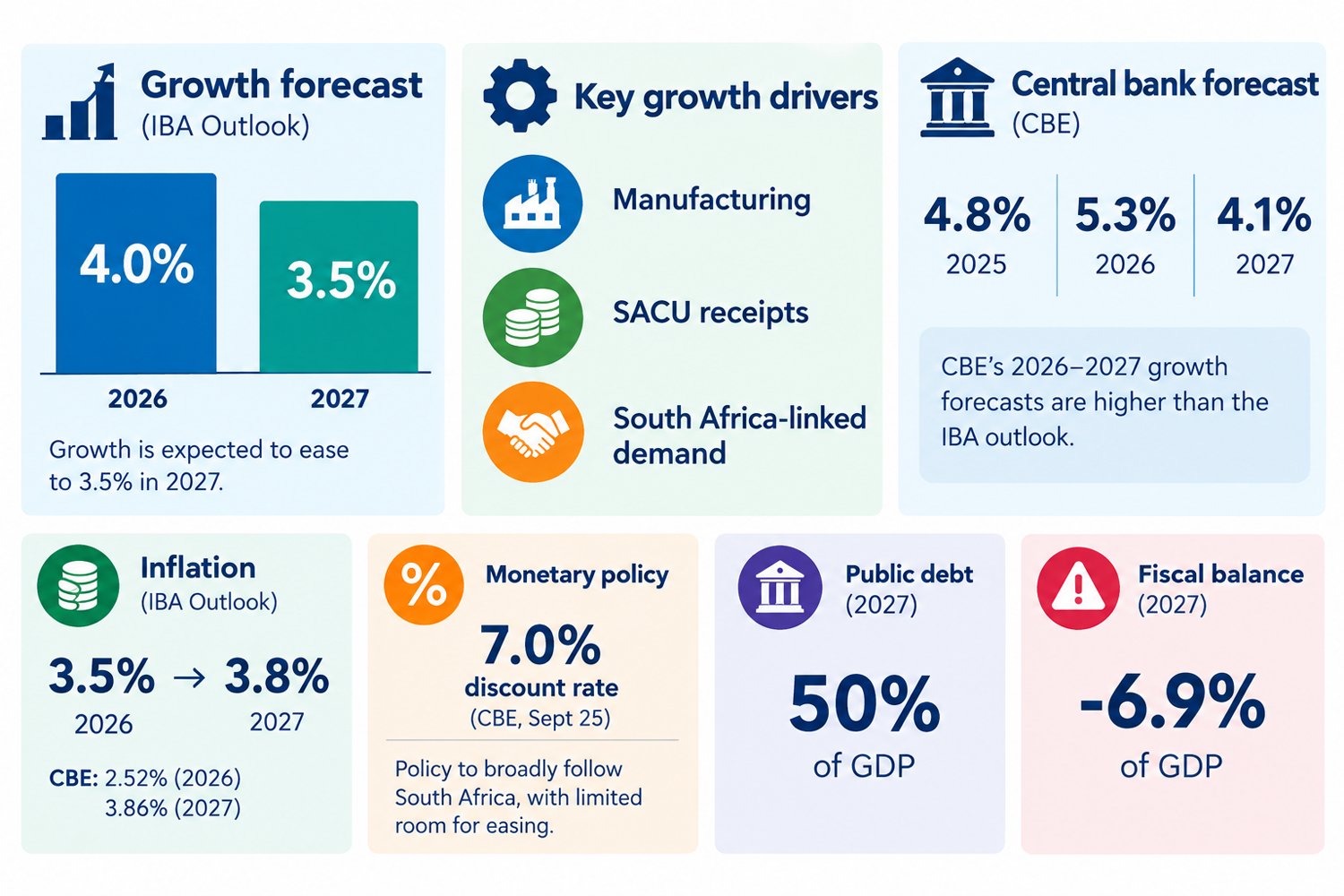
The country’s economic growth is projected to slow to 3.5% in 2027, according to the IBA Africa 2027 Outlook, below the central bank’s latest forecast.
The outlook projects growth of 4.0% this year before moderating next year, with manufacturing, Southern African Customs Union (SACU) receipts and demand linked to South Africa identified as the economy’s main growth engines.
“Engine: manufacturing, SACU receipts and South Africa-linked demand,” the report says, describing Eswatini as a small-market economy of about 1.2 million people.
It identifies jobs, housing, skills and service delivery as important social-economic transmission channels — the areas through which economic conditions are expected to affect households and businesses.
The forecast is more conservative than the latest Central Bank of Eswatini (CBE) projection.
In its September 25 monetary policy statement, the CBE said the economy grew by 4.8% in 2025 and is projected to expand by 5.3% in 2026 before moderating to 4.1% in 2027.
The Central Bank said first-quarter 2026 growth reached 6.1%, year-on-year, on a seasonally adjusted basis, up from a revised 5.8% in the fourth quarter of 2025.
It attributed the stronger momentum mainly to a rebound in the secondary sector, which includes manufacturing, construction and electricity, although the primary and tertiary sectors also recorded positive, but mixed performances.
The difference between the two forecasts places the IBA outlook’s 2027 growth projection 0.6 percentage points below the CBE’s latest baseline.
Both, however, anticipate a moderation from stronger activity in the near term.
The outlook also points to the continued importance of regional revenue and trade flows.
Government’s 2026/27 budget projects SACU receipts of E11.7 billion, up from E10.4 billion, while stating that stronger export performance and domestic production will remain important to external sustainability.
That dependence sits alongside a broader government push to diversify the economy.
In his February address to Parliament, His Majesty King Mswati III acknowledged the contribution of SACU revenue but called for the economy to be restructured and diversified.
He challenged the country to deliberately grow at least 10 companies with annual turnovers exceeding E10 billion across different sectors.
His Majesty also highlighted major projects as potential growth and investment drivers, including a proposed E6 billion industrial park, while calling for industries capable of creating meaningful employment.
Government’s 2026/27 budget similarly puts job creation at the centre of economic policy.
Minister of Finance Neal Rijkenberg said the objective was for GDP growth to exceed population growth, raising GDP per capita and creating better jobs and incomes.
IBA SEES MODERATE RISE IN INFLATION
The Investment Bank of Africa (IBA) outlook sees inflation rising moderately, from 3.5% in 2026 to 3.8% in 2027.
The Central Bank of Eswatini (CBE), however, has a slightly different inflation path, revising its 2026 forecast down to 2.52% and its 2027 forecast to 3.86%.
Inflation stood at 2.8% last month.
Despite lower inflation expectations, the CBE raised its discount rate by 25 basis points, or 0.25 percentage points, to 7.0% on September 25, following a similar increase by the South African Reserve Bank to 7.25%.
The CBE said local monetary conditions remain closely linked to regional developments.
The IBA outlook likewise says the kingdom’s monetary policy should broadly follow South Africa, with limited room for easing if inflation and foreign-exchange conditions remain contained.
Beyond growth and inflation, the outlook projects public debt at 50% of GDP in 2027, a fiscal balance of -6.9% of GDP and a current-account deficit of 1.8% of GDP.
A fiscal balance of -6.9% means government spending is projected to exceed its revenue by that amount relative to the size of the economy, while a current-account deficit indicates that more money is flowing out of the country through trade and other external transactions than is coming in.
The report also identifies drought, heat and water variability among the country’s risks, while highlighting reliable power, affordable broadband, digital payments, digital identity and data, as well as competition as areas of importance to development.
The CBE, meanwhile, reported that private-sector credit rose 11.4% year-on-year in July to E23.8 billion, with business credit reaching E12.9 billion.
Foreign-exchange reserves stood at E11.4 billion on September 18, equivalent to 2.6 months of import cover.
Foreign-exchange reserves are the country’s holdings of foreign currencies and other external assets, while import cover indicates how many months of imports those reserves could finance.
Taken together, the IBA outlook presents an Eswatini economy that is expected to continue expanding in 2027, but at a slower pace, with manufacturing, SACU revenues and South African demand remaining central to the growth outlook while government seeks to broaden the country’s economic base.
FISCAL DEFICIT TO WIDEN
The country’s fiscal deficit is projected to widen to 6.9% of GDP next year, according to the IBA Africa 2027 Outlook, highlighting continued pressure on public finances.
The outlook also places public debt at 50% of GDP next year and forecasts a current-account deficit of 1.8% of GDP.
The projection comes against a government budget that targets a smaller deficit of 4.9% of GDP, equivalent to E5.02 billion, for the 2026/27 financial year.
Minister of Finance Neal Rijkenberg said the budget was built around economic growth and job creation, while government continues efforts to manage expenditure.
One area under pressure is the public-sector wage bill.
Government budgeted E12.44 billion for public servants in 2026/27, up from E10.48 billion in the previous financial year, partly reflecting implementation of the salary review.
Therefore, it has set a medium-term target of reducing the wage bill’s share of total expenditure to below 30%.
The IBA outlook also identifies regulatory predictability as relevant to sovereign and project risk and highlights public-private partnerships and state-owned enterprises among Eswatini’s institutional considerations.
Sovereign risk refers to the risk associated with lending to or investing in a country, while public-private partnerships are arrangements in which government and private companies work together to finance or deliver public projects.
Meanwhile, the CBE reported preliminary public debt of E43.1 billion, equivalent to 41.4% of GDP, at the end of August 2026.
The differing debt and deficit figures reflect different forecast periods and baselines, but both government and the IBA outlook point to fiscal management as an important feature of Eswatini’s economic outlook.