



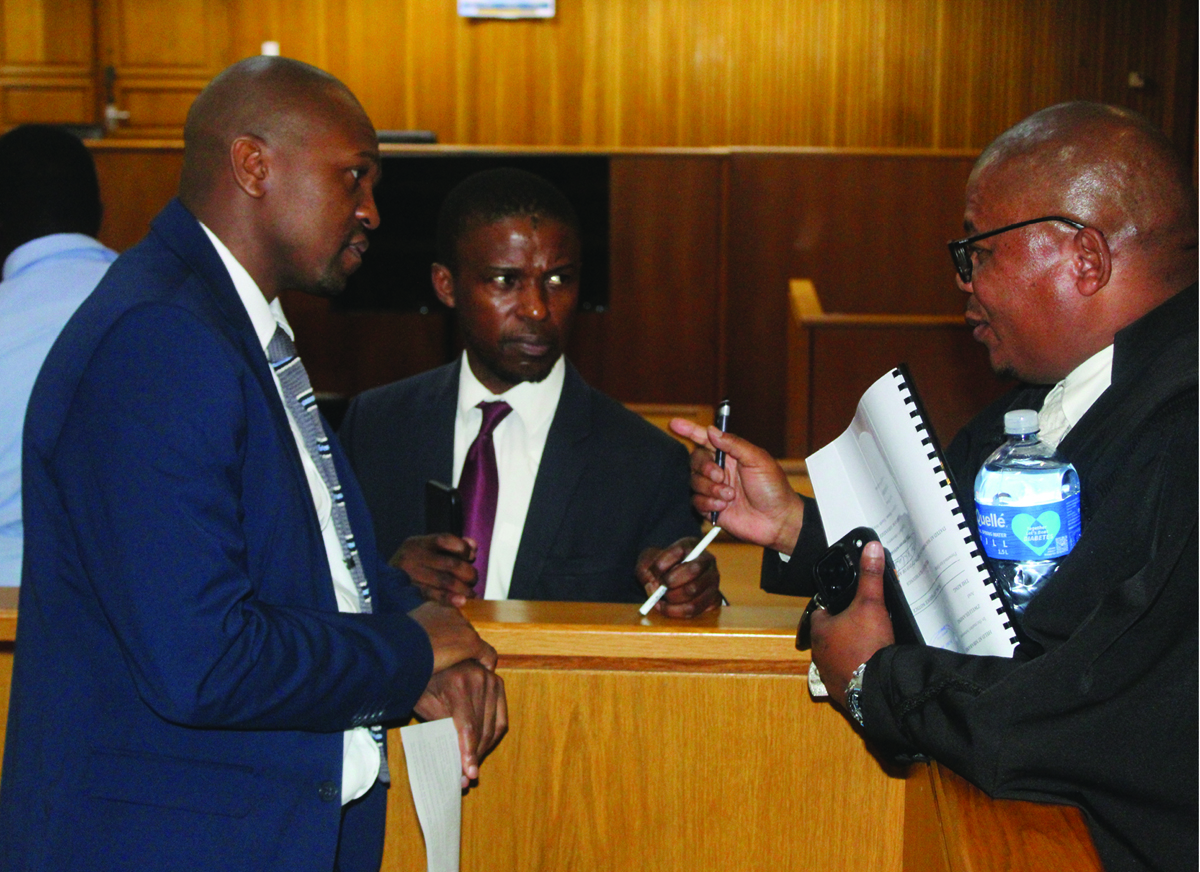
THE Supreme Court has rejected Mbabane businessman Zweli Dlamini’s bid for freedom.
It ruled that allegations involving a live fragmentation grenade, ammunition and the risk of him fleeing to South Africa justified keeping him behind bars pending trial.
The court found that Dlamini’s dual citizenship, homes and business interests in both Eswatini and South Africa combined with the seriousness of the charges he faces provided sufficient grounds for refusing bail. The Supreme Court dismissed Dlamini’s appeal against the High Court’s decision, finding no misdirection that would justify overturning the refusal of bail.
“The particular facts and circumstances of the case justified the refusal of bail and such was in the interests of justice,” reads the judgment authored by Justice Margriet van der Walt, who was sitting with the late Chief Justices Bheki Maphalala and Justice Jacobus Annandale. Dlamini faces charges of contravening the Arms and Ammunition Act of 1964, the Explosives Act of 1961 and the Suppression of Terrorism Act of 2008.
The allegations are linked to a suspected plot to disrupt the Incwala Ceremony. His trial has been scheduled for November 2, 4 and 5.
A major factor considered by the court was the allegation that police recovered a military-green M26 high-explosive grenade, a 9mm Glock semi-automatic pistol and various rounds of ammunition at Dlamini’s residence in Eswatini.
The ammunition allegedly included 15 rounds for the Glock, additional 9mm rounds, 20 rounds of 5.56-calibre ammunition loaded into a magazine, 26 rounds of .38-calibre ammunition and 15 rounds of 9x17mm ammunition.
Dlamini allegedly told the police that he believed the grenade was a dummy and that his interest in it arose from his involvement in the security and self-protection business. He also claimed that he held a South African firearm licence for the Glock.
He disputed the allegations and claims that he was tortured and the pointing out of the items was not done freely and voluntarily.
The Crown, however, disputed his account, stating that a preliminary forensic assessment indicated that the grenade was a live, high-explosive fragmentation device.
The court noted that the admissibility of the disputed pointing out would be determined during the main trial. It nevertheless found that Dlamini had failed to provide a persuasive explanation for the alleged possession of the firearm, ammunition and grenade in the country.
‘RED FLAG’ OVER DUAL CITIZENSHIP
THE High Court had identified Dlamini’s dual citizenship as a key concern when refusing bail, particularly because he has residences and business interests in both countries.
“The red flag in this bail application before court is applicant’s own claim to dual citizenship,” the High Court stated.
It further said Dlamini could cross into South Africa if he decided not to attend trial. “If he decides not to attend trial due to the seriousness of the charges he faces, he could simply cross over to South Africa; his other home. He can do this within a short period of time and if need be he could utilise an informal crossing,” the High Court ruled.
On appeal, Dlamini’s lawyer Sibusiso Nhlabatsi argued that dual citizenship alone did not prove that his client was a flight risk. He submitted that Dlamini had co-operated with the police during his arrest and questioning and had undertaken under oath to comply with any bail conditions imposed by the court.
The proposed conditions included a substantial bail amount, regular reporting to a police station and the surrender of his local travel document and South African identity documents. The lawyer also pointed to the extradition treaty between the country and South Africa as a safeguard against absconding.
However, the Crown argued that the seriousness of the charges and the potential punishment upon conviction increased the likelihood that the appellant might abandon his local interests to evade trial. The Supreme Court agreed that the circumstances had to be considered collectively, including Dlamini’s connections across the border, the nature of the allegations and the enforceability of proposed bail conditions.
Meanwhile, Dlamini had argued that his continued detention posed a serious risk to his health, alleging that he suffered from multiple medical conditions requiring specialist treatment, advanced diagnostic procedures and potentially surgery. The Supreme Court found that his medical claims were not supported by documentary evidence.
“There are no medical certificates or reports or any independent affidavit,” the judgment states. The court also noted that Dlamini had not provided medical documentation with his replying affidavit, despite having an opportunity to do so. In dismissing the appeal, the Supreme Court reaffirmed that an appellate court should not interfere with a lower court’s discretionary decision on bail unless a misdirection has been demonstrated.
The court made no order to expedite the trial, noting that the matter was already scheduled to be heard on November 2, 4 and 5.