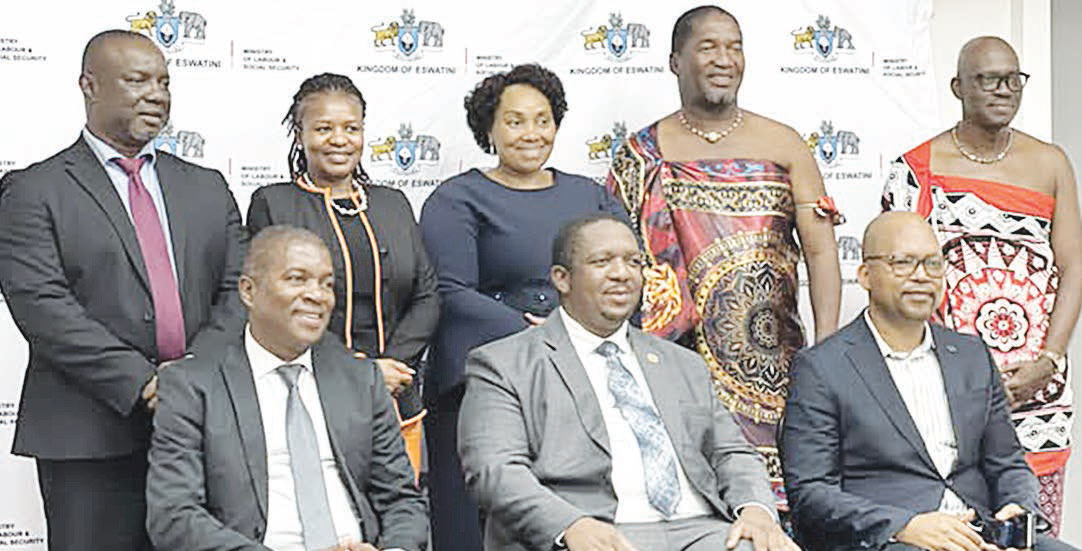
I was among the privileged audience at the Palazzo ICC Hotel a week ago when the Entrepreneur of the Year was crowned, with His Majesty the King once again overseeing the ceremony, now in its 20th year.
On a night of glitz, pomp and glamour, Minister for Labour and Social Security Phila Buthelezi had the humbling responsibility, as acting prime minister, of inviting the Head of State to address the gathering.
Buthelezi performed the task with ease. His soft, carefully selected words revealed a man comfortable in the political spotlight and, perhaps, equally comfortable in borrowed robes.
Right there, you could be forgiven for wondering how such a brilliant mind applies itself inside the hallowed corridors of Cabinet. That is, of course, if a few polished remarks before the Head of State are enough to establish the brilliance of a mind.
But Buthelezi’s reputation does not rest on ceremonial appearances alone. He was a formidable chairperson of the Public Accounts Committee, presiding over matters brought before Parliament by the auditor general. He was, to borrow from today’s younger generation, a cool politician: composed, firm and sufficiently exacting to make an appearance before his committee an uncomfortable prospect for controlling officers.
Whether that same discomfort still accompanies summons to Parliament, given how easily some now appear to escape serious scrutiny, is a story for another day.
Dispute
Anyway, my mind returned to that evening at the entrepreneur awards when the minister announced his newly assembled Eswatini National Provident Fund Board this past week.
Here was the same minister, receiving a second opportunity to resolve a dispute that should never have been allowed to drag on for so long.
The first attempt, with Derrick Shiba as chairperson, produced months of resistance, a parliamentary inquiry and, eventually, the dissolution of the board.
Throughout that controversy, the minister and his Cabinet colleagues defended the appointment. What matters now is that their handling of it failed, and failed dismally. A second attempt should have demonstrated that somebody had learnt something. It should have resolved the outstanding disagreements, repaired relations with the Fund’s social partners and restored confidence in government’s oversight.
Instead, we have another contested appointment process, another confrontation and another intervention by the courts. At what point does an appointment dispute become evidence of a failure to govern?
After roughly a year of controversy, the public is entitled to expect better. Certainly, the second time around, it is entitled to expect a minister to anticipate the very problems that undermined his first attempt.
Appointing a board requires care, consultation and an understanding of the governing framework. These are basic responsibilities of the office he holds.
The parliamentary inquiry into the first impasse brought into focus concerns that had been there for all to see. These included the longstanding convention under which the chairpersonship rotated among government, employer and employee representatives, and the statutory basis for appointing Shiba under a category of ‘specialised skills’.
That category stuck out like a sore thumb. It required a convincing explanation from the outset.
The minister and his colleagues at Hospital Hill should have applied themselves to these questions before the appointment became a prolonged institutional crisis.
A minister who departs from an established governance convention must be prepared to explain why, demonstrate the legal foundation and engage those whose participation gives the institution legitimacy.
An established practice can be changed. But changing it requires more thought than announcing a new arrangement and expecting everyone else to fall into line. Nor can legitimate questions be wished away through evasive responses or by dodging media scrutiny.
The power to appoint carries a duty to account.
That includes answering this newspaper’s questions. A minister cannot reasonably demand public confidence while treating scrutiny of his decisions as an inconvenience.
The opportunity to start again should, therefore, have been an opportunity to demonstrate that the lessons had been learnt. Yet the latest process has produced a fresh challenge over the exclusion of Business Eswatini nominee E. Nathi Dlamini and Federation of Eswatini Business Community nominee Themba Dlamini, alongside objections to the appointment of the ministry’s principal secretary, Makhosini Mndawe.
The High Court’s interim intervention does not settle the merits of those objections.
It does, however, leave government confronting another serious dispute over a process it had every reason to handle with exceptional care.
The minister reportedly rejected E. Nathi Dlamini on the basis that he had reached the maximum number of consecutive terms. Business Eswatini disputes the counting of the dissolved board’s brief existence as a completed term.
That disagreement deserves a clear legal answer. But it also raises an obvious political question: why was it still unresolved when government proceeded with the appointments?
Surely, after the first debacle, the minister knew which issues required agreement, which required legal clarification and which were likely to send the parties back to court.
What, then, was done with that knowledge?
Perhaps there will be time for a fuller discussion of Business Eswatini’s own role in these disputes and in the country’s economic affairs. It, too, must account for how it exercises its influence.
Its handling of the Inyatsi membership issue has left me questioning whether the organisation always displays the openness and restraint it expects from others. But that is an argument for another Sunday.
Whatever one thinks of Business Eswatini, it is entitled to challenge decisions it believes undermine its representative role. Its disagreements with others do not relieve the minister of his responsibilities.
Consultation cannot guarantee agreement. Neither should a federation possess an unlimited veto over appointments. Meaningful consultation should, however, expose disagreements early and allow them to be addressed before an inauguration becomes an urgent court matter.
The recurrence of this dispute suggests that the work was inadequate.
And this is where the matter moves beyond Buthelezi’s office and lands squarely at Cabinet’s door.
According to the applicants’ account reported in this newspaper, notification of the latest inauguration followed a Cabinet resolution.
Cabinet must therefore, explain what scrutiny it applied before the process went ahead.
What advice did it consider? What assurance did it receive that the earlier problems had been addressed? Were the social partners’ objections properly examined? On what basis did it conclude that this process would restore stability?
These are elementary questions. That they must be asked after a second contested process is an indictment in itself.
Collective responsibility must involve collective judgment. It cannot amount to endorsing a minister’s position and then watching from a comfortable distance when the consequences arrive.
If Cabinet approved the course taken, it shares responsibility for explaining it. The broader relationship between business and government also deserves scrutiny.
Business Eswatini occupies an influential place in the economy, while its chief executive also chairs the Eswatini Communications Commission.
Such overlapping responsibilities demand transparency about representation, competing duties and potential conflicts. They do not, on their own, establish wrongdoing.
They do make accountability essential.
Business Eswatini must meet the standards it demands from government.
Its nominations should be defensible in terms of the interests of its constituency and the Fund.
Neither political office nor institutional influence confers ownership of a board seat.
The ENPF exists to safeguard its members’ interests. Those interests should govern every appointment and every decision taken in the name of oversight.
Members deserve to know who is represented, why particular people have been selected and how competing interests will be managed.
They should not have to decipher a prolonged struggle among powerful institutions to understand who is looking after their money.
Where explanations are absent, speculation flourishes. Talk of cabals and hidden commercial interests is no substitute for evidence. But government cannot ignore how its own opaque decisions nourish those suspicions.
Repeated controversy, met with inadequate explanation, corrodes public trust. Cabinet should insist on a process that can withstand scrutiny – proper engagement with the recognised social partners, clear reasons for accepting or rejecting nominees, and a defensible application of the governing rules and established conventions.
Which brings me back to the man who stood before us at the ICC, handling with such assurance a task that might have made other men’s knees buckle. Where is that same tact when dealing with the Fund’s social partners?
Where is the firmness of the former PAC chairperson when demanding that the appointment process withstand scrutiny? Where is the careful preparation when Cabinet considers a matter that has already embarrassed it once? The courts will determine the legal questions.
Cabinet must answer for the judgment it exercised. There is egg on its face.
But the greater concern is that members of the Fund are still waiting for those entrusted with oversight to demonstrate that they can get the fundamentals right.
That, for me, boggles the mind.
With Buthelezi’s experience, and the collective authority of Cabinet behind him, the public should not still be watching government stumble over the same responsibility.
This has become a symptom of failed leadership. A second opportunity has produced another impasse, and Cabinet owes the country an explanation.