



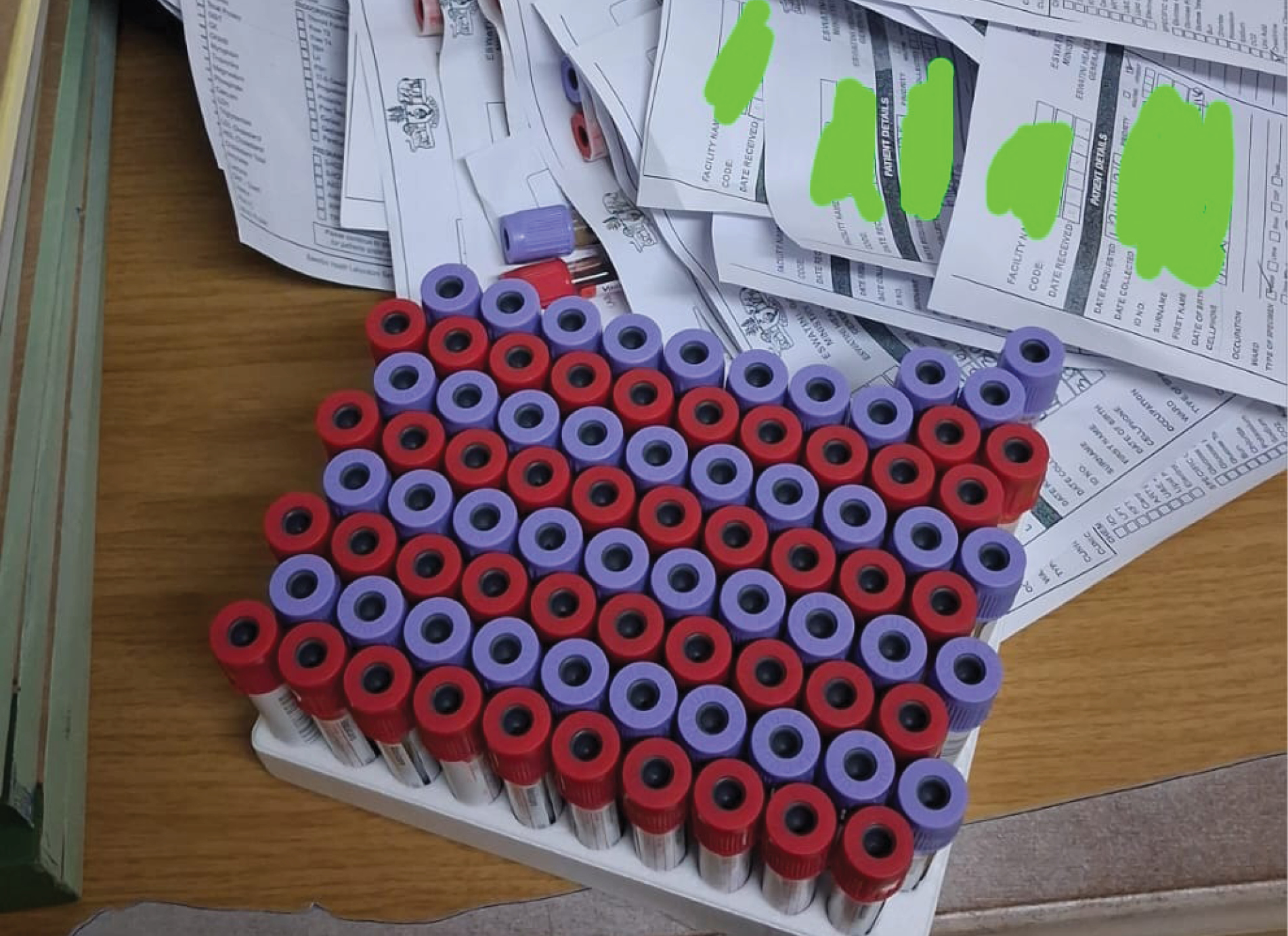
There is an alleged disruption to services at public clinics and hospitals across the country after phlebotomists withdrew some of their services following the introduction of a new job description (JD) by their supervisors.
The affected workers are those working under the Eswatini Health Laboratory Services.
According to the staff representative Zandile Mthandi, the workers had a meeting on November 6 after not reaching an agreement with the hospital’s management on their job description, which stated that they were now phlebotomists instead of laboratory assistants /phlebotomists.
She said during that meeting, the phlebotomists resolved to stick to the new job description that they were given which tasked them with only one responsibility, which was vein puncture, as they might be overstepping when performing the rest of the responsibilities.
When this publication visited the Mbabane Government Hospital Clinical Laboratory Department on Friday, over 14 phlebotomists were found sitting at the reception waiting for patients who needed vein puncture services.
Mthandi said the disruptions started last Monday, noting though that the employees were showing up at work and performing their duties diligently but have decided to stick to the new JD until the matter is resolved.
She said they were hoping to also get paid fairly and as per the responsibilities that they were doing, since they used to perform many duties as laboratory assistants /phlebotomists.
Since Monday, she said patients’ results were delayed, with some patients not getting their results at all. The TB department had practically shut down as they were the ones who used to work there, but they were now expected to do phlebbing only.
As phlebotomists, she said they were expected to perform and monitor venipuncture to obtain patient samples in accordance with approved procedures.
This was the only key responsibility in their new job description, which they had resorted to performing.
Meanwhile, another staff representative Phinda Dlamini stated that the affected services they performed as laboratory assistants/phlebotomists included the handling and transportation of samples, as well as waste management. He stated that they had also stopped preparing, disinfecting and maintaining the work area by ensuring that all commodities were in place, including phlebotomy trays, twice a day.
Dlamini said they were also no longer ensuring the receipt of examination forms and guiding patients for specimen collection according to the tests requested, nor were they performing TB smear microscopy or registering patient demographics in the laboratory register.
“We have even stopped performing the EQAs, which are HIV, TB, microscopy, GeneXpert and serology tests, because our new job description does not permit us to do that,” said Dlamini.
He added that the issues started immediately after the salary review report, as they were placed under Grade C3, a higher salary grade recommended by the consultant, which was later disputed by their employer. He said after they protested following the implementation of the salary review, matters died down, but they later heard that they would be given new job descriptions.
He said they had since been given new job descriptions, whereas for the longest time they had used a job description that described them as laboratory assistants/phlebotomists, which was the initial JD submitted to the consultant.
“The workers have decided not to perform some of the many responsibilities and are performing the duties in their new JD.
The service is suffering, but we do not want to interfere since that is no longer our job. We want to meet with the ministry of public service and the ministry of health so that they can clarify our job description because we are currently using the one that was given to us by our supervisors,” said Dlamini.
The employees were currently drawing blood from patients only and were no longer following up on what happened thereafter.
He said even in clinics, the phlebotomists were collecting blood samples and specimens only which also frustrated even medical doctors as they were not getting results on time. He added that some of the specimens were going stale in clinics as no one was collecting and transporting them to the laboratory.
The workers clarified that they had reached the decision after trying to engage the hospital management and request a meeting with the ministry of health and the ministry of public service, which never happened.
They said to date, there had not been any meeting. They stated that in Mbabane, students were trying to perform their duties and were doing so unsupervised.
“We understand that we are an essential service and that services have been halted in the country, but management is relaxed and no one has engaged us since Monday when we last spoke to them.
90% of the affected staff members are on contract, and they are being threatened to perform all their duties while they have been given a totally different job description,” they said.
Ministry of Health acting Communications Officer Lombuso Dlamini stated that the ministry was looking into the issue, while the Principal Secretary in the Ministry of Public Service, Mthunzi Shabangu, said he had not been consulted by the ministry of health on any challenges, further noting that the issues started with the salary review report.
90% of staff on contract
ABOUT 90% of the phlebotomists at the Mbabane Government Hospital Clinical Laboratory Department are on contract.
This was shared by the workers who stated that they were unable to join a union as they were under contracts.
They said they were allegedly also being threatened for not performing the rest of the duties.
“Their contracts had expired in September and they were recalled in October. Some of them have been on contracts for 17 and 15 years. We have engaged our bosses on this but there has been no change,” a source said. One of the phlebotomists Phinda Dlamini stated that he has been a laboratory assistant/phlebotomist for close to 20 years and was only been absorbed into government system in June.
He said for 17 years, he has been on contract and performing all the duties that were required from a laboratory assistant/phlebotomist until recently.
He was shocked when he was told that they were phlebotomists and were only supposed to do vein puncture and then give the specimens to a medically trained staff member.
Facilities informed about delay in results
ALL referring facilities have been informed about the risk of prolonged turnaround times for all tests, including viral load testing.
In a memorandum that was shared as urgent with all referring facilities dated November 10 by the National Molecular Reference Laboratory (NMRL) Laboratory Manager Susan Kamalizeni that was shared with this publication, all referring facilities were informed about the prolonged turnaround time for all tests. Kamalizeni advised the referring facilities that the NMRL was currently experiencing a shortage of human resources.
“As a result, there is a risk of prolonged turnaround times for all tests, including viral load testing. We kindly request your understanding and continued cooperation during this period,” said Kamalizeni.