



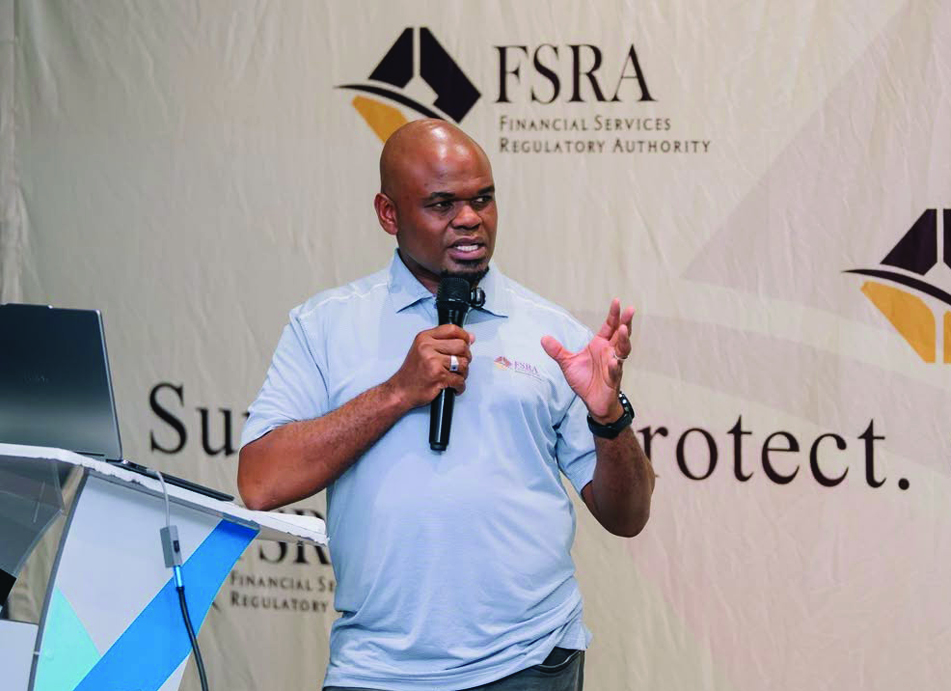
THE High Court has empowered the Financial Services Regulatory Authority (FSRA) to appoint an interim administrator to take charge of the Fairlife Beneficiary Fund amid allegations that the fund is insolvent, with a deficit of approximately E9.53 million and millions of Emalangeni allegedly channelled towards the operations of its administrator.
The court also ordered Fairlife Benefit Services Swaziland (Pty) Ltd, which administers the beneficiary fund, to fully cooperate with the interim administrator and provide all the assistance required to run the fund’s business.
The order was granted by Judge John Magagula on Friday. The orders were granted in terms of prayers one and two of the FSRA’s notice of motion, which sought the intervention of the court under Section 38(2) of the Retirement Funds Act No. 5 of 2005.
In its first prayer, the FSRA sought an order empowering it to appoint an interim administrator for the Fairlife Beneficiary Fund.
The second prayer sought an order directing Fairlife Benefit Services Swaziland (Pty) Ltd to cooperate fully with the appointed interim administrator and provide all the assistance necessary to manage the fund in accordance with Sections 38 and 39 of the Retirement Funds Act.
The application was brought by FSRA through its Chief Executive Officer Ncamiso Ntshalintshali who deposed to the founding affidavit.
According to the FSRA, the intervention became necessary after regulatory inspections allegedly revealed serious financial weaknesses, governance failures, questionable transactions and persistent disregard of regulatory directives, placing the interests of beneficiaries at risk.
The regulator told the court that the beneficiary fund’s financial position had deteriorated significantly, with its funding ratio dropping from 80% in 2024 to 73.5% as at March 31, 2026.
A funding ratio measures a fund’s ability to meet its financial obligations using its available assets.
The FSRA explained that the 73.5% ratio meant that for every E1 owed to beneficiaries, the fund had only 73.5 cents available.
According to Ntshalintshali, the fund had approximately E33.43 million in gross invested assets during the first quarter of 2026. However, after accounting for an impairment of E7 million relating to investments considered unlikely to be recovered, its effective assets were reduced to approximately E26.43 million. Against liabilities of E35 957 901.33, this left the fund with a deficit of approximately E9.53 million.
In the founding affidavit, Ntshalintshali stated that the fund’s financial position meant it could not meet all its obligations to beneficiaries.
“In simple terms, Fairlife Beneficiary Fund owes approximately E36 million but only has about E26 million in real assets. Fairlife Beneficiary Fund is short by just under E10 million,” he stated.
FSRA further alleged that the fund’s financial difficulties were compounded by questionable transactions involving its administrator, Fairlife Benefit Services Swaziland (Pty) Ltd.
The regulator’s investigation allegedly established that the administrator had been receiving excessive fees, including management fees amounting to 60% of monthly investment returns, leaving beneficiaries with only 40%. FSRA said this arrangement was not provided for in the administration service agreement between the two entities.
An analysis of bank statements covering October 2024 to April 2026 allegedly revealed that E3 159 143.58 had been extracted from the beneficiary fund as fees over 18 months. Of this amount, E1 819 081.44 was allegedly taken as management fees without contractual authority, while E1 340 062.14 was paid as administration fees. The regulator calculated that the total excess extraction above the contractual limit amounted to E2 571 893.58. It further alleged that the fund’s cash balance declined by 65% despite investment redemptions amounting to E8 077 723.23.
The FSRA told the court that the money channelled to the administrator appeared to have been used to finance its operations, including salaries and rental payments. “The management fees extracted were, in substance, a payroll mechanism, member capital entered Fairlife Beneficiary Fund, was relabelled as a management fee, and exited as Fairlife Benefit Services Swaziland (Pty) Ltd salaries,” Ntshalintshali stated.
The founding affidavit also raised concerns about conflicts of interest between the two entities.
According to the FSRA, two major shareholders of Fairlife Benefit Services Swaziland were also sponsor trustees of the beneficiary fund. One allegedly held a 70% shareholding in the administrator, while another held 25%. The regulator argued that these relationships compromised the independence of the trustees responsible for protecting beneficiaries’ interests.
It further alleged that the administrator exercised significant influence over the beneficiary fund’s operations, including its banking arrangements. The FSRA also raised concerns about investments, stating that 61.73% of the fund’s total assets were tied up in three illiquid promissory notes issued by a single company, African Alliance Eswatini Capital.
The fund’s financial survival was allegedly dependant on the repayment of approximately E10.3 million from one of the promissory notes, which matured in September 2026. Another concern was the possibility of withdrawals by four retirement funds, namely Rainmaker Plus Provident Fund, Ingcamu Provident Fund, Eswatini Railway Provident Fund and Umzabalazo Provident Fund.
The FSRA stated that these funds had collectively deposited approximately E24 954 025.16 with Fairlife, representing 69.4% of its total liabilities. It warned that their withdrawal demands could trigger a run on the beneficiary fund and potentially lead to its liquidation.
The regulator said it had repeatedly attempted to address the problems through inspections, directives and licence conditions. An inspection conducted between November 13 and 24, 2023, resulted in a report issued in May 2024, which identified weaknesses in financial management, governance and regulatory compliance.
Despite subsequent interventions, the FSRA alleged that the fund failed to submit outstanding audited financial statements for the financial years ending June 30, 2023 and June 30, 2024 as well as an actuarial valuation report and a financial restoration plan. It also allegedly received E2 135 947.75 in new contributions despite restrictions prohibiting it from accepting new business without the regulator’s written approval. Following the court’s order, the FSRA is empowered to appoint an interim administrator under Section 38(2) of the Retirement Funds Act.
The regulator had identified Corporate Business Solutions, a firm of chartered accountants led by Mfundo Msibi, as its proposed interim administrator.
The proposed administrator is expected to undertake a forensic examination of the fund’s finances, verify beneficiaries’ balances, investigate related-party transactions, assess its investments and establish its actual financial position.
The FSRA maintained that the intervention was necessary to protect beneficiaries and prevent further financial losses.