Nolwazi Kunene, the second wife of the late Faith Christian Fellowship Church founder Apostle Jeremiah Dlamini, has broken her silence following the emotional memorial service that placed focus on the late apostle’s marital history, saying the platform should have been used to celebrate his life and legacy rather than discuss family matters.
Kunene said she was disappointed that issues concerning the Dlamini family were raised during a church gathering, arguing that such matters should have been handled privately by the family.
This was after what was intended to be a celebration of the life of Apostle Dlamini became an emotionally charged memorial service that laid bare the divisions surrounding his personal life, as church leaders openly celebrated his reconciliation with his first wife while his second wife sat quietly among mourners.
From the moment Dlamini’s casket entered the packed church auditorium in Ngwane Park yesterday afternoon, grief filled the atmosphere. Hymns echoed through the hall as family members, church leaders and hundreds of congregants fought back tears while paying their final respects to the late apostle. Yet, as the service unfolded, another story quietly emerged.
Dlamini’s first wife, Sibongile Shongwe, arrived dressed entirely in white. Accompanied by her daughters and sons, she was seated prominently in the front row, almost resembling a bride on her wedding day.
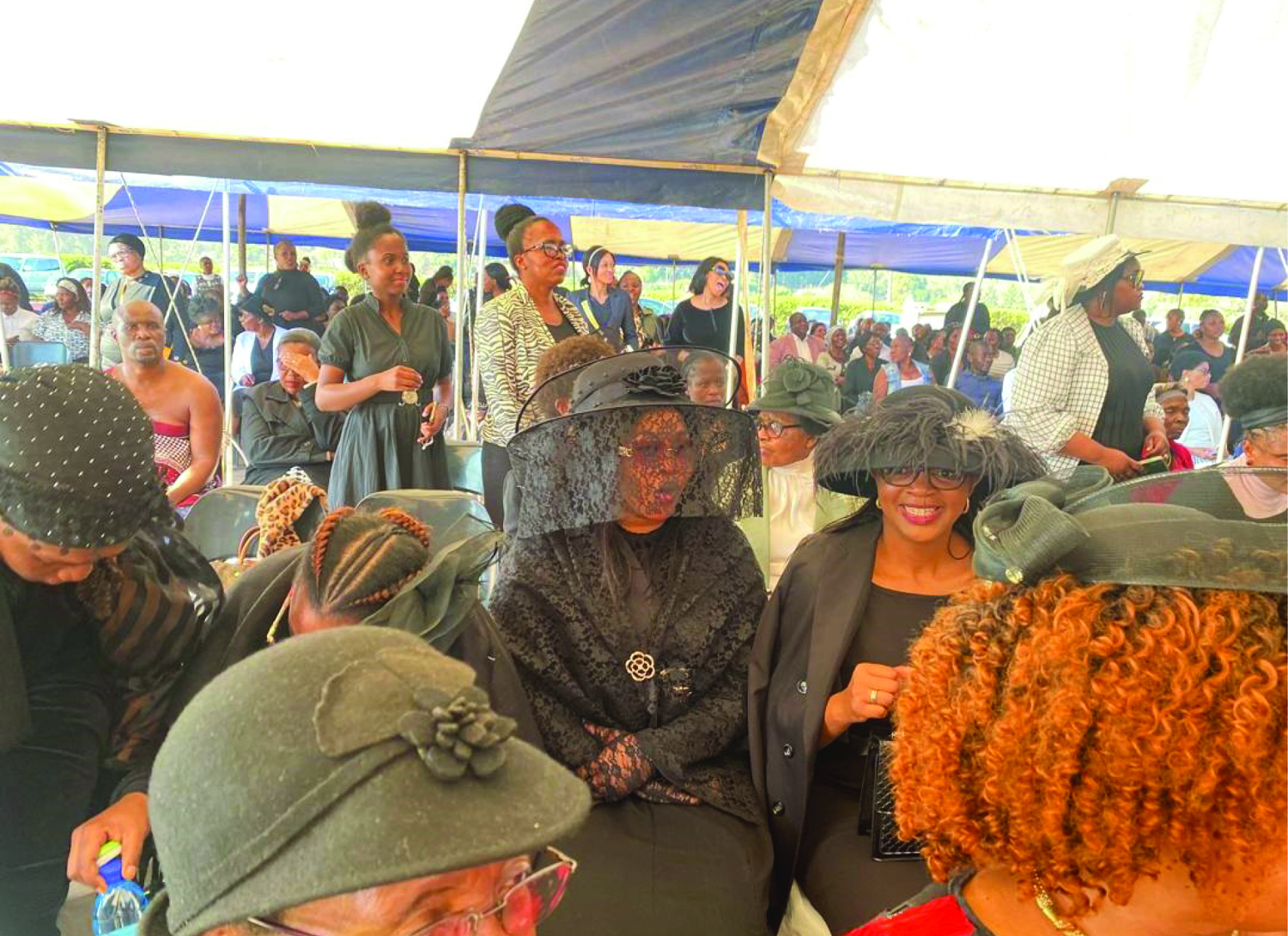
His second wife, Nolwazi, with whom the late apostle had been with before his death, sat quietly at the back of the church dressed in black.
Throughout the proceedings, she remained largely unnoticed as speaker after speaker reflected on Dlamini’s life and ministry. Both her and her family were also not included in the programme.
In reaction to this, Kunene said as a house of faith, the church should have remained focused on maintaining faith and honouring the work of the late apostle.
“As the house of faith, we should be maintaining faith, not fighting family issues of the Dlamini house which were supposed to have been talked about by the Dlamini family if there were issues. This was talked about on the wrong platform, by people of faith,” she said.
Kunene said she was hurt by remarks made during the memorial service, but chose not to respond in the same manner, saying she believed God knew the truth and would defend her.
She said she felt the speaker should have offered her encouragement instead.
“I was encouraged by a prayerful person who told me; the woman who was talking does not know you, but you will not be like the people of the world, despite being disappointed. She should have encouraged me, but did not. You will not do as the world does. God knows the truth, He will fight for you,” she recalled.
She maintained that she had been present throughout Dlamini’s illness and cared for him until his death.
“Your husband was taken care of by you; you took care of him till the end, even his last breath was out while he was in your care,” she said.
Kunene said she had prepared a personal tribute for her husband, which she had hoped to deliver herself during the memorial service because she wanted to personally honour him.
She said she would share the tribute, which reflected on their journey and the impact Dlamini had made. Reflecting on the events at the memorial service, Kunene said she had chosen to remain calm and leave the matter in God’s hands.
“I say God should forgive them for they do not know what they are doing. I pray that at the end, God may remember them, because as elders, they ought to end well and we should learn from them,” she said.
Kunene said she found comfort in knowing that her relationship with the late apostle was not hidden, adding that Dlamini had openly loved and acknowledged her.
“The truth cannot be suppressed. It was in the light and was known by everyone. My husband never hid me, he loved me openly and I am proud of that. I am left with that peace,” she said.
She said she was saddened that the memorial service, which was meant to honour Dlamini’s life, instead focused on matters she believed took away from celebrating his contributions.
“That platform was wrongly used. There, the good things about him that he did while alive were supposed to be talked about and celebrated. It was his last day, one that we would never celebrate him again. Instead of celebrating the good works that he did for the entire Eswatini, such was talked about. It was sad,” she said.
Kunene said she believed Dlamini’s legacy extended beyond his personal life, highlighting his ministry, vision and commitment to serving God.
She said the late apostle had a vision that half of his wealth would go towards the work of God, adding that such contributions and his impact were the stories that deserved to be shared.
“There is a lot that God used the man of God for, that will continue to live on, his legacy. The world needs to hear that, not the things that were talked about, that will make faith go back,” she said.
Kunene said believers should remain focused on faith and the work that Dlamini left behind, saying his ministry and contributions would continue speaking beyond his death.
Gogo Khumalo presents defining moment
The defining moment of Apostle Jeremiah Dlamini’s memorial service came when Gogo Khumalo, who introduced herself as Dlamini’s spiritual mother and said his children were her grandchildren, rose to address the congregation on behalf of the children.
She first reflected on her own spiritual journey, recalling how she and her late husband had left the Assemblies of God in 1978 after what she described as God’s calling to move beyond their comfort zone and preach the Gospel.
She said Dlamini was among the men God had raised to perform miracles and wonders, adding that members of her own household had personally experienced his ministry.
However, she said that behind such a man of calibre stood a woman whom she wished to honour, before calling Shongwe by name.
The church immediately erupted into applause. Khumalo said pastors’ wives had learnt valuable lessons from Shongwe’s example, praising her for standing by the apostle until the very end.
She said the country had suffered a great loss through Dlamini’s passing before likening him to the biblical cedar tree, describing it as a tree so strong that it could only be cut by specialists.
Using the analogy of light attracting insects, she told mourners that powerful men of God naturally attracted people from every direction.
“Uyabona ke nawuphetse kukhanya bazalwane, konkhe lokwetilwanyana; imimiyane, tindozolo, ini ini, konkhe kufuna kusondzela,” she said.
The congregation responded with loud laughter and applause.
She continued by saying that because Dlamini carried ‘light’, ‘all the termites wanted him’.
“Kwaba khona ke angikwati noma bekulivivane noma lindozolo, kwabese kuyamsutela,” she said, drawing another round of applause and laughter.
Khumalo then turned the congregation’s attention to LaShongwe’s white attire.
She told mourners that they should notice the late apostle’s wife was not dressed in black but in what she described as a wedding dress, saying it symbolised that they were “getting married for the second time”. The remark was greeted with cheers, whistles and sustained applause.
Throughout her address, Khumalo repeatedly reflected on what she described as Dlamini’s reconciliation with his first wife before his death, saying it brought peace to his family and those closest to him.
She said she was grateful that, before his passing, he had mended his relationship with Shongwe and his children, whom she thanked for caring for him during his illness by feeding him and playing worship music at his bedside.
As she concluded, Khumalo declared that she was proud because, in her view, Dlamini and Shongwe were now separated only by death.
The congregation once again responded with applause. The repeated tributes to Shongwe, coupled with the symbolism of her white clothing, the standing ovations and the congregation’s vocal approval, shaped the tone of the memorial service.
Meanwhile, Nolwazi remained seated quietly at the back of the auditorium throughout the proceedings as the service drew to a close, bringing into sharp focus the contrasting roles the two women occupied during one of the most significant moments in the late apostle’s farewell.
Khumalo went on to share what she described as a conversation between Dlamini and God, saying the late apostle had told her that he once prayed for God to take him while he was battling with illness.
She told mourners that Dlamini later reflected on his past actions and came to the realisation that he needed to make amends.
According to Khumalo, she said Dlamini believed he had to return and correct his mistakes before his relationship with God could be restored.
As she delivered the account, the congregation responded with a mixture of murmurs, cheers, whistles and applause.
Khumalo said Dlamini eventually approached LaShongwe and admitted that he had been wrong by focusing on her shortcomings while failing to acknowledge his own.
Quoting what she said were his words, she recalled him saying:
“Shongwe, my love, I made a mistake by magnifying and capitalising on your mistakes and yet I too had my own. Khumalo and others tried to reason with me but I was hard-headed.”
She told mourners that she had previously tried to counsel Dlamini, but alleged that some pastors had encouraged him by telling him that, because he was umntfwanenkhosi, God would understand. Khumalo said those pastors had since died.
She then described what she said was the moment of reconciliation between Dlamini and Shongwe, telling mourners that Shongwe forgave him and that the two reconciled as a couple.
The congregation erupted into applause.
“Lomntfwanami uyilungisile indlela yakhe, namuhla usekhaya!” she declared.
Khumalo said she thanked God that Dlamini had found what she described as ‘real salvation’ before his death. She also praised his children for caring for him during his final days, saying they fed him, played worship songs for him and stood by him during his illness.
“What makes me proud is that they are separated by death,” she said.