


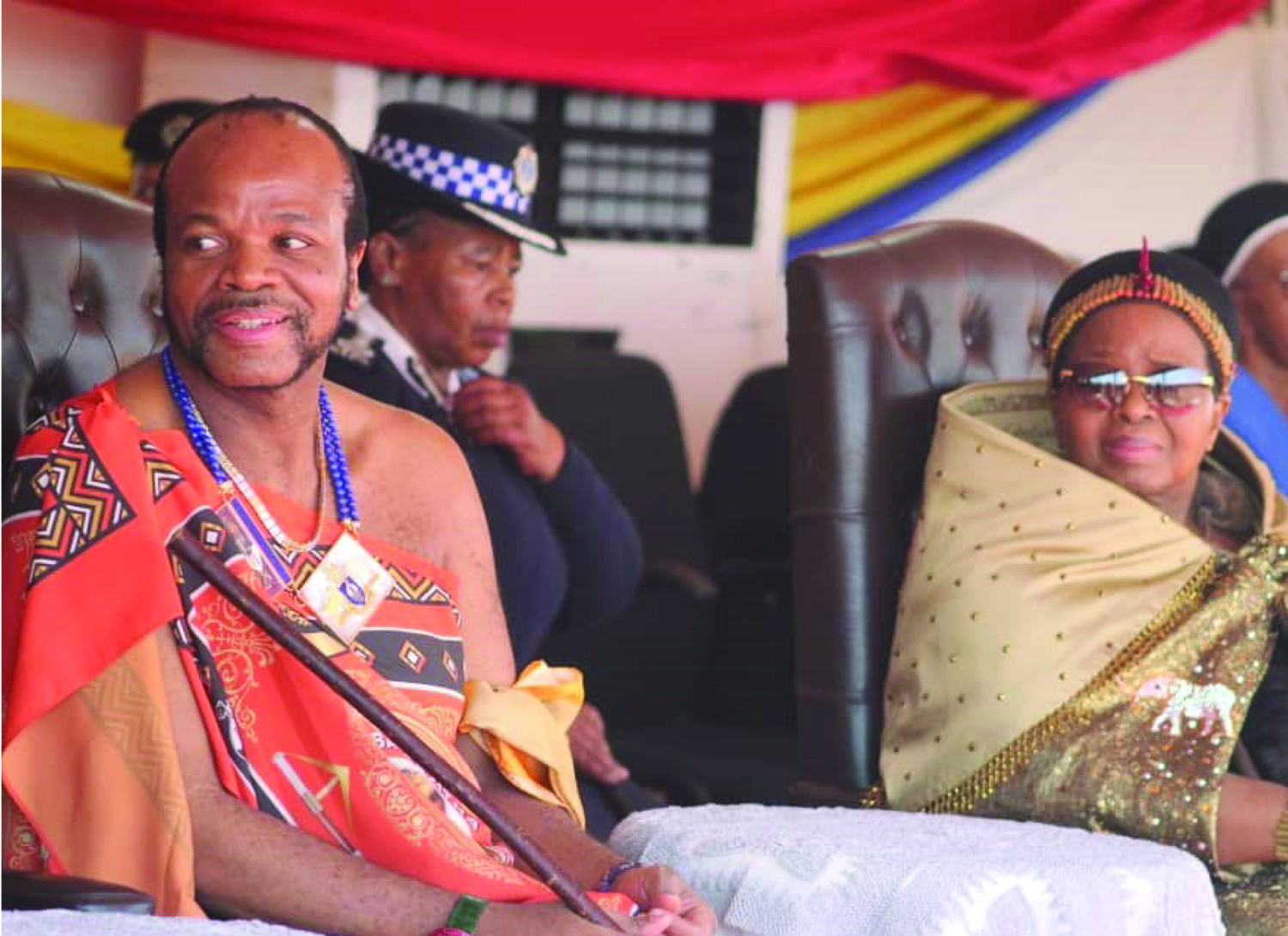
HIS Majesty King Mswati III has warned 159 newly qualified teachers that the future of the kingdom will pass through the minds of the children they teach, urging them to see every classroom as an opportunity to shape the nation’s next generation.
Speaking at Ngwane Teacher’s College’s 40th graduation ceremony in Nhlangano yesterday, the king said the graduates were leaving the institution not merely as teachers, but as “commissioned nation-builders” entrusted with preparing responsible citizens and future leaders.
He urged them to teach with purpose, lead by example and approach their classrooms as spaces where the future of Eswatini would be shaped.
“The future of this kingdom is now placed, quite literally, in your hands, for it will pass first through the minds of the children you teach,” the king said.
He told the graduates that every classroom they entered presented an opportunity to transform a life, while every child they taught represented “a seed of the future kingdom”.
The king said teachers occupied a position of great honour in society because they were entrusted with preparing children to become responsible citizens, leaders and custodians of the country’s national values and heritage.
He urged the graduates to carry more than academic knowledge into the teaching profession, calling on them to demonstrate humility, integrity, discipline, compassion and a deep sense of service to the nation.
His message came as the college marked four decades since it opened its doors in Nhlangano to train teachers who would take education to communities across the kingdom.
He said the 40th graduation ceremony was a significant milestone for the institution, which has produced approximately 6 750 holders of the Primary Teacher’s Diploma and 450 specialists in Early Childhood Care and Development since its establishment.
The king commended the college for its contribution to the country’s education system, saying its four decades of work had helped take knowledge “into every corner of our kingdom”.
However, he challenged the institution and its graduates to prepare for an education landscape vastly different from that of previous generations. He said the world they were entering was increasingly defined by artificial intelligence, changing labour markets and rapidly evolving information, meaning classrooms could no longer focus solely on memorisation.
“A classroom that asks a child only to remember will not prepare that child for such a world,” he said, stressing the need for learners to be taught to think and innovate.
The king commended government and the ministry of education and training for steering the country’s schools from outcome-based education towards competency-based education. He said the approach focused not only on what learners could recite, but also on what they could actually do.
The king also welcomed Ngwane Teacher’s College collaboration with the European Union in developing an appropriate curriculum, saying such partnerships were important in responding to the changing demands of education.
The king said there was evidence that Ngwane Teacher’s College was progressing, particularly in strengthening the qualifications of its academic staff. He noted that the college had increased the number of staff members holding PhDs from 11 last year to 14, alongside 25 holders of master’s degrees and 12 with bachelor’s degrees.
He described this as evidence that those responsible for training the country’s teachers remained committed to learning themselves.
The king further welcomed the gazetting of the task team tasked with transforming Ngwane and other colleges into universities. He challenged the team to work with stakeholders to deliver tangible results on the transformation of the institutions, saying the process had taken too long.
Invoking the national motto, Nkwe, Yenta Njalo, the king called for action rather than continued discussions.
“We therefore expect the team to work with all stakeholders to ensure that they deliver tangible results on change management for our institutions, including Ngwane College,” he said.
He challenged those involved to turn the available opportunities into realisable goals and wins in record time.
“To speak of outcomes rather than strategies. This issue has been dragging for some time. Time for talking is over, let us talk tangible results,” the king said.
Turning to the graduating class, the king congratulated the 159 graduates for reaching the historic milestone, reminding them that they were graduating on the same occasion that the institution celebrated its 40th graduation.
He told them that they were leaving the college not merely as students, but as “commissioned nation-builders” whose influence would extend far beyond the classroom.
He also acknowledged the families, lecturers, mentors and communities whose support had contributed to the graduates’ success, saying their sacrifices demonstrated that achievement was never accomplished in isolation.
“Siyanibongela, bothishela labasha,” the king said, congratulating the new teachers.

…graduates prepared for CBE transition
NGWANE Teacher’s Training College has produced 159 newly-qualified teachers across science, technology, languages, social studies and applied sciences, as the country accelerates its transition towards a competency-based education (CBE) system.
The graduates are entering an education sector increasingly focused on moving beyond rote learning towards the practical application of knowledge, critical thinking, problem-solving and skills development.
Of the 159 graduates, 47 specialised in Sciences, Information and Communication Technology (ICT) and Mathematics, while 30 graduated in languages, covering French, Siswati and English. Another 30 specialised in Social Studies, comprising Geography, Religious Education and History, while 52 graduated in Applied Sciences, specialising in Consumer Science and Agriculture.
College Principal Celiwe Khumalo said the broad areas of specialisation were critical to preparing teachers capable of responding to the changing needs of the local education system. She said the college was already working to align its teacher-training programmes with the CBE, with assistance from the European Union.
Khumalo said the transformation was intended to ensure that teachers were equipped to produce graduates who could apply what they learned rather than merely retain information. The college was seeking to produce teachers capable of helping learners to “think critically, solve problems, use technology effectively, demonstrate entrepreneurial abilities and continue learning throughout their professional lives,” she said.
Eswatini’s move towards CBE forms part of a broader reform of the national education system. The Eswatini National Curriculum Framework for General Education, adopted in 2018 with European Union support, established a competency-based, learner-centred approach to curriculum development.
King hails deaf graduands for breaking barriers
HIS Majesty King Mswati III has commended two graduates with hearing impairments for overcoming barriers to attain professional teaching diplomas, describing their achievement as a victory not only for themselves but for the nation.
The two graduates, Nkosinathi Matsenjwa and Bongekile Ntombikayise Myeni, were recognised during the 40th graduation ceremony, where they received their professional teaching diplomas.
Both graduates previously attended the School for the Deaf in Siteki, before pursuing their teacher training, ultimately reaching the milestone of graduating as professional educators.
In acknowledging the pair, His Majesty said their achievement demonstrated that disability should never be allowed to determine an individual’s capabilities or limit their contribution to society.
The king said the country took particular pride in the two graduands, noting that their success represented more than a personal accomplishment.
“This is not merely a personal victory for these two young citizens. It is a national one,” His Majesty said.
He added that their journey was proof of the country’s commitment to ensuring that no citizen was left behind in the progress being made.
The two graduates were congratulated for overcoming the challenges associated with their hearing impairments and refusing to allow their disabilities to define their potential.