
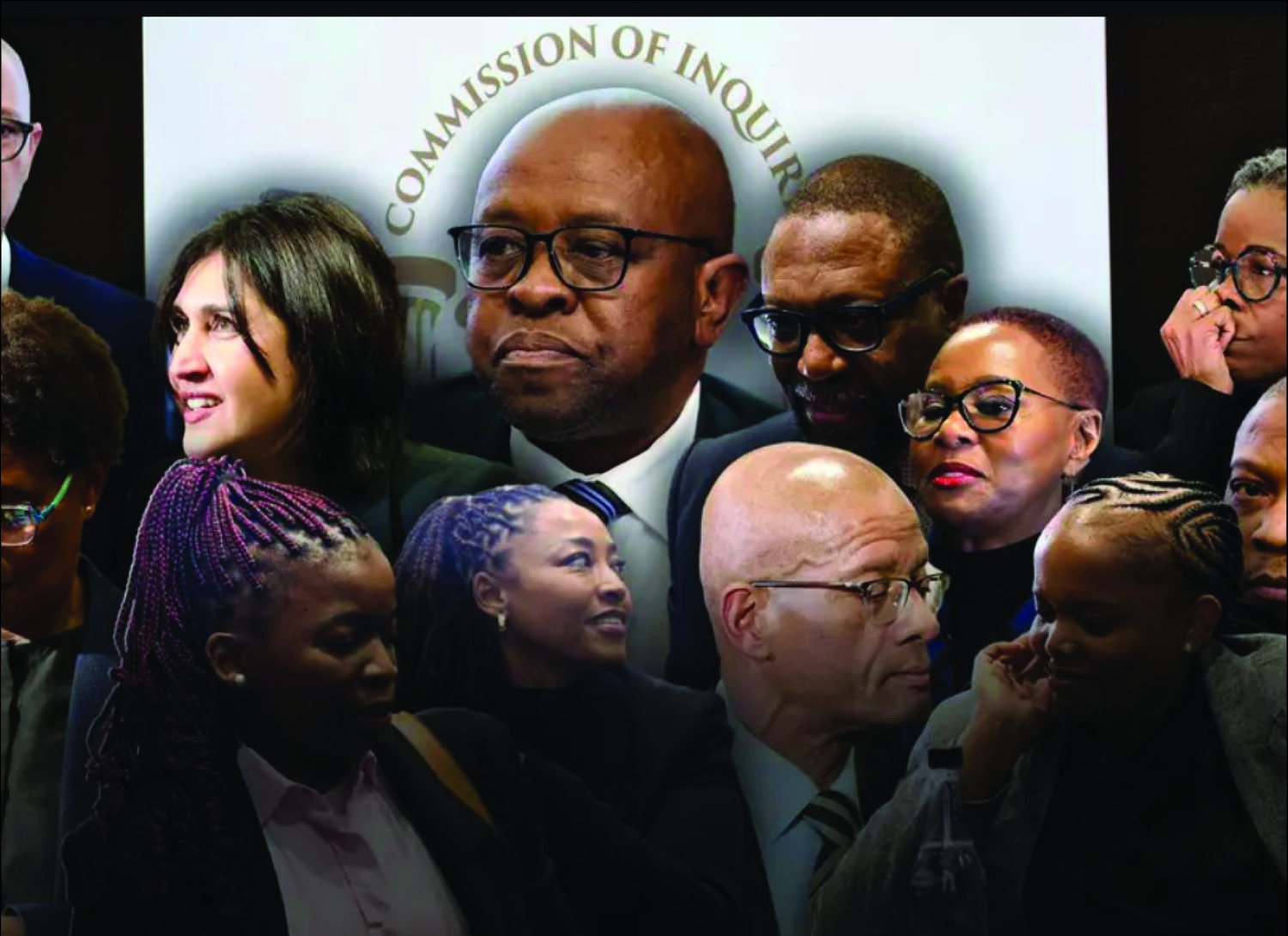
Let me start with a quick disclaimer: I am not one of those people who sit all day following the Madlanga Commission of Inquiry on television, as many of you do.
I know my better half is hugely interested in it and often calls to give me updates – which is really useful because, between my many meetings, I could never manage to follow all of it!
I also come across enough posts on my social media timeline to know that we are following what is happening that side of the border – and with reason. I personally always say that South Africa is us.
They gave us this tenderpreneur thing that eventually became a thing here too, starting with briefcase businesspeople and developing into the tenderpreneurship that has come to dominate parts of our business environment.
Then we copied the corruption and fraud tendencies and, well, the rest is history.
So, whatever South Africa does, you can expect that we are probably doing three times as much here. The lifestyle and social scene are so intertwined that if there is state capture that side, you can rest assured somebody will eventually find our own version this side!
Anyway, let me get to my point.
I have been keeping some interest in developments in South Africa and there is something deeply uncomfortable about watching the Madlanga Commission unfold.
It is not merely the names being mentioned or the extraordinary allegations being ventilated before the commission – or my personal interest in the ‘Cat’ Matlala case and that Eswatini passport, of course.
It is not even the spectacle of institutions that are supposed to fight crime being forced to answer questions about whether criminal interests may have penetrated the very structures established to protect society.
For me, it is what the whole affair teaches us about corruption. Corruption does not flourish merely because corrupt people exist. It flourishes because systems allow corrupt people to exist.
What we have observed and learnt – perhaps gleaned – from the Madlanga Commission is that corruption grows when institutions become weak, oversight becomes selective, political interests become more important than public interests and, above all, when good people occupying positions of responsibility see what is happening and decide that silence is safer.
South Africa might never have arrived at the Madlanga Commission, at least in its present form, had KwaZulu-Natal Police Commissioner Lieutenant-General Nhlanhla Mkhwanazi not stood before the nation on July 6, 2025 and made serious allegations about criminal syndicates, political interference and the alleged infiltration of law-enforcement and intelligence structures. President Cyril Ramaphosa subsequently established the commission to investigate those allegations, but the truth is he was left with no choice!
Mkhwanazi’s allegations were not automatically transformed into facts because a senior police officer made them. They had to be tested and a commission was necessary as a platform, because South Africa could not leave the door ajar for such serious allegations to remain so open.
WHERE IS OUR MKHWANAZI?
But somebody had to speak first – and Mkhwanazi stood up, whatever the risks, and decided enough was enough.
And as we sit here in Eswatini watching what is being uncovered next door, perhaps there is one uncomfortable question we ought to ask ourselves: Where is our Mkhwanazi?
Of course, the premise here is that we are already at that stage in this country where we need our Mkhwanazi moment. There is no disguising how much corruption has settled in our system, or that there is enough to suggest that a lot of our institutions have long been infiltrated.
Now we need that person sitting somewhere inside the corridors of power, who has seen enough to stand up and, to borrow from the prime minister, cause a disruption that will enable us to tackle the bull by its horn.
In our line of work, we are always looking for that one public servant who knows where the files are and is prepared to trust us with the information.
Yet, what I am beginning to observe is that people are increasingly happy to play along. They see what is happening, shrug their shoulders and continue with life.
I know there are officials who have watched decisions being manipulated, processes circumvented or public resources abused. In some cases, we see this. It is there and it is glaring. I know of institutions where officials want to speak, but they look around and see how powerful and connected the people involved are — and decide not to bother themselves. That is how corruption wins.
My thoughts around this were triggered by recent developments in some of our institutions, where serious questions exist, yet there appears to be little appetite to confront them.
Instead, there is often a mad rush by individuals to benefit from whatever situation presents itself. You can tell, for instance, that the vultures are circling for that EPTC loan, having already depleted the Microprojects Fund.
So, I ask myself what these people who are corrupt will have to say for themselves the day everything is exposed – just as some of those appearing before the Madlanga Commission are discovering that public scrutiny can eventually reach places once considered untouchable.
Whenever I catch a glimpse of the commission, I find myself wondering when our moment will come – and where it will come from.
I also wonder what our skelems must be thinking as they watch, because I know they are watching too. Perhaps they should understand – or should be warned – that one day somebody will speak.
And one day our own General Mkhwanazi may descend upon this land like that proverbial manna from heaven! When that day comes, popcorn and a camp chair will be ready.
Perhaps one should provide some context, as to why I am going down this route. It is simple, I have watched enough to see that we have lost the fight against corruption. We have lost even the shame that usually makes people a little sceptical.
Instead, the sheer, staggering display of arrogance of power that glows with invincibility is at some Donald Trump level.
Take, for instance, the attitude we have witnessed from some MPs towards The Luke Commission controversy and allegations raised by former employees concerning clinical practices and other aspects of the institution and government has engaged regulatory and investigative authorities to examine those claims.
The allegations remain allegations and must be properly investigated.
Of course The Luke Commission must be afforded every opportunity to respond and that is exactly why an investigation matters.
An investigation does not presume guilt. It establishes facts, except that we must be willing to embrace it.
Yet the resistance we have witnessed in Parliament towards scrutiny of the institution leaves a bad taste in the mouth. I previously wrote in this column about Education Minister Owen Nxumalo’s poor comment that MPs have an election to win and how I found it to be really unfortunate. Another MP publicly argued in the same matter that there was an agenda to ‘cripple and destroy’ TLC during debate on a motion calling for investigation into certain allegations concerning the institution.
And that leaves us asking uncomfortable questions.
You would assume that an investigation would establish the facts, vindicate those wrongly accused or expose the allegations as false if, for instance, former employees have exaggerated or misrepresented what happened.
But suppose even a fraction of the serious allegations concerning clinical practices were substantiated – wouldn’t an MP worth his seat in the legislature want to know?
Isn’t that important to every citizen who might one day place his or her life in the hands of that facility?
Shouldn’t our politicians want patients to be confident that their health comes before political interests and institutional loyalties?
I mean, honestly, you have to ask yourself, how does investigating serious allegations cripple an innocent institution?
If anything, an independent investigation offers an institution an opportunity to clear its name.
The alternative is far worse.
Allegations remain unanswered, suspicion deepens, political camps form and eventually nobody knows whether they are defending the truth or merely defending the side they chose before the evidence was examined.
And this is where the Madlanga Commission becomes so relevant to us. Imagine if South Africa had responded to Mkhwanazi by saying: we don’t want another inquiry.
Imagine if the argument had been that investigating allegations involving senior officials would damage the police.
Imagine if political leaders had simply decided that the allegations were too inconvenient to examine.
The allegations would not magically have disappeared. They would simply have remained beyond proper scrutiny. That is how rot spreads through institutions.
Not always because everybody is corrupt, but because enough people become accustomed to corruption, silence or institutional failure.
And perhaps that is the conversation Eswatini needs to have.
Corruption is not defeated by creating institutions whose officials become spectators while politically connected people operate beyond meaningful scrutiny.
It is defeated when institutions work.
The Madlanga Commission is still doing its work. Indeed, its second interim report has already resulted in further recommendations and referrals, while its final report remains outstanding.
But Mkhwanazi’s intervention has already demonstrated the enduring truth that institutions cannot correct what nobody is prepared to expose.
Eswatini, therefore, does not need politicians protecting institutions from questions.
This country needs politicians protecting the public through questions.
And this country desperately needs a few good men and women prepared to stand up – and tell us what we need to know, because where we stand right now is that we have too many men and women happy to look the other way.
And now they are starting to tell us about 2028 – Lord save us from this lot!