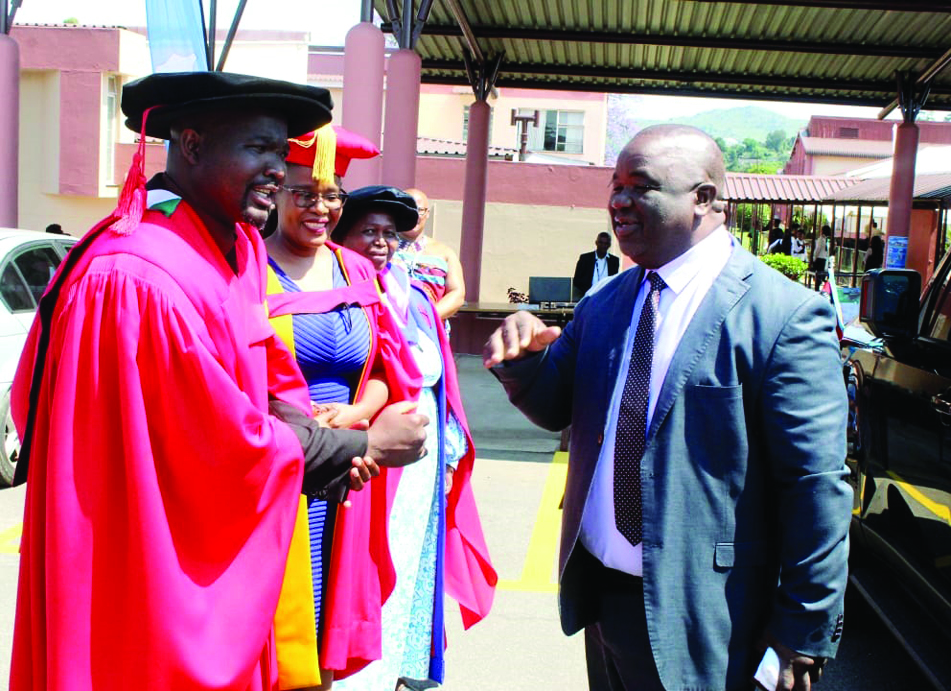
Minister of Education and Training Owen Nxumalo has urged students at the Eswatini College of Technology (ECOT) to engage him directly over challenges affecting the institution, saying protests are not the solution to their grievances.
Nxumalo said students experiencing problems, including delays in the payment of living allowances, should approach him so that he could provide answers and help address their concerns.
Speaking during ECOT’s 24th graduation ceremony and 80th anniversary celebration, the minister said there was a need to resolve institutional challenges through engagement rather than protests.
“If there are challenges at the school, let’s engage. If the living allowances have been delayed, come to me, I will have the answers,” he said.
He cautioned students against resorting to protests, stating that Their Majesties did not like the noise and such issues needed to be ironed out amicably.
Nxumalo said protesting was not the solution, encouraging students to use available channels to raise their concerns.
He also commended the institution’s new Principal Dr Scebo Kunene, noting that there had been no protests since his arrival and there was evident transformation of the institution, including the newly renovated administration block.
The minister’s remarks came as ECOT marked 80 years of providing technical, technological, commercial and professional training in the country.
Established in 1946, the institution held its 24th graduation ceremony, during which 360 students graduated from various programmes.
Nxumalo said the anniversary provided an opportunity to reflect on the institution’s contribution to skills development and national development, while considering what it needed to become in the next 80 years.
He said ECOT needed to preserve its legacy while positioning itself as an institution that responds to changing skills requirements, emerging technologies and the needs of industry.
The minister said government recognised technical and vocational education and training (TVET) as an important part of national development, particularly in addressing youth unemployment, poverty, economic diversification and the need to strengthen local production.
He said industrialisation, infrastructure development and employment creation depended on a skilled and adaptable workforce.
Nxumalo also called for stronger partnerships between training institutions, industry, the private sector and development partners to ensure that training remained relevant.
He said employers should participate in curriculum development, internships, apprenticeships, mentorship and workplace-based learning.
The minister further said TVET transformation required investment in modern infrastructure, appropriate equipment, qualified personnel, relevant curricula and digital technologies.
He said institutions also needed to embrace applied research, innovation, entrepreneurship and the commercialisation of their expertise.
On ECOT’s future, Nxumalo said the aspiration to position the institution for university-level status deserved strategic consideration.
However, he said any transition would have to be guided by policy frameworks, institutional readiness, quality assurance requirements and regulatory processes.
He acknowledged the support of the European Union, the Taiwan Technical Mission and the Skills for Youth Project in advancing skills development, institutional capacity and youth empowerment. He also thanked lecturers, academic staff, management and support staff for their contribution to the training of students.

ECOT graduates urged to create jobs, not wait
Minister of Education and Training Owen Nxumalo has challenged graduates to use their qualifications to create employment opportunities rather than limiting their ambitions to securing jobs in government or the private sector.
Addressing 360 graduands during the Eswatini College of Technology’s (ECOT) 24th graduation ceremony, which coincided with the institution’s 80th anniversary, Nxumalo said young people needed to explore opportunities through technology, innovation and entrepreneurship. He said formal employment remained important, but graduates should also consider establishing businesses and creating opportunities for themselves and others. “Do not allow your qualifications to become certificates that merely hang on walls. Let them become instruments for solving problems, establishing enterprises, improving communities and contributing to economic growth,” he said.
He encouraged graduates to identify gaps in the market, develop solutions and use their skills to address challenges facing their communities.
The minister said the country faced challenges relating to youth unemployment, poverty and economic diversification, which required people with practical competencies, technical expertise and the ability to turn knowledge into economic value.
He said the success of technical and vocational education and training should not only be measured by the number of certificates awarded, but also by the contribution graduates made to productivity, enterprise creation and improved livelihoods. The 360 graduates came from programmes including building studies, civil engineering, quantity surveying, office management and technology, human resource management, hospitality and tourism management, commercial studies, information and communication technology, computer science, automotive engineering, vehicle body repair, electrical and electronics engineering and mechanical engineering.