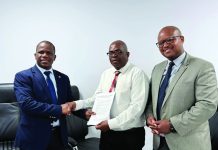




PRIME Minister Russell Mmiso Dlamini has positioned himself for the next national elections two years earlier.
The premier registered for voting at his offices yesterday, where his voter’s card was issued instantly.
The PM commended the Elections and Boundaries Commission (EBC) officials for the exercise, which he said offered an opportunity for people to register while there was still time.
“We appreciate the special visit by the EBC team. It has enabled us to register for the upcoming elections,” he said.
The EBC has since introduced a new provision to its usual operations, which allows continuous voter registration. This means the EBC has moved away from the time-bound, once-off registration periods to registration that takes place throughout the year.
Other people who registered yesterday include acting Government Spokesperson Thabile Mdluli, Principal Secretary (PS) in the PM’s Office Bheki Bhembe and some journalists.
During this year’s international trade fair, the EBC opened its doors to people who wanted to register.
The EBC disclosed that many people registered during the trade fair, adding that the commission was still consolidating the figures, after which an official report will be issued.
EBC REGISTERS OVER 1 400 VOTERS IN FIVE DAYS
BY MELISA MSWELI
THE Elections and Boundaries Commission (EBC) has registered over 1 400 people since the commencement of the 2028 voter registration exercise five days ago.
According to EBC Communications Officer Mbonisi Bhembe, 55% of those who had registered were women while men accounted for 45%.
Bhembe said the commission had also started taking the registration exercise to schools after observing a significant number of learners who were eligible to register.
He said the commission visited Lavumisa during the week, where it identified pupils who qualified to register as voters and facilitated their registration.
Bhembe said the exercise had presented an opportunity for the EBC to reach more schools with eligible voters instead of waiting for the compulsory registration phase closer to the elections. “We saw that there is an opportunity for us to visit more schools where there are people who are eligible to vote so that they can be registered,” he said.
He said registering early was beneficial because the registration would remain valid for the 2028 elections, allowing eligible voters to complete the process well before the elections.
Bhembe said the early registration drive was also part of the commission’s efforts to minimise long queues when the elections drew closer.
He explained that the current registration exercise was phased, which would eventually be closed before the permanent registration phase was opened closer to the elections.
He said more phases would be opened and closed to provide opportunities for those who have not registered during the current exercise to do so. Bhembe also said young people who had not yet reached the voting age but would become eligible before the elections would be given an opportunity to register when they qualified. The registration process also captures biometric information, including fingerprints, which Bhembe said would be one of the ways to assist the commission in retrieving and verifying the information of registered voters.
He said the use of biometric information formed part of the systems being used to ensure that registered voters could be identified when required. The EBC is responsible for the registration of voters and management and conduct of national elections in Eswatini.