



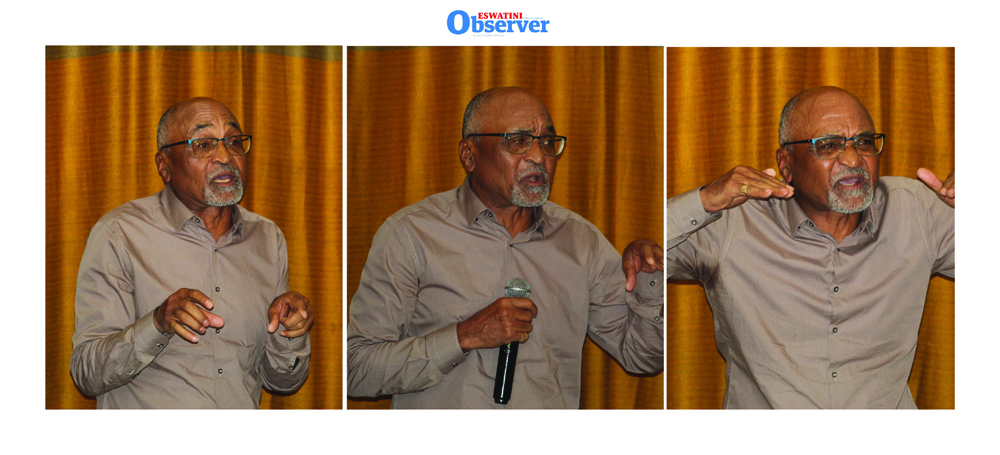
The rise in politicians’ pay driven by the civil service salary review is financially unsustainable and out of step with the country’s economic realities, businessman and former senator Walter Bennett has said.
He is on that account, questioning whether the Royal Commission played its role in making recommendations regarding politicians’ benefit under Finance Circular No. 2 of 2023, and if they properly weighed the country’s capacity to carry the cost.
If implemented as set out in the Circular, each backbench member of Parliament will be entitled to an ex-gratia payment of just over E1 million at the end of the 12th Parliament in 2028, a figure equivalent to one year’s basic salary after the review.
Bennett said the projected payouts exposed a widening gap between political office-bearers and the economic circumstances faced by ordinary citizens and the broader public service, at a time when the economy is under strain and government finances are tight.
ALSO READ | PSUs slam government on salary gaps
“This is not something that requires an economist to understand. You simply look at the state of the economy and ask how this level of remuneration can be justified or sustained going forward,” Bennett said in an interview.
Under the Circular, an MP (backbencher) currently earns an annual basic salary of E613 258, or E51 104.83 per month, based on the entry notch. Following the salary review, the monthly basic salary rises to E83 984.24, translating to an annual package of E1 007 810.88.
The ex-gratia payment, defined as a once-off payment equal to 12 months’ basic salary before tax, would, therefore, exceed E1 million per MP at the end of the parliamentary term.
The review alone increases the ex-gratia entitlement by E394 552.88 per backbencher.
With 79 backbenchers in a 103-member Parliament, which also includes 20 Cabinet ministers, two presiding officers and two deputy presiding officers, the projected cost for ex-gratia payments to backbench MPs alone stands at E79.6 million.
Ex-gratia provisions are set out in Sections 3.10.1 and 3.10.2 of Finance Circular No. 2 of 2023, which state that the payment is made ‘by favour’ at the end of the parliamentary term, rather than as a legal entitlement accrued monthly.
Bennett’s criticism focused squarely on the Royal Commission responsible for reviewing politicians’ terms and conditions of service.
The commission was appointed by His Majesty King Mswati III and part the body’s mandate includes aligning political remuneration with the civil service while balancing competitiveness and national economic realities.
The commission, chaired by Mvuselelo Fakudze, the chief executive of Standard Bank Eswatini, was appointed by the king in May, with seasoned attorney Sidumo Mdladla serving as secretary. Other members include Princess Sakhizwe, Sikhomba Gumbi, Nomathemba Hlophe, Kobla Quashie and Joseph Shilubane.
RELATED | MPs get over E32 000 salary increment
Bennett said he found it difficult to accept that a commission with such expertise would endorse increases of this scale without robust economic caution.
“When you look at the figures, it raises serious questions about whether that balance was truly achieved,” he said, arguing that the increases risk deepening public frustration at a time when many citizens are grappling with high living costs, slow growth and limited job creation.
He warned that locking in high remuneration now could burden future budgets, particularly if economic growth remains subdued.
“How are we going to sustain this going forward? When you compare these packages with what most civil servants earn, the gap is glaring. People can see for themselves that the economy is struggling. There are no clear signs of a rebound strong enough to sustain these costs in the medium to long term,” he stated.
A member of the commission, speaking anonymously because they were not authorised to comment publicly, said the Circular makes explicit that the linkage between the remuneration of politicians and civil servants is deliberate.
“Article 2.1.1(a) and (b) provides that the salaries of all parliamentarians, designated office-bearers and the attorney-general remain linked to the civil service through the secretary to Cabinet for the duration of the 12th Parliament,” they said.
“The secretary to Cabinet’s salary is used as the base, with the prime minister’s basic salary set at 50% above it. All other political salaries are then calculated as a ratio of the prime minister’s pay,” they added.
Efforts to obtain comment from the commission’s chairperson were unsuccessful by publication time as he did not respond when called yesterday.