


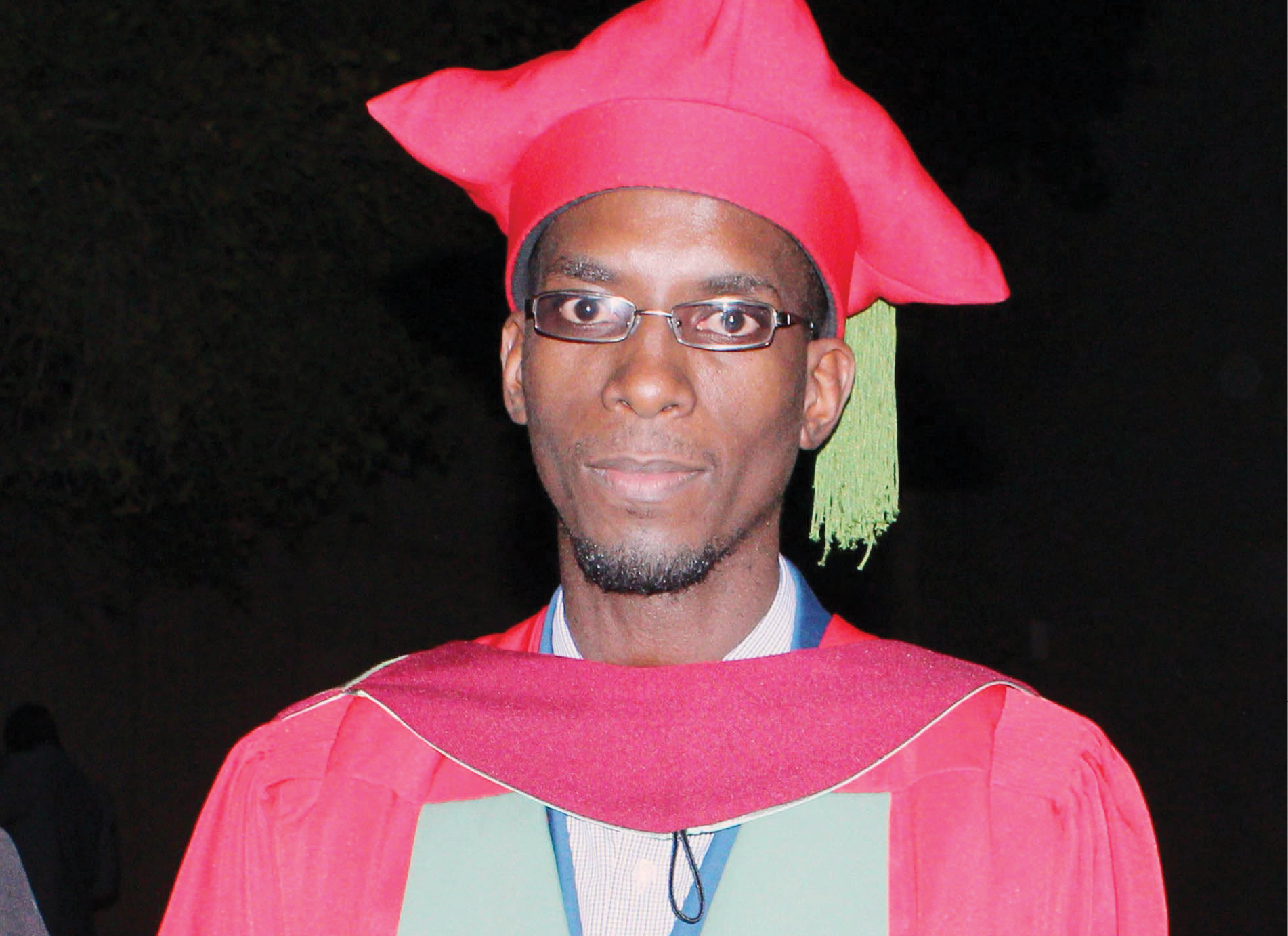
Last week, we were met with the devastating news of the passing of Dr Thabo Sacolo, the Executive Director of the Eswatini Economic Policy Analysis and Research Centre (ESEPARC).
His passing has been met with deep sadness, particularly among those who understood the value of his contribution to this country. At just 42, he was a distinguished scholar, economist, policy thinker and institutional leader whose work had earned him an important place in Eswatini’s national development journey.
Sacolo’s death is a profound loss, made more painful by the knowledge that he had so much more to contribute and that the country still had much to learn from his experience and leadership.
A REMARKABLE ACADEMIC JOURNEY
Some people contribute meaningfully to a nation away from public attention, in research rooms, policy discussions and technical engagements where decisions about the country’s future are examined and shaped. Dr Sacolo belonged to this category, providing research, evidence and professional guidance that informed important national conversations.
His academic journey was remarkable, not only for his qualifications, but also for the determination behind them. He held a bachelor of science degree in agricultural economics from the University of Eswatini, a Master of Science in agricultural economics, specialising in environmental economics and a PhD in environmental economics from the University of Pretoria, which he attained in 2018 at the age of 34.
For many young people in Eswatini, achieving a doctorate at 34 is an exceptional milestone. What makes his achievement even more remarkable is the discipline with which he pursued his education.
I remember a casual conversation in which Dr Sacolo told me that from the time he started school, he never stopped until he achieved his PhD.
He went from Grade I through secondary and high school, straight into university, then his master’s and finally his doctorate, without taking a break. That simple account spoke volumes about his focus and determination. His academic success was the product of years of consistency and an unwavering commitment to excellence.
His academic interests included behavioural economics, environmental policy, agricultural development, natural resource management and impact assessment. Before joining ESEPARC, he lectured at Tshwane University of Technology, teaching research methodology, introduction to economics, applied economics and international trade.
He also worked as a research assistant at the University of Pretoria, contributed to projects through the Centre for Environmental Economics and Policy in Africa and served as Assistant Programme Director for the African Economic Research Consortium’s Collaborative Masters Programme in Kenya.
FROM RESEARCHER TO LEADER
His journey at ESEPARC began in May 2017 as a Senior Research Fellow. In 2019, he became acting Executive Director before assuming the substantive position in 2020. His progression demonstrated the confidence placed in his professional ability and leadership.
This is an important part of Dr Sacolo’s story, particularly when conversations about youth participation in national development tend to focus on political representation, employment and entrepreneurship.
Young people must also be encouraged to occupy strategic spaces in research, academia, economic planning and public administration. Dr Sacolo demonstrated that knowledge, competence and dedication could take a young professional into positions of considerable national responsibility.
SHAPING NATIONAL POLICY
As executive director, he led an institution directly connected to the quality of public policy and the country’s ability to make informed development decisions. ESEPARC was established to strengthen national capacity in policy research and analysis, providing evidence to help government and other stakeholders understand the country’s challenges and identify solutions.
Under his leadership, the institution contributed to research and policy processes covering skills development, labour markets, vocational training, public service performance, agriculture, State-owned enterprises, digital readiness and human resource development. Its work on the national skills audit and the subsequent development of the National Human Resource Development Policy helped examine the relationship between skills produced by the education system and those required by the economy.
These are not merely technical matters for economists and policymakers. They affect whether young people graduate with skills employers need, whether businesses can find the talent required to grow and whether the country is preparing its workforce for a changing economy.
A NATIONAL RESPONSIBILITY
One significant assignment associated with ESEPARC during Dr Sacolo’s leadership was its role in developing the Kingdom of Eswatini’s Post-COVID-19 Economic Recovery Plan.
The institution served as the secretariat when the pandemic had disrupted businesses, threatened livelihoods, affected employment and placed considerable pressure on public finances.
Launched by then Prime Minister Ambrose Mandvulo Dlamini on August 14, 2020, the plan outlined an investment programme valued at approximately E30.12 billion, comprising 97 projects with the potential to create an estimated 40 126 jobs.
Of these, 84 were private-sector initiatives valued at approximately E23.07 billion, while 13 were government projects worth approximately E7.05 billion. ESEPARC provided technical and research support.
At the launch, Dr Sacolo spoke about creating employment, improving economic growth and ensuring that Emaswati, particularly vulnerable groups, could participate productively in the economy.
His remarks reflected an understanding that recovery should not be measured only through investment figures and economic projections, but also by whether ordinary people could improve their lives.
He was leading an institution involved in shaping the country’s recovery at a time of considerable economic uncertainty. It was a responsibility requiring an understanding of economic realities and the challenges of translating policy intentions into results.
THE VALUE OF RESEARCH
His professional life also reminds us that research should never remain confined to academic reports and conference presentations. It gives a country the evidence needed to understand its problems and the consequences of its choices.
ESEPARC’s published research, including studies on the economic cost of electricity interruptions and the effects of the 2015/16 El Niño-induced drought, examined challenges affecting households, businesses, public finances and the wider economy.
We should not pretend that one individual or institution can resolve every national challenge. However, we must recognise those who dedicate their professional lives to improving the quality of information, analysis and advice available to decision-makers. That was an important part of Dr Sacolo’s contribution.
A LOSS BEYOND MEASURE
There is something particularly painful about losing someone at a stage in life when so much of his experience was still finding expression.
At 42, he had completed an impressive academic journey, led an important national institution and participated in processes affecting the country’s economic direction. Yet he still had years of knowledge, experience and leadership to offer.
His family has lost someone whose place in their lives cannot be replaced. ESEPARC and the wider research and policy community have lost a colleague whose knowledge and leadership contributed to their work.
The country, too, has lost a professional who had earned the opportunity to contribute meaningfully to its future.
As we mourn Dr Sacolo, we should also consider the national environment that allows people with knowledge, ability and commitment to assume strategic responsibilities.
We need more opportunities for young professionals to lead institutions, influence policy, contribute to national planning and participate in decisions that shape our economy and society. Research and intellectual work must be valued as essential components of how we govern and prepare for the future.
A LEGACY THAT ENDURES
I find it difficult to write about Dr Sacolo without thinking about the work that still lay ahead of him, the conversations he would have continued contributing to and the young professionals who could have benefited from his experience.
His life reminds us that national contribution is not measured only by how long a person lives, but also by what they give during the time they have.
Eswatini has lost a good man, a capable economist, a respected scholar and a young leader whose contribution reached into some of the country’s most important areas of policy and development.
His passing is painful not only because he died young, but because there was still so much he could have offered.
May his family find strength and comfort in the difficult days ahead.
May his colleagues at ESEPARC and everyone who had the privilege of working with him find comfort in knowing that his work formed part of the country’s continuing effort to understand its challenges and build a better future.
Feedback & Correspondence:
Email: johnpires@live.com
Mobile: +268 7606 5993
WhatsApp: +268 7602 7758