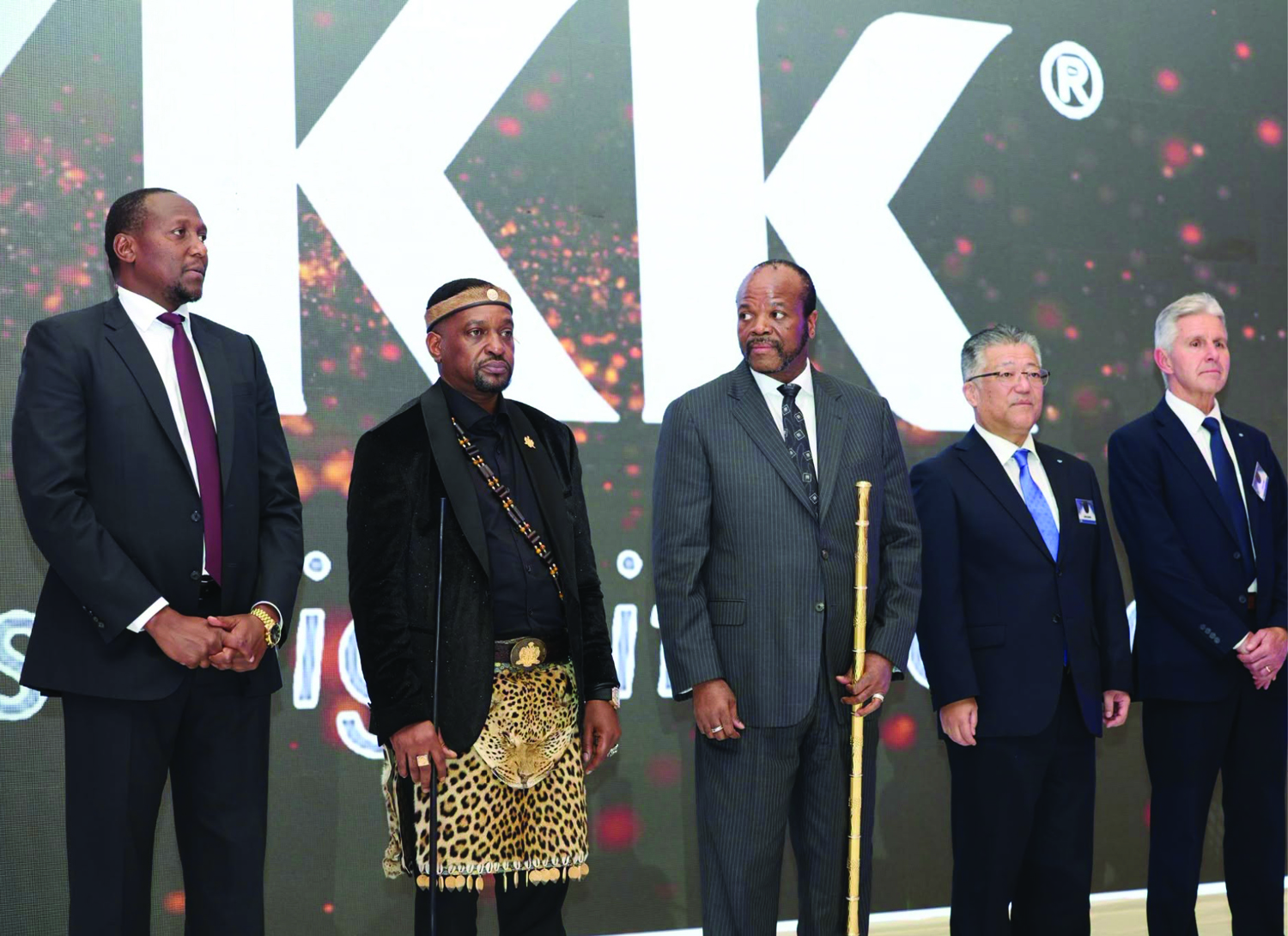
YKK Southern Africa’s 50 uninterrupted years of operations in Eswatini demonstrate that the country has a favourable investment climate capable of sustaining long-term foreign investment.
This was said by His Majesty King Mswati III during YKK Southern Africa’s golden jubilee celebration at Ezulwini Palazzo on Thursday night.
The king said the Japanese manufacturer’s continued presence in the country was evidence of the strength of the partnership between government and private enterprise. He said YKK’s longevity showed that international companies could thrive, export and build generational relationships in Eswatini. Therefore, he encouraged YKK’s leadership to share the company’s success story across corporate Japan, saying Japanese and other international enterprises should view Eswatini not merely as an investment destination, but as a strategic manufacturing base in Africa.
“We implore YKK to be our ambassador and share the good news about the kingdom,” the king said.
He also said the country had a good investment climate, supported by a tax regime and other incentives designed to attract foreign investors. The king identified agro-processing, pharmaceuticals, automotive components, renewable energy technology and advanced electronics as some of the sectors that could benefit from increased investment.
Since its establishment in Matsapha in 1976, YKK has invested about E290 million in the country, with the king noting that the investment had also created employment opportunities for citizens.
According to His Majesty, the company’s contribution extends beyond the manufacture of zippers and fastening systems, as the company has become an anchor of the country’s industrial ecosystem.
He further said the company had provided sustainable livelihoods and careers to generations of citizens while imparting specialised technical capabilities, industrial discipline and managerial expertise.
“The company also acts as a reliable cornerstone for our broader textile, apparel and design sectors, good enough to compete on quality anywhere in the world,” stated the king.
He also traced YKK’s relationship with the kingdom to 1976, when the company made the decision to establish its Matsapha operations at a time when the country’s industrial base was still developing. Back then the factory was officially commissioned in 1977 in the presence of YKK founder Tadao Yoshida and the late King Sobhuza II.
The king said the establishment of the factory demonstrated that durable economic transformation could be achieved through genuine partnerships between government and private enterprise.
He also recalled his personal association with YKK, saying he officially opened an expansion of the Matsapha facility on September 12, 1986, shortly after ascending to the throne. He described the occasion as memorable because it was his first official visit to an industrial company as king.
Fifteen years later, on May 30, 2001, the king said he and YKK representatives reconvened at Lozitha Palace to mark the company’s 25th anniversary in Eswatini. He said his official visits to YKK Corporation in Japan had also allowed him to witness the company’s technological sophistication, manufacturing discipline and global operational standards.
“Going forward, let us commit to deepening this partnership, expanding production lines, transferring higher technical skills, strengthening linkages with local suppliers and advancing the enduring friendship between our countries,” urged the king.
He also commended the local employees who dedicated their working lives to YKK and urged the company to continue bringing new technological capabilities and innovative ideas to the country.
‘Investments made in good faith will be protected’
Government has reaffirmed its commitment to creating and strengthening conditions that enable businesses to invest, expand, innovate and create lasting employment in the country.
Prime Minister Russell Mmiso Dlamini said government remained committed to ensuring that investments made in good faith in the kingdom were protected, nurtured and allowed to flourish.
He was speaking during YKK Southern Africa’s 50th celebration of uninterrupted operations, which he said provided evidence of the value of sustained investment partnerships.
Dlamini said the king’s presence in the company’s celebration of such a milestone stood as clear and abiding testimony to His Majesty’s commitment to an environment in which investment, once made in good faith within the kingdom, is protected, nurtured and permitted to flourish.
The prime minister said government would continue strengthening the conditions necessary for businesses to operate and grow.
“In that spirit, His Majesty’s government hereby reaffirms its undertaking to strengthen, without cessation, those conditions which enable enterprises to invest, expand, innovate and create meaningful and lasting employment for our people,” he said.
Dlamini reiterated that YKK’s 50 years of continuous industrial operations in Eswatini as an achievement of exceptional significance, particularly considering that the company established its Matsapha operations in 1976 when the country’s industrial foundations were still developing.
He recalled that the original YKK plant was formally opened in 1977 by the late King Sobhuza II and YKK founder Tadao Yoshida.
The premier said YKK had remained operational through changing economic conditions, shifts in global markets and developments in industrial practices.
He said the company had demonstrated that products manufactured in Eswatini could meet international standards and compete in regional and global markets.
Dlamini said YKK had also contributed to the livelihoods of thousands of Emaswati across generations while strengthening the country’s textile and apparel value chain.
He described the company as a trusted partner in local industrial development.
“For five decades, YKK has stood firm through the vicissitudes of economic fortune, the shifting currents of global markets and the evolution of industrial practice. Throughout, it has furnished incontrovertible proof that goods manufactured in Eswatini are capable of meeting and exceeding, the most exacting international standards, and competing with distinction in regional and global markets alike,” stated Dlamini.
He added that in this, the company had given practical effect to His Majesty’s standing invitation to investors to establish themselves in the country and to employ the kingdom as a gateway to an African market of more than 1.4 billion people.
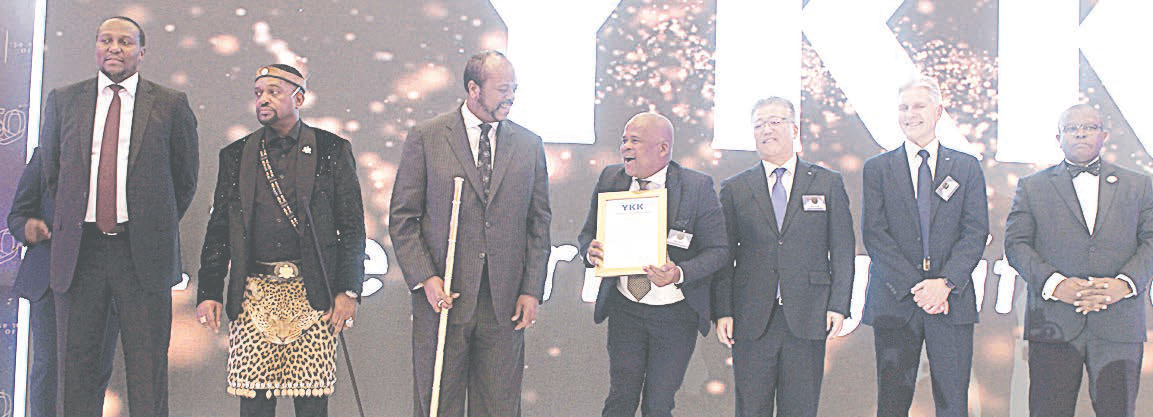
About 120 foreign-owned enterprises operating in Eswatini
Eswatini is home to between 80 and 120 major foreign-owned enterprises and multinational corporations, with foreign-backed industries employing more than 40 000 people.
Speaking during YKK Southern Africa’s golden jubilee celebration at Ezulwini Palazzo, His Majesty King Mswati III said the foreign-owned companies operated across manufacturing, agribusiness, commercial processing and logistics.
He said these enterprises had become an important source of livelihoods for thousands of households, particularly women and young people.
The king highlighted YKK Eswatini’s exports to South Africa, Lesotho, Kenya, Botswana and Namibia, with the company also extending its reach to Mauritius.
He said the expansion into overseas markets was encouraging as it demonstrated Eswatini’s ability to serve as a springboard into regional and continental markets.
“Eswatini is offering investors an unmatched springboard into the Southern African Customs Union (SACU), the SADC market and the African Continental Free Trade Area (AfCFTA),” he said.
Further, His Majesty said the manufacturing sector had remained a significant contributor to the country’s economy, accounting for between 29% and 31% of gross domestic product (GDP) over the past decade.
He said manufacturing helped insulate the economy, generated vital foreign exchange and remained the country’s largest source of formal private-sector employment. The sector had also contributed to attracting what he described as a dynamic community of international investors.
He said the company’s long-standing presence, investment and exports demonstrated the potential for foreign-owned enterprises to establish lasting operations while using Eswatini as a base to access markets beyond the country’s borders.