MBABANE businessman Zweli Welile Dlamini has admitted possessing a hand grenade, a pistol and ammunition allegedly found at his Matsapha residence but denies that he intended to use the weapons to disrupt the Incwala Ceremony or overthrow government.
Dlamini made the distinction when he appeared before the High Court, where he pleaded not guilty to terrorism and explosives charges but admitted to three separate charges relating to the unlawful possession of a firearm, ammunition and firearm magazines.
His defence maintains that although he does not dispute that the explosive device was found in his possession, he rejects the Crown’s allegation that he possessed it with the intention of causing harm, disorder or public disruption. The charges arise from an incident on December 22, 2025, at the Matsapha State Warehouse staff houses, where police allegedly recovered an M26 hand grenade, a Glock 19 pistol and various rounds of ammunition.
According to the amended indictment, the Crown alleges that Dlamini, acting individually or jointly with other people unknown to the prosecution, possessed the weapons as a member of a terrorist group. The Crown further alleges that the weapons were intended to cause death or bodily harm, damage property, endanger public health and welfare and put people’s lives at risk.
It claims that the alleged acts were politically or ideologically motivated and calculated to compel government to abandon its mandate or overthrow it through force or violence.
However, Dlamini disputes the alleged motive, with his lawyer Sibusiso Nhlabatsi telling the court that the accused was not admitting that the grenade was intended to hurt anyone.
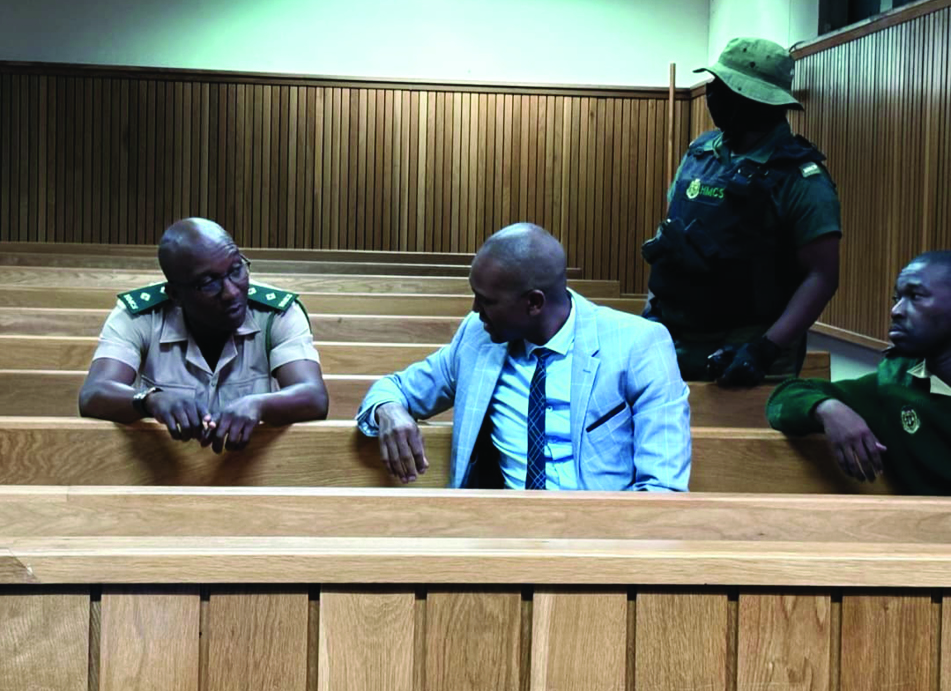
During the proceedings, Advocate Jacob Tloubatla assisted by Crown council Mandla Dlamini, represented the Crown, while Nhlabatsi appeared for the accused. When the amended indictment was read, Dlamini pleaded not guilty to the first count under the Suppression of Terrorism Act of 2008. He also pleaded not guilty to the second count under Section 9 of the Explosives Act of 1961, which relates to possessing an explosive device with the intention of injuring a person or damaging property.
However, he pleaded guilty to count three, involving possession of a Glock 19 pistol bearing serial number BWND829 without a valid licence or permit. He also admitted to count four, relating to possession of 68 rounds of 9mm ammunition, 20 rounds of 5.56mm ammunition and 26 rounds of .38 Special revolver ammunition without the required licence. On count five, he pleaded guilty to possessing a Glock 19 pistol magazine and an R4 magazine without a valid permit or licence.
Judge Sabelo Masuku found him guilty on counts three, four and five after he made admissions in terms of Section 272 of the Criminal Procedure and Evidence Act (CPE). The judge said the court was satisfied that Dlamini had filed a statement of admission before finding him guilty as charged on the three counts.
Nhlabatsi maintained that Dlamini was not disputing that the grenade had been found in his possession but was challenging the allegation that he intended to use it to cause harm or danger. Mandla Dlamini, representing the Crown, indicated that the accused’s partial agreement with the allegations amounted to a plea of not guilty.
Tloubatla argued that the not-guilty pleas meant Dlamini was disputing the elements of the second charge, particularly the alleged intention behind possessing the explosive device.
The proceedings experienced three adjournments because of administrative issues.
I got an anonymous tip – Cop
THE Crown’s first witness was Superintendent Derrick Makhanya, who testified that on December 28, 2025 at approximately 11.30am, he received a telephone call from an anonymous person who wanted to provide information about someone allegedly possessing firearms in Matsapha.
He said the caller refused to disclose their identity but identified the suspect as Zweli Dlamini, who allegedly drove a silver-grey Ford Ranger.
According to Makhanya, the caller informed him that Dlamini was staying at the ERS houses in Matsapha, next to His Majesty’s Correctional Services facilities and was allegedly in possession of firearms and ammunition.
The caller allegedly claimed that the weapons were intended to disrupt the Incwala Ceremony and would be used by Dlamini and other members of PUDEMO.
“The firearms and ammunition were used to disrupt Incwala by himself and the accused and other members of the PUDEMO,” Makhanya told the court while recounting the information received.
After receiving the information, Makhanya said he reported the matter to Senior Superintendent Thabo Hlophe.
Given the sensitivity of the allegations and the fact that Incwala had already started, they assembled a team of approximately seven investigators to follow up on the information.
He said the team proceeded to the ERS houses in Matsapha, where they identified the silver-grey Ford Ranger believed to belong to Dlamini.
The officers waited for approximately 15 minutes before Dlamini emerged from his room and walked towards the vehicle.
“We went to him and introduced ourselves as police from the Manzini Criminal Investigation Unit,” Makhanya said.
According to the witness, Dlamini appeared puzzled but agreed to accompany the officers to the Manzini Regional Police Headquarters for further discussions.
At the headquarters, Makhanya said he explained Dlamini’s rights, including the right to instruct an attorney and remain silent and warned him that anything he said could be used as evidence against him in court.
Makhanya testified that Dlamini was cooperative during the interaction and that the information he provided led investigators to proceed with further police procedures at Matsapha Police Station.
Makhanya testified that he subsequently received a telephone call from a colleagues informing him that a hand grenade and ammunition had been found at Dlamini’s residence.
He said he was particularly concerned about the grenade because of the danger it posed. “I instructed them to be very careful when handling it since it was very dangerous,” he said, adding that he then contacted the Ngonini Bomb Disposal Unit to arrange for the explosive device to be safely removed.
He said Dlamini failed to produce licences for the other items, including the 26 rounds of .38 Special ammunition, the R4 magazine, the additional pistol magazine and the 68 rounds of ammunition for the pistol.
Makhanya said the exhibits were handed over by Constable Machawe Dlamini, while the grenade was taken by the Ngonini Bomb Disposal Unit to its base for safekeeping.
During cross-examination, Nhlabatsi questioned the basis of Makhanya’s evidence, arguing that the witness had not personally been inside Dlamini’s residence when the items were allegedly discovered.
During the compiling of this report the matter was still pending before court.