


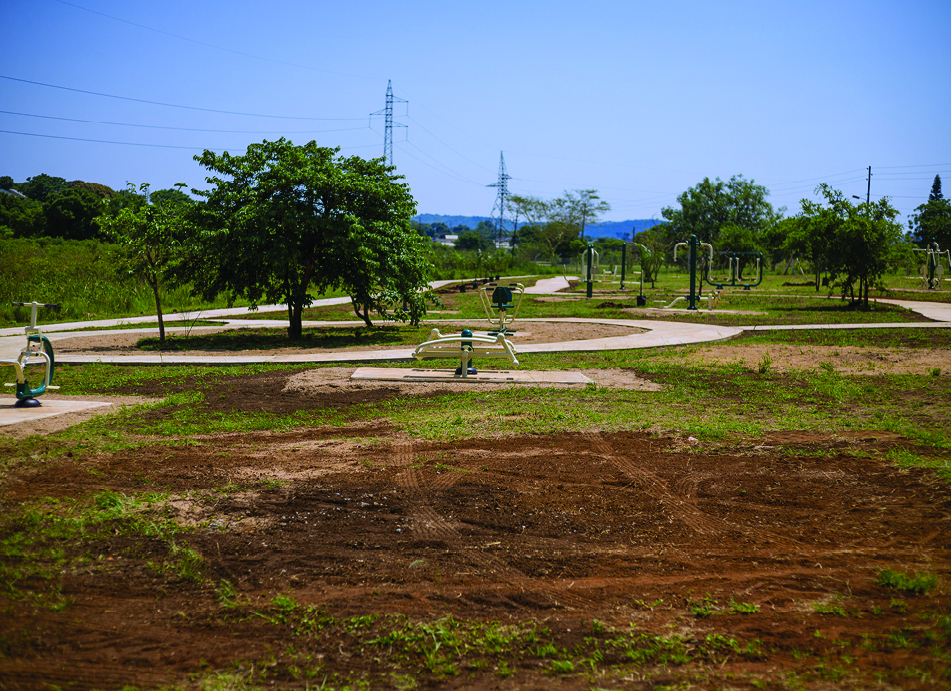
“Urban areas must be more than centres of economic activity. They must also be places where people can live, work, relax, exercise, and connect with nature.”
These sentiments were shared by Minister of Housing and Urban Development, Appolo Maphalala, yesterday when he officially opened the Matsapha Silent Eco Park, a project spearheaded by the Matsapha Town Council.
Delivering his remarks through the ministry’s Principal Secretary (PS), Dr Simon Zwane, Maphalala described the launch of the eco park as a landmark development that ushers in a new chapter in the country’s quest for sustainable urban development, environmental conservation and an improved quality of life for communities.
“Today, we are not merely inaugurating a park; we are investing in the future of our cities, our communities, and our environment. As the ministry of housing and urban development, we recognise that urban areas must be more than centres of economic activity. They must also be places where people can live, work, relax, exercise, and connect with nature,” the minister said.
He noted that well-planned public spaces were essential in creating inclusive, resilient and sustainable human settlements.
According to Maphalala, the Matsapha Silent Eco Park embodies these principles by providing residents, workers, students and visitors with a peaceful environment for recreation, relaxation and wellness.
He emphasised that as urbanisation continues to gather pace, access to green public spaces should no longer be viewed as a luxury, but as a necessity, considering their contribution to physical health, mental wellbeing, social cohesion, biodiversity conservation and environmental sustainability.
The minister, however, pointed out that the newly-opened facility represents only the first phase of a much bigger environmental restoration and urban development programme planned for Matsapha.
He explained that phase one focuses on protecting and restoring one of the most important wetland ecosystems within the Matsapha industrial area.
The wetland, he said, was a valuable environmental asset that plays a significant role in natural water filtration, supporting biodiversity, strengthening climate resilience and mitigating the effects of flooding.
Maphalala revealed that phase two of the project would focus on developing a dedicated bicycle lane, a seven-kilometre running track, a children’s park and additional sporting and recreational facilities for young people. He said the planned amenities would create opportunities for youth development, healthy lifestyles, talent development and community engagement, while ensuring that young people have access to quality recreational infrastructure within their own community.
Meanwhile, phases three and four will extend wetland protection and rehabilitation efforts towards the Lusushwana River, with the ambitious project targeting the preservation of more than 95 hectares of wetland habitat.
‘Park will be centre of environmental conservation’
THE newly-established Matsapha Silent Eco Park is expected to become more than just a recreational facility, with plans to transform it into a centre for environmental conservation, biodiversity research, education and tourism.
This was revealed by Matsapha Town Council Chief Executive Officer (CEO) Sizwe Dlamini, who said the initiative was designed to conserve and restore natural ecosystems, strengthen biodiversity and promote health and wellness among residents and visitors.
Dlamini said as a town renowned for its strong industrial identity, Matsapha had a responsibility to demonstrate that economic investment, environmental protection and human wellbeing could coexist. He noted that the quality of a town should not only be measured by its industrial and economic achievements, but also by the health of its ecosystems, the accessibility of its public spaces and the experiences it offered residents and visitors.
He explained that the eco park was established to provide a natural environment, where people could unwind, exercise and reconnect with nature, away from the pressures of everyday life. According to Dlamini, the facility’s walking trails and wellness gym would provide opportunities for physical activity while encouraging healthier lifestyles within the community.
He said the council envisioned the park as a welcoming space where residents could take leisurely walks, improve their fitness, spend quality time with their families and enjoy moments of tranquillity.
Dlamini emphasised that creating a healthier community required providing recreational facilities that were accessible, safe, clean and responsive to the needs of different users.
Beyond recreation and wellness, the CEO said the eco-park would also serve as an important resource for academic research, environmental education and the preservation of knowledge about different plant and animal species. He explained that the facility presented opportunities for herbarium and entomological collections, allowing different flora and fauna species to be documented and preserved for the benefit of future generations.
Through guided tours, conservation activities and partnerships with educational institutions, Dlamini said the park could be transformed into a living classroom where visitors, particularly learners, could gain practical knowledge about environmental conservation.
| Focus | Role described by the CEO | Status in the report |
|---|---|---|
| Conservation | Conserve and restore natural ecosystems and strengthen biodiversity. |
Stated objectives; no measured results are supplied. |
| Recreation and wellness | Walking, exercise, family time and relaxation, with reference to walking trails and a wellness gym. |
Amenities are mentioned; operational and visitor access details are not supplied. |
| Research and documentation | Academic research and opportunities for herbarium and entomological collections. |
Envisaged opportunities; no established collections or active research projects are identified. |
| Environmental education | A living classroom supported by guided tours, conservation activities and educational partnerships. |
Proposed approach; no partners or programme schedules are named. |