


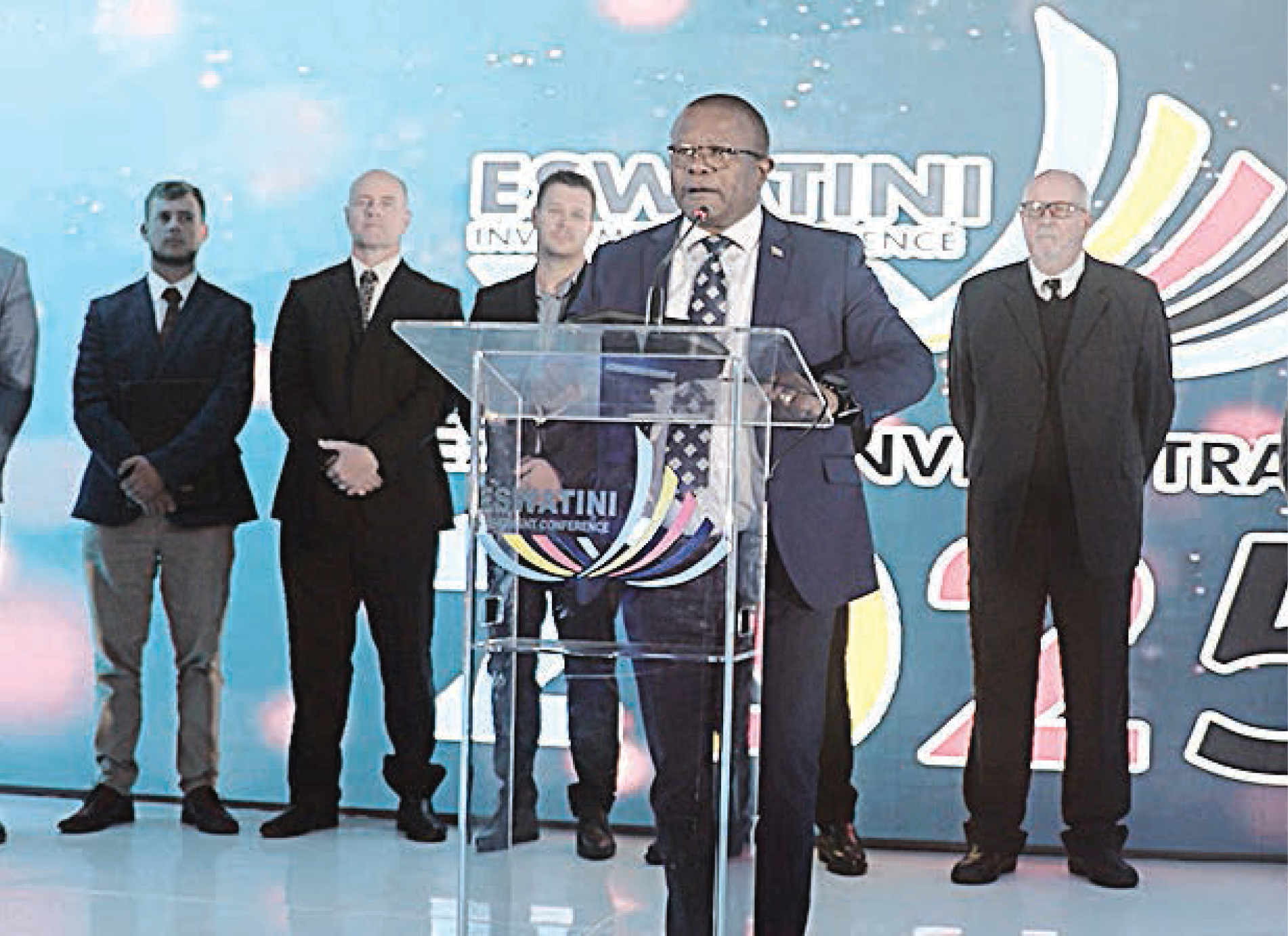
The recent Eswatini Investment Conference hailed by politicians as a success, might have looked impressive on paper, especially with its loudly proclaimed E37 billion in pledges, but honestly, when you look past the polished speeches and exaggerated optimism, it’s hard to ignore what a haphazard, underwhelming and poorly executed event this truly was.
It’s truly become a disturbing norm in this country to equate half-done work with achievement and to label anyone who dares speak the truth as being obstructive or negative.
Some of us remain committed to the principle of holding public institutions and officials to account, even when doing so comes at personal cost, so EIPA together with its parent ministry, must answer for what was, by all indications, a hastily arranged and poorly conceived affair.
Perhaps the only credit due to EIPA and the ministry of commerce, industry and trade is that they had the good sense, or at least the shame, not to trouble His Majesty King Mswati III with an appearance at what I can only describe as a farcical investment conference.
Let us begin with the planning, which, of course, involved a consultant (wink wink), which is in itself quite telling.
From the outset, the entire affair resembled little more than a box-ticking exercise, rather than a carefully considered platform for sustainable economic engagement.
For a country of our size and economic limitations, one would assume such a large-scale event would have been aligned with existing efforts like the International Trade Fair.
EIPA is responsible for the Trade Fair, so why not use that platform to create a stronger and more connected conference? It’s this lack of integration and strategic thinking that makes the entire conference appear more performative than transformative.
But no, instead, EIPA chose to stage it as a standalone event, separate from the very ecosystem that could have ensured continuity, feasibility and genuine investor engagement.
The decision to exclude organised labour from the forum is not just shocking, it’s reckless.
How do you talk about jobs and industrial growth without involving workers?
And how do you talk about attracting new investors while ignoring the grievances of current ones, some of whom are in court over disputes with EIPA itself?
It’s also deeply concerning that, apart from a few recurring names like Ubombo Sugar and African Alliance, there was very little space given to local businesses or MSMEs, the very backbone of our economy.
There was a glaring absence of interactive platforms or panels where already existing investors across various sectors could share their challenges and contributions.
Nor was there space for the businesses His Majesty the King has launched or visited in recent years to speak on their experiences or progress.
In fact, the conference ignored these entirely, despite them being critical indicators of how investment is actually playing out on the ground.
Coming to the E37 billion investment pledges announced with much enthusiasm.
BakaNgwane, let’s be honest, what this country needs is not the inflation of numbers to score political points, but a sober reflection and transparency.
Are we seriously suggesting that this country will in the current year have a windfall of investments that should fully tackle unemployment? Mbamba?
This is insensitive to us as young people because year after year, similar pledges are made at glitzy events, yet joblessness rises and we continue to aspire to leave our country of birth for good in search of opportunities elsewhere.
Let’s also not forget that the conference came just days before Prime Minister Russell Dlamini publicly admitted that some members of his Cabinet were working against him.
This bombshell, an indictment of Cabinet cohesion, should have triggered alarm bells in my books, but surprise, surprise, not a single peep from any Cabinet member. Not even the minister of ICT, when the head of government business says he’s been hacked!
Not the national commissioner of police. Not Parliament except for Isaac Magagula, yet one of our major selling points to potential investors at the conference was political stability?
So, which is it? Are we a politically stable country, or do we have a dangerously fractured Cabinet with ministers plotting and undermining the very man at the helm of government?
You can’t have it both ways.
Anyways, before I digress, my main point here is that until EIPA is evaluated not by how many air tickets it books, but by measurable outcomes, jobs created, investments materialised and support given to local entrepreneurs, these investment forums will remain expensive PR stunts.
Likewise, the ministry of commerce must account for public funds spent on initiatives like factory shells, by clearly linking investment inputs with tangible economic results.
Otherwise, all we’re doing is feeding globe-trotting officials in allowances while the rest of the country is left waiting for investments that may never come.
It’s time to stop the charade. If Eswatini is truly open for business, then it must also be open to criticism, correction and above all, honesty.
AUDITOR-GENERAL’S OFFICE HAS BECOME LAW UNTO ITSELF
I was not among those who clutched their pearls when Prime Minister Russell Dlamini questioned the competence of the auditor-general’s office during his meeting with editors.
While I might quibble with his delivery, the substance of his criticism struck me as both familiar and overdue.
What followed in the media is a story for another day, but the real issue remains, an office created to expose waste and fraud should never be dogged by even a whiff of controversy, least of all allegations of cosy dealings with suppliers or an uncomfortable familiarity with the Public Accounts Committee (PAC).
Instead of pausing to weigh the PM’s words, many rushed to defend the AG’s ‘independence’, as though autonomy were a magic shield against all inquiry.
All of a sudden, very few acknowledged that complaints about the AG’s office had reached Cabinet long before the PM’s remarks as his own staff formally wrote to Cabinet levelling damning accusations. To me, nothing proves the PM’s point more than the Funduzi Forensic Services mess. Appointed to probe the catastrophic drug shortages, the controversial firm signed a contract worth E2.8 million that has since swollen to nearly E4 million over the past two years, yet the final report is still unknown to the public.
This by the way, is the same company that blamed ‘unexpected delays’ by the Royal Eswatini Police Service for failing to secure the mandatory police-clearance certificate when tendering.
Logically, that should have been warning enough, but the red flags kept waving. Financial records later revealed that the company transferred E2.8 million to Clariscent Consulting Services’s sole Director, Delisa Malinga, who at the time was an employee at Standard Bank Eswatini.
Malinga later resigned from the bank after disciplinary proceedings began and the Anti-Corruption Commission opened an investigation that is still unresolved, which of course, is far from being surprising as well.
Even the abridged report Funduzi eventually submitted to Parliament could not withstand daylight.
It claimed the World Health Organisation donated E9 million worth of Remdesivir that had then been fraudulently invoiced, but WHO publicly denied ever making such a donation.
Now if auditors can misstate a gift of that size, what else have they misunderstood? Most worrying of all is the conflicting noise from Cabinet.
In an interview with this newspaper, the PM called the report ‘not helpful’ and warned of a calculated bid to capture the health sector.
Barely a month later, the minister of health reports to Parliament after being questions about the ongoing crisis, that the problem is that the Funduzi report has still not been tabled, directly contradicting what the premier said. What is even more confusing is that when the shortage of life-saving drugs has grown worse and Funduzi’s invoice continued to fatten.
The Funduzi affair, which I could write an Oscar-winning movie script on at this point, is not an isolated blemish. Over the past three years, the AG’s office has awarded tenders to forensic audit companies nobody has ever heard of.
Aside from the health one, the forensic audits were into the Small Enterprises Development Company (SEDCO), the Pretoria Embassy renovation and more.
Now, all of these so-called forensic audits came at a public cost of roughly E8 million, but about three years later, none has yielded a final, publicly available report or even led to arrests or completed disciplinary hearings.
Instead, taxpayers have gone on to fund ‘fact-finding’ trips by the Public Accounts Committee (except of course that Mumbai one), per diems and contract extensions that drift on without end.
As if that wasn’t enough, the same Funduzi, that has attracted the most controversy than any other forensic audit company in this country, was later shortlisted by the very office of the auditor general, to bid for a high-profile audit of the Royal Science and Technology Park (RSTP).
The company lost this time around, but the mere invitation, especially through the limited procuring tendering method, is alarming.
This is why parliamentarians calling for a forensic audit of the Eswatini Posts and Telecommunications Corporation (EPTC) is a trigger at this point honestly, because while it should, in theory, please anyone who values oversight, recent history suggests that forensic audits have become a profitable industry in their own right, a quick route to skelems making a quick buck.
At this point, what is clear is that we might require a forensic audit of the forensic audits themselves, or of the office that commissions them.
I mean yes, the AG’s office should have autonomy, but that honestly can’t be the get-out-of-jail-free card whenever accountability is demanded (pun unintended).