



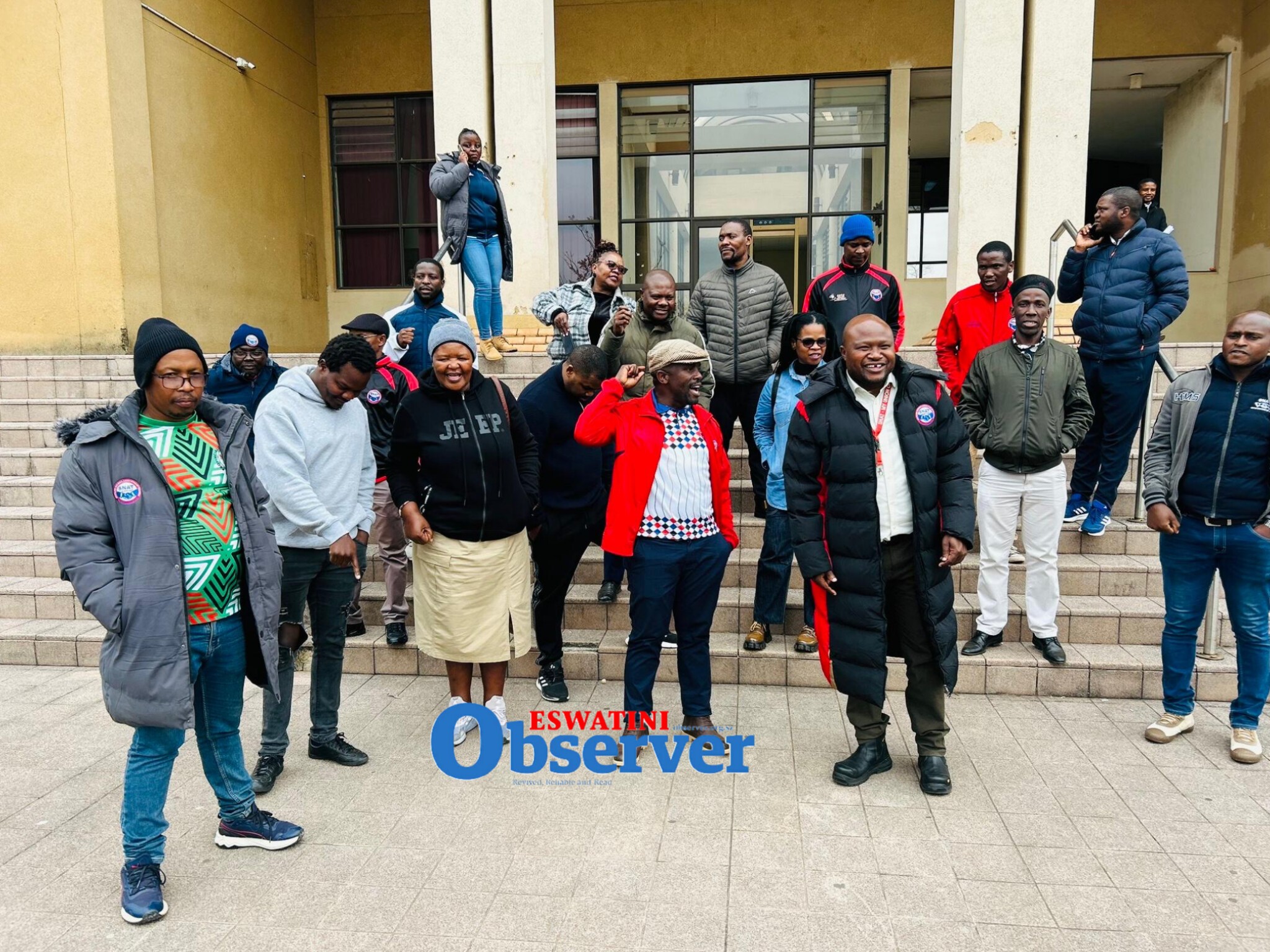
The High Court has found the chairman of the Teaching Service Commission (TSC) in contempt of court for failing to reinstate Mbongwa Dlamini to his post at Moyeni High School, despite a standing order from the Industrial Court that invalidated Dlamini’s dismissal.
In a judgment handed down by Judge Zonke Magagula, the court gave the TSC chair seven days to purge the contempt or face possible imprisonment.
The contempt proceedings followed a long legal battle that began when Dlamini, a teacher and unionist, was dismissed in August 2023 without a hearing. The Industrial Court later ruled the dismissal null and void and ordered the TSC to restart disciplinary proceedings.
That decision was upheld by the High Court in a failed review application brought by the TSC.
Following the review judgment, Dlamini reported for duty at Moyeni High School, but was refused entry and barred from signing the attendance register by the school headteacher, who said there was no formal instruction allowing Dlamini to resume his duties.
Dlamini then launched a contempt application against the TSC Chair (first respondent), the TSC (second), the Moyeni headteacher (third), the Ministry of Education (fourth) and others, arguing they had deliberately defied a valid court order.
In his ruling, Judge Magagula rejected arguments by the respondents that the Industrial Court’s judgment did not amount to a reinstatement. He found that the TSC had been fully aware of the judgment, attended its delivery and had even conceded in court papers that the dismissal was legally null.
“It should be apparent that once a dismissal is declared to be of no force or effect, then the status quo ante should obtain,” the judge wrote, dismissing claims of ambiguity as a red herring.
The court clarified that although the Industrial Court had ordered disciplinary proceedings to start afresh, the legal effect of its ruling was that Dlamini was never lawfully dismissed and therefore remained employed.
Judge Magagula ruled that only the TSC chair, in his official capacity, could be held responsible for the noncompliance, noting that the TSC as a body lacks legal persona and that other cited officials, including the school headteacher and Ministry of Education, had no direct role in implementing the court order.
The court ordered the TSC chair to purge his contempt within seven days, failing which he must appear before the court to show cause why he should not be imprisoned for 30 days, renewable if the contempt continues. He was also ordered to pay the costs of the application.
The High Court also dismissed the Teaching Service Commission’s (TSC) application for leave to appeal in the long-running employment dispute involving Dlamini, ruling that the case does not raise a substantial question of law nor does it fall within the public interest.
The TSC had sought leave to challenge a High Court judgment which upheld an earlier Industrial Court ruling that declared Dlamini’s dismissal invalid and ordered a fresh disciplinary hearing.
The dismissal, based on prolonged absence and statements allegedly contradicting the Ministry of Education, had been imposed after a disciplinary hearing proceeded in Dlamini’s absence, despite a request for postponement due to his attorney’s bereavement.
The Industrial Court found this decision procedurally unfair, declaring the guilty verdict null and void. Judge Magagula later dismissed the TSC’s application to review the Industrial Court ruling. Now, in the latest decision, he has refused to grant leave to appeal that outcome.
In assessing the application, Judge Magagula emphasised that to qualify for appeal, the case must raise “a legal issue that is contentious, one not previously determined or settled and must have a bearing on the case at hand.”
He found that none of the legal questions raised by the TSC were novel or unsettled.
“The applicants have not satisfied this court that there is a substantial question of law,” he wrote, adding that the applicable legal principles had already been clearly addressed in existing Eswatini and comparative jurisprudence.
Further, Judge Magagula dismissed the argument that the case was in the public interest, simply because Dlamini is the president of the Swaziland National Association of Teachers (SNAT). He drew a distinction between personal employment disputes and matters of true public interest, such as national elections or constitutional challenges which might warrant a Supreme Court review.
On procedural grounds, the judge also found no basis to challenge the application of Rule 14 of the Industrial Court Rules, which the TSC had questioned. He affirmed the Industrial Court’s discretion to dispense with formal processes where the matter involves purely legal issues.
Judge Magagula found that there is nothing uncertain, debatable or novel in the application that would justify Supreme Court consideration and ordered the TSC to pay costs.
Eswatini Observer Press Reader | View