



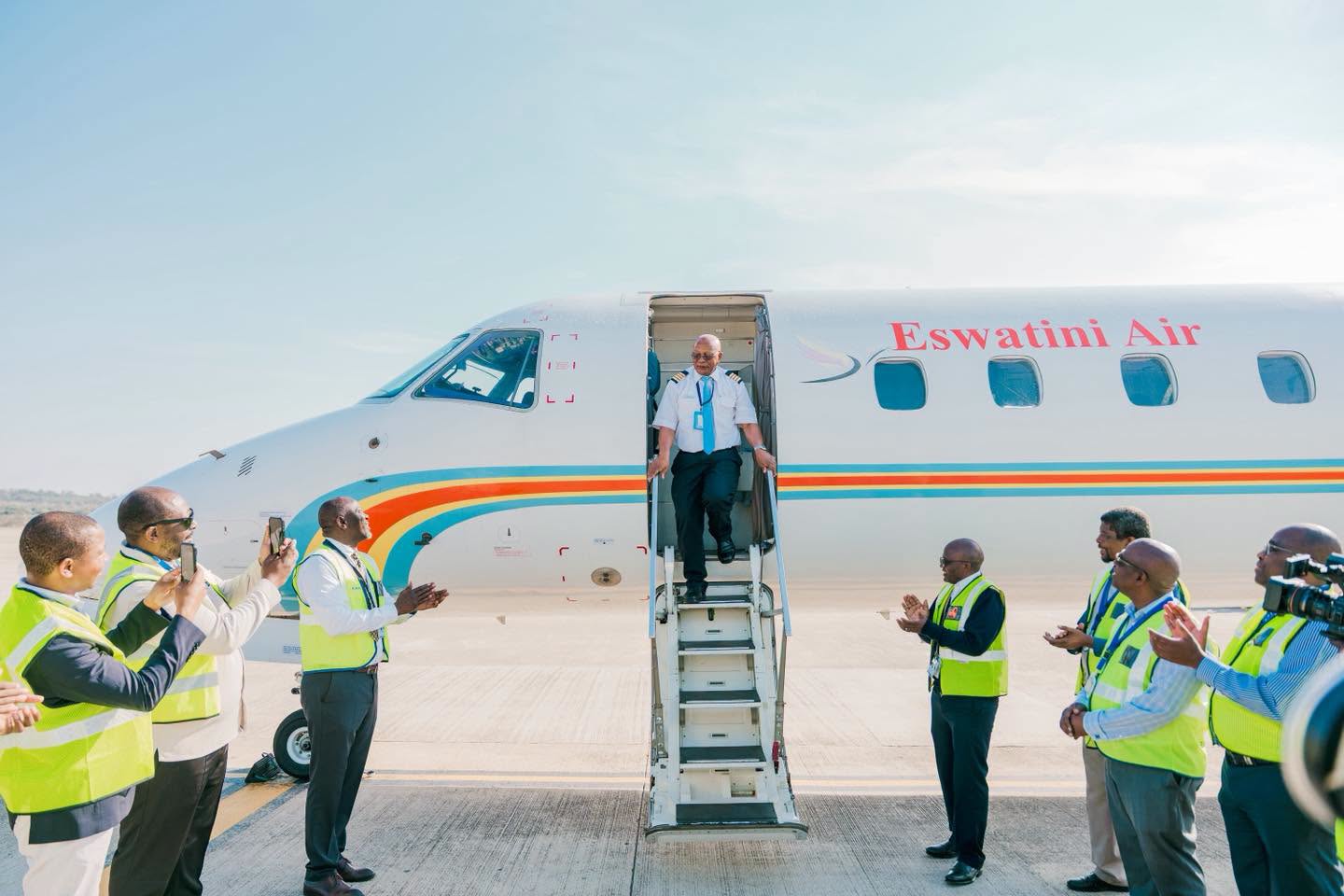
After more than four decades of a life lived between the cockpit and the clouds, Captain Robert Dlamini finally took his last landing yesterday, bringing an illustrious aviation career spanning 20 600 flying hours to a poignant close.
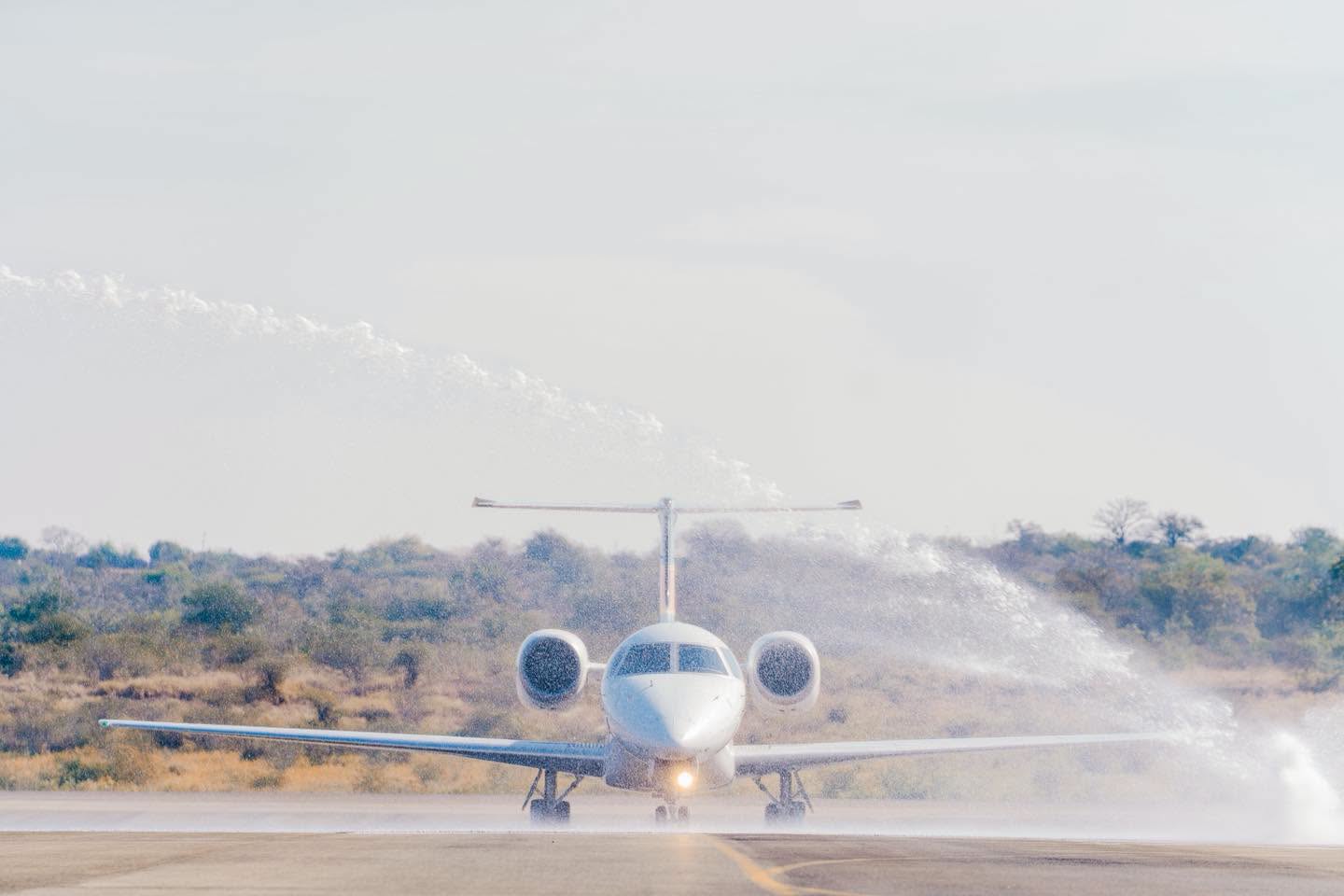
The veteran pilot, who retires as Eswatini Air’s Director of Operations, was given a fitting farewell at King Mswati III International Airport yesterday, where his final flight was met with a ceremonial water salute, marking the end of an extraordinary journey that began in 1986.
For Captain Dlamini, aviation was more than a profession. It was the one constant that had defined much of his adult life. Reflecting on his retirement, the veteran aviator said flying had been the one thing he knew better than anything else for the past 35 years, making the end of his career an understandably emotional moment.
He acknowledged that the journey had not always been smooth, saying there had been ‘thunderstorms’ and unfortunate situations along the way, but he had learnt to accept life as it came and persevere with courage.
“It is an emotional thing,” he said, as he expressed his gratitude to the Eswatini Air Board and management for giving him the opportunity to serve.
Behind the remarkable 20 600 hours in the skies lies a career built on discipline, resilience and an unwavering commitment to staying flight-ready.
Captain Dlamini revealed that every six months, pilots were required to undergo rigorous testing, with the stakes of failure potentially threatening everything they had worked for. He said the repeated examinations had been a demanding but necessary part of his career, requiring courage and determination to continually prove himself worthy of remaining in command of an aircraft.
Yet, for him, perhaps the most meaningful measure of his career is not only the number of hours logged in the sky, but the people he has helped prepare to take his place.
For Eswatini Air Board Chairperson Dr Wiseman Mdumiseni Dlamini, the veteran captain’s career was a testament to courage and dedication, forged through some of aviation’s most demanding moments.
He recalled an incident in 1993 involving the then Royal Swazi Airways, when the airline was subjected to a hijacking. Captain Dlamini, he said, was among those caught up in the traumatic incident, a moment that demanded extraordinary calmness, focus and bravery.
The board chairperson said Captain Dlamini’s courage during the incident had even earned him recognition from His Majesty King Mswati III, who had acknowledged his bravery and the character he displayed under immense pressure.
In 2022, he returned to Eswatini and joined Eswatini Air as a captain, later taking on the responsibilities of chief pilot before becoming Director of Operations.
CAPTAIN ONCE FLEW UNDER GUN ATTACK
For Captain Robert Dlamini, the most emotional moment of his career came at 35 000 feet, with a gunman on board, a wounded captain in the cockpit and his ability to speak Portuguese suddenly making him the only link between the hijacker and those in command.
It was a moment that demanded absolute calm.
As the hijacker communicated in Portuguese, Captain Dlamini found himself carrying the weight of the terrifying situation on his shoulders, relaying the man’s instructions to a captain who could not understand the language.
The danger was heightened by the fact that the hijacker was firing inside the aircraft at 35 000 feet, where even a small breach could compromise the aircraft’s pressurisation and put everyone on board at risk.
Captain Dlamini recalled that the captain, who had been shot in the leg, could only rely on subtle movements of his head or eyes to indicate whether he agreed with how the situation was being handled.
The hijacker was also injured, having been shot in the head, but both men survived the ordeal.
For Captain Dlamini, it remains the most emotional incident of an illustrious career that began in 1986 and would eventually see him accumulate 20 600 hours in the skies.
The irony, he reflected, was that a skill he had acquired during his time in Mozambique would unexpectedly become critical in one of the most dangerous moments of his aviation career.
Having been sent to Mozambique by the then Royal Swazi Airways, where he flew the DC-3, Captain Dlamini had picked up enough Portuguese to communicate. When the hijacking unfolded, that ability suddenly became indispensable.