
NOTCHING is a right, therefore it cannot be negotiated, says Swaziland National Association of Teachers (SNAT) President Mbongwa Dlamini.
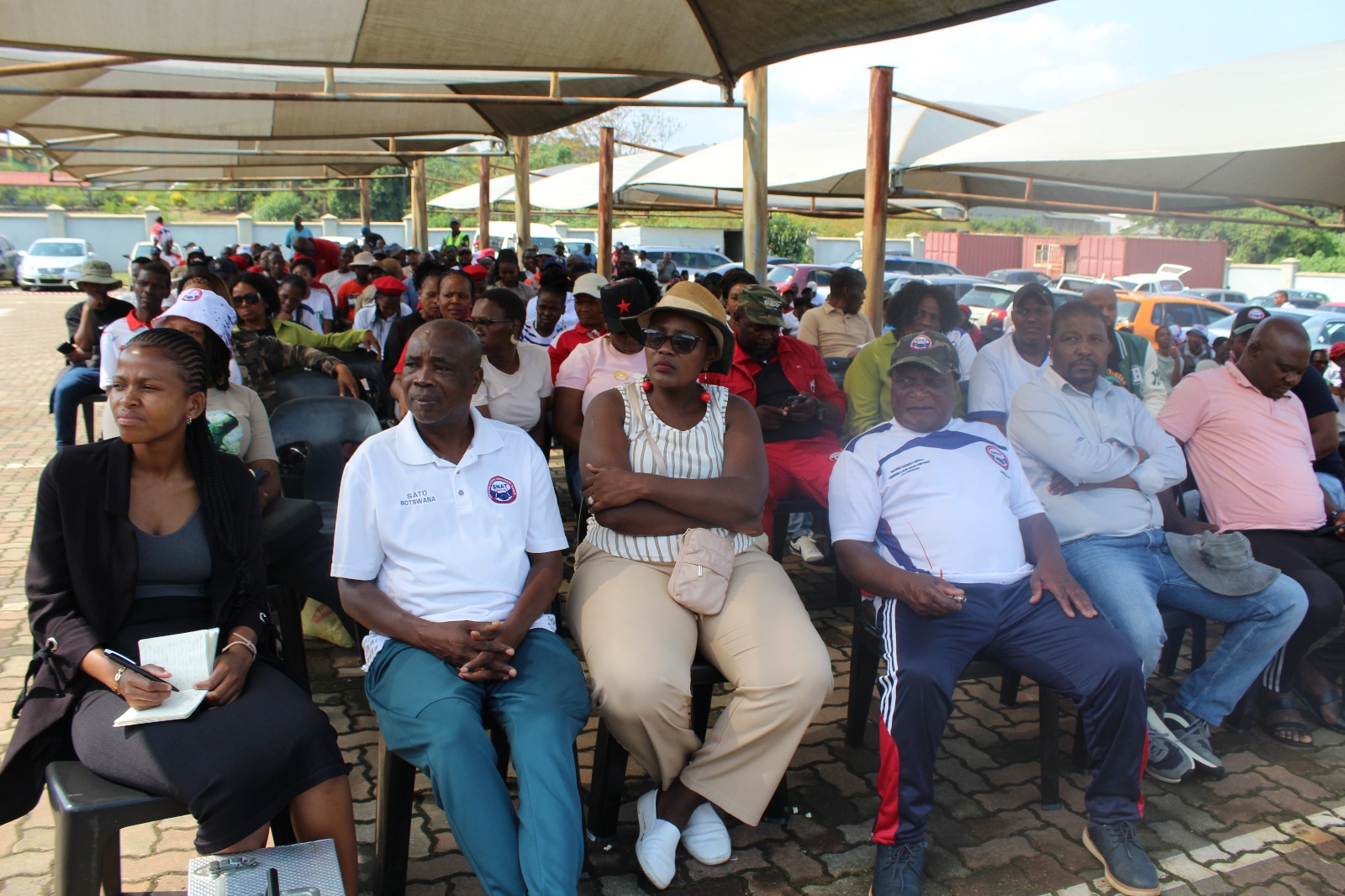
Dlamini made these remarks yesterday when addressing civil servants during the mass meeting convened by public sector unions (PSUs) at the SNAT Centre in Manzini.
The gathering aimed to determine a collective response after reports alleging that the increment would be withheld pending the completion of an ongoing salary review process.
Dlamini began by reflecting on the recent reinstatement of 22 civil servants who had been suspended for nearly five years, describing the development as a turning point that had restored confidence in the country’s justice system.
He said the outcome had rekindled hope among workers that government would ultimately fulfil its obligations and pay what is due.
“Notching is not a favour; it is a right clearly provided for in Government’s General Orders,” he said.
Dlamini further alleged that civil servants often bear the brunt of government cost-cutting measures, claiming that whenever expenditure has to be reduced, it turns first to the wages and benefits of public workers.
Against this backdrop, he called for unity among civil servants, encouraging them to present a collective front in demanding the implementation of their salary increment.
READ MORE | Family shocked as relative’s corpse buried in SA
Meanwhile, SNAT Secretary General Lot Vilakati warned that the current standoff could signal deeper implications.
He suggested that government’s alleged refusal to implement notching this year may be a test of workers’ tolerance ahead of the pending payment of the remaining 85% of the salary review.
“If you do not receive your notching this month, you might as well forget about the salary review expected in July,” Vilakati cautioned.
He recalled that last year, civil servants had made significant compromises when government implemented only 15% of the salary review. At the time, he said, workers were urged to exercise patience, with assurances that notching would follow within six months.
Vilakati described it as troubling that the same government now appeared to be shifting its position, contrary to earlier commitments.
Meanwhile, civil servants resolved to march to Mbabane today, following growing tensions over government’s alleged suspension of this year’s annual salary increment, commonly known as “notching.”
Swaziland Democratic Nurses Union (SWADNU) Secretary General Mayibongwe Masangane said public servants traditionally received their notching adjustment every April, marking the start of the government’s financial year.
However, he said this year, workers were reportedly informed that the increment would not be implemented, as the salary review exercise had not yet been fully concluded.
Masangane stated that union leaders, comprised of the National Public Service and Allied Workers Union (NAPSAWU), Eswatini National Association of Teachers (SNAT), Eswatini Nursing Association (SNA) and Eswatini National Association of Government Accounting Personnel (SNAGAP), first learned of the development through informal channels, prompting them to seek clarification from the ministry of public service.
He mentioned that officials allegedly indicated they were unable to provide an immediate response but proposed a follow-up meeting later that week, on Friday to be precise.
He said that meeting, however, was cancelled due to its clash with the Army Day commemorations.
He stated that a subsequent meeting was then scheduled for Monday; a delay Masangane said raised further concern among union leaders.
He said during discussions at the Joint Negotiation Forum (JNF), the Joint Negotiation Team (JNT) reportedly informed union leaders that government lacked the budget to fund a second notching this year.
He alleged that government further argued that the increment could not be implemented until the salary review process had been completed.
Masangane criticised the position, saying it contradicted existing General Orders established by government itself.
He added that union leaders rejected the proposal outright, arguing that it did not comply with established procedures and legal expectations.
He said following an adjournment which lasted for about an hour, the JNT requested that the matter be deferred to another JNF meeting scheduled for today, indicating that in the interim, it would seek a fresh mandate from Cabinet regarding the matter.
Masangane said union leaders also expressed concern over what they described as a lack of transparency, alleging that government had not formally communicated its decision to halt the notching exercise and it seemed like its intention was to execute it behind their backs.
Masangane suggested that, had unions not pursued the matter, civil servants might only have discovered the change upon receiving their April payslips.
NOW READ | 22 civil servants reinstated after 5-year suspension
He further noted that the last notching adjustment was implemented in October last year after the signing of a collective agreement tied to the salary review.
He said under the current framework, adjustments were expected annually on a five-year cycle until the next review cycle in 2030. Skipping this year’s increment, he warned, could disrupt that timeline.
Masangane emphasised that the issue was not merely financial but rooted in principle, urging workers to remain united and assert their rights.
He also cautioned that failure to act could set a precedent, potentially affecting the outstanding balance of the 85% salary review owed to workers, which is due in July this year.
During the meeting, union members were invited to voice their views, with an overwhelming majority rejecting government’s stance.
Approximately 98% of speakers supported taking action, resolving to join union leadership in presenting their demands at the JNF.