



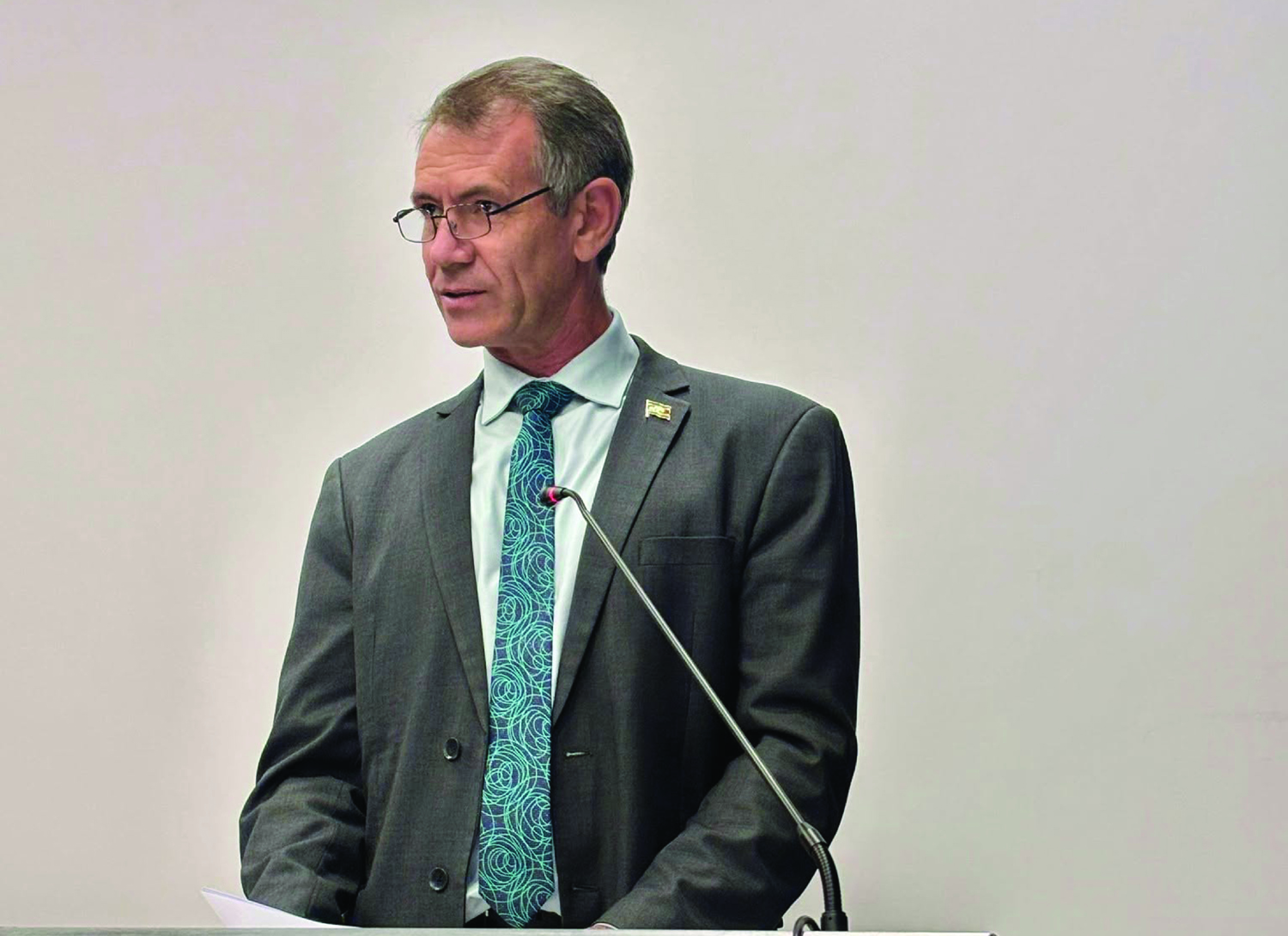
ESWATINI’S successful prosecution of individuals linked to illegal gambling marked another step towards strengthening the country’s compliance with international anti-money laundering standards, Minister of Finance Neal Rijkenberg said.
The minister said the convictions demonstrate the country’s commitment to combating financial crime and could strengthen Eswatini’s standing during future international assessments conducted by the Financial Action Task Force (FATF).
This includes its regional body, the Eastern and Southern Africa Anti-Money Laundering Group (ESAAMLG).
His remarks come amid an increase in the repatriation of foreign nationals who were allegedly involved in illegal gambling operations. Many were fined by the courts and sent back to their countries.
Rijkenberg dismissed suggestions that the recent crackdown reflected weaknesses in local financial crime controls. Instead, he argued that the swift response by law enforcement agencies showed the country’s systems were functioning effectively.
“The fact that these guys started and were caught straight away and are now before the courts actually strengthens our case that Eswatini is on top of its game in making sure these activities do not become entrenched in our country,” he said.
He noted that criminal activities can emerge in any country, but what distinguishes effective jurisdictions is their ability to detect, stop and prosecute offenders before such operations become established.
“In every country, criminals can start anything. It is about the effectiveness of our system to stop it, prevent it and make sure criminals are brought to justice,” he said.
The minister added that the crackdown should reinforce, rather than undermine, confidence in Eswatini’s effort to avoid international greylisting.
“In fact, it helps prove that Eswatini is very vigilant in this space.”
Addressing concerns that the arrests could discourage investors, Rijkenberg said the speed with which authorities dismantled the alleged illegal gambling operation should instead reassure the business community.
“They started doing it in Eswatini and within two or three months we were on top of them, we grabbed them and it stopped. That is proof that our systems are working,” he said.
Rijkenberg explained that the local anti-money laundering and counter-financing of terrorism framework is assessed by ESAAMLG under the broader oversight of FATF, the global standard-setting body on financial crime.
He said previous assessments identified shortcomings in the country’s ability to secure convictions for financial crimes, largely because such offences had been relatively uncommon.
ALSO READ | ‘Pastors among biggest clients of sex workers’
“A problem that we were having as Eswatini was that we hadn’t convicted anybody for financial crimes simply because there was very little taking place in the country. Now that we have convicted people for financial crimes, that box is now ticked and it means we have made progress in that area,” he said.
According to Rijkenberg, Eswatini’s compliance has improved significantly in recent years.
He said the country initially met only 14 of the 40 international recommendations assessed by FATF, but after implementing reforms and undergoing a re-rating, that figure has increased to about 29 recommendations, with the latest convictions expected to strengthen the country’s record further.
He also clarified that assessments of Eswatini’s financial crime controls are conducted by FATF and ESAAMLG rather than correspondent banks.
He said it is not actually a banking issue until a country is greylisted. Banks rely on FATF and ESAAMLG assessments. They do not judge countries based on individual cases such as this.
The minister highlighted that continued enforcement against illegal gambling and other financial crimes remained critical to safeguarding the country’s reputation as a responsible financial jurisdiction and maintaining confidence in its financial system.
The recent crackdown bears striking similarities to enforcement operations elsewhere in Asia, highlighting a growing pattern in transnational cybercrime.
In Indonesia, for instance, authorities recently conducted one of the country’s largest-ever raids on illegal online gambling operations, arresting 321 foreign nationals.
The suspects, mostly from Vietnam and China, allegedly ran more than 70 betting websites from a single commercial building in Jakarta, managing customer service, financial administration, telemarketing and digital platforms targeting victims abroad.
Many suspects had overstayed their visas and the operations were part of a wider network displacing activity from countries like Myanmar and Cambodia, where governments have recently intensified crackdowns.
Indonesian officials reported detecting the movement of online gambling operators into new host countries following enforcement actions, suggesting that syndicates seek locations with less stringent monitoring systems.
In Eswatini, the Royal Eswatini Police Service (REPS) worked quickly to dismantle the illegal gambling network involving more than 200 Asian nationals.
National Commissioner of Police Manoma Vusi Masango confirmed in a previous interview that REPS collaborates with Interpol to trace victims linked to the alleged scheme and to ensure proper prosecution.