


PRIME Minister Russell Mmiso Dlamini has called for the disruption of outdated government systems that are slowing down the growth of the tourism sector.
He warned that the country’s tourism sector could not continue with business as usual.
Dlamini was speaking at the second Eswatini Tourism Nkwe Summit held at the Hilton Garden Inn yesterday.
He said his approach to government had been described by some as disruptive leadership, a description he said he embraced.
He said while government remained committed to the Nkwe Programme of Action and the broader national transformation agenda, tourism had to become one of the key engines driving the country towards its target of double-digit annual gross domestic product (GDP) growth.
“A year ago, in this same spirit of urgency, we gathered to declare that Eswatini’s tourism sector could no longer afford business as usual. Today, we return not only to reflect but to account, to ask ourselves honestly, what has moved? What has stalled? And what still demands our full attention?
Disruption, in my understanding, is not disorder. It is the refusal to let outdated systems slow processes and comfortable habits stand in the way of the country’s progress. Where a system serves only itself and not the people, that system must be disrupted. I embrace that description, and I do so without apology,” Dlamini said.
He also identified the country’s e-visa system as one area requiring urgent attention.
The PM acknowledged concerns raised by the tourism industry regarding the reliability of the platform, payment processing and turnaround times, particularly during peak periods such as the Umhlanga Ceremony.
He said government had also heard concerns about processing delays, payment failures and the absence of a manual fallback system while the platform was being refined.
The prime minister also raised concerns about the accuracy of tourism data, particularly the extent to which informal and small operators are captured.
He said the development of a Tourism Satellite Account should provide a more accurate picture of the sector’s contribution to the economy.
“I really want to be direct that a visitor system that frustrates the very visitors we are courting is a contradiction that we cannot sustain, and government is committed to resolving it with urgency and not indefinite patience.
If our data does not yet fully capture the informal and small operator side of this industry, then our public narrative of growth risks is obscuring the real conditions faced by the men and women who work in it daily,” added Dlamini.
The premier further pointed to gaps in the regulation of e-hailing services and seven-seater vehicles, saying these had become an important part of how tourists move around the country while the regulatory framework had failed to keep pace.
He also highlighted the Eswatini Payment Switch as an example of the structural changes needed to remove barriers facing tourism businesses.
He said fast payments were already flowing, while open banking and card, point-of-sale and ATM switching were still to come.
These developments could enable hospitality businesses to process domestic and international transactions with fewer of the difficulties experienced in the past.
Dlamini emphasised that disruptive leadership was not about criticism for its own sake, but about identifying what was not working and changing it.
He said the country’s tourism potential remained rooted in its culture, landscapes, heritage and the warmth of its people.
“That is what I mean by disruptive leadership, and it is the standard I am asking every ministry, every parastatal and every partner in this room to hold themselves to. What has to change is our tolerance for the systems that stand between that potential and its realisation.
I look to this conference to again produce practical, measurable recommendations and this time, I look to all of us to return next year able to report not just what we discussed, but what we disrupted, fixed and delivered,” Dlamini closed.
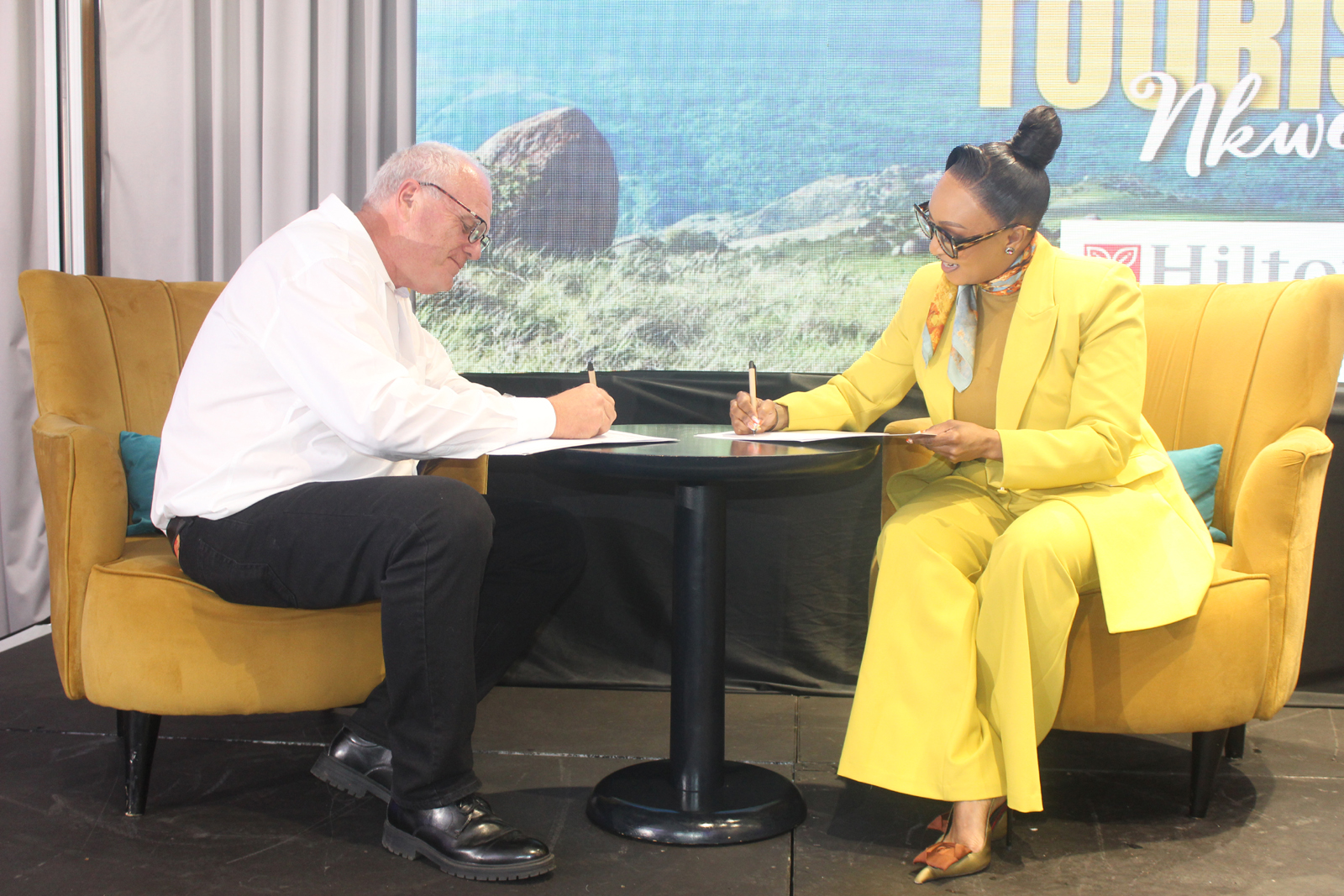
CEO Gciniwe Fakudze signing the MoU during the Eswatini Tourism Nkwe Summit yesterday. (Pics: Mduduzi Mngomezulu)
Tibiyo, PSPF partner to reopen Royal Swazi Sun
THE Royal Swazi Sun is set to reopen following a partnership between Tibiyo TakaNgwane and the Public Service Pensions Fund (PSPF).
The partnership’s move is expected to revitalise tourism in the Ezulwini Valley. The development was announced during the second Eswatini Tourism Nkwe Summit.
PSPF Chief Executive Officer Masotja Vilakati reflected on the history of the Royal Swazi Sun. He said it opened in 1965 at a time when the region was experiencing some of its harshest policies.
He said the establishment went on to become a symbol of dignity and hospitality, welcoming royalty, dignitaries and visitors from across the world.
Vilakati said the Royal Swazi Sun also played an important role in putting the Ezulwini Valley on the international map through its hospitality and sporting activities, particularly golf.
He said the closure of the establishment had been felt particularly by people in the hospitality industry who had built their careers, businesses and lives around tourism.
He said the partnership represented the relighting of the Royal Swazi Sun’s ‘light’ and an opportunity to build on the legacy of the establishment.
“For half a decade, if you wanted to know where Eswatini was, you followed the light of the Royal Swazi. The years that followed were not easy; doors that once opened wide were now closed.
For those in the hospitality industry who had given their careers, lives, businesses and, in many cases, the very identity of tourism and hospitality in the kingdom, those quiet years were felt.
The light is being lit again. When reopened, there will be a celebration, a renewal and a chance to take everything that the Royal Swazi once had and build on it,” Vilakati said.
He said the reopening would also provide an opportunity to honour the pioneers of Eswatini’s hospitality industry while creating a new chapter for the country.
The Royal Swazi Sun would reflect a country that was proud of its culture, confident in its identity and ready to welcome the world.
He said the impact of the reopening would extend beyond the establishment itself, benefiting the broader tourism industry and the Ezulwini Valley.
Vilakati expressed appreciation to Tibiyo TakaNgwane management and board, as well as Dr AT Dlamini and the board for approving the partnership.
“When that facility is opened, it would belong to all the hoteliers, tour guides, craftsmen, chefs and small businesses that breathe and live alongside every visitor that comes here. The Royal Swazi will be lit and will not shine alone, but will light up the whole industry and the entire valley.
This partnership will see Royal Swazi being the light that welcomes the world to the kingdom again,” Vilakati added.