ORDERLIES at the National Psychiatric Referral Hospital have stopped reporting for night duty after months of unsuccessful efforts to secure payment for overtime worked in July and August.
The workers took the decision last Friday, notifying the hospital administration in writing that they would no longer report for night shifts with immediate effect until their grievances over unpaid overtime were addressed.
In a letter dated October 30, the employees said their decision was prompted by the continued nonpayment of overtime despite their commitment to carrying out night-duty responsibilities.
“We hope that this matter will receive urgent attention and that a fair and amicable resolution be reached,” the workers stated in the letter addressed to the administration.
The latest development follows an earlier dispute in which the National Public Services and Allied Workers Union (NAPSAWU) intervened on September 15 to mediate between the orderlies and the administration over the outstanding overtime claims.
At the time, the workers had resolved not to report for night duty after the expiry of a deadline they had given the administration to address their concerns. However, the union’s intervention temporarily halted the planned action.
The orderlies had claimed that their overtime claim forms for July and August had not been approved or signed by the hospital administrator, despite their assertion that government provides for overtime payments where applicable.
They further alleged that the administrator had refused to approve their claims without providing reasons for the decision.
The workers also raised concerns over what they described as selective approval of overtime claims, alleging that other employees were receiving payments while their own claims remained outstanding.
They cited the alleged case of a junior clerical officer who, according to the orderlies, had been working on weekends and submitting overtime claims while their forms remained unsigned.
The orderlies described the alleged disparity in the handling of overtime claims as victimisation, arguing that they had not been given an explanation for the failure to approve their submissions.
Apart from the unpaid overtime, the workers also claimed that they were not receiving hardship allowances despite the hazardous nature of their duties at the psychiatric facility.
The latest decision to withdraw their services during night shifts signals a renewed escalation of the dispute, which had previously prompted the union to intervene in an attempt to resolve the matter.
The workers have called on the administration to urgently address their grievances and reach an amicable resolution.
Efforts to resolve the dispute had previously centred on the outstanding claims for the two months, but the workers’ latest notice indicates that they are no longer willing to continue reporting for night duty while the matter remains unresolved.
Orderlies ‘go-slow’ results to chaos
NURSES working the night-shift have revealed that the absence of the orderlies is a recipe for chaos.
They said attending to the patients at night would be a cumbersome task, citing that the orderlies were necessary for smooth night operations.
The nurses stated that without the orderlies at night, the facility would not be in a position to admit new patients.
“The orderlies are responsible for processing an incoming patient before admission,” said one nurse.
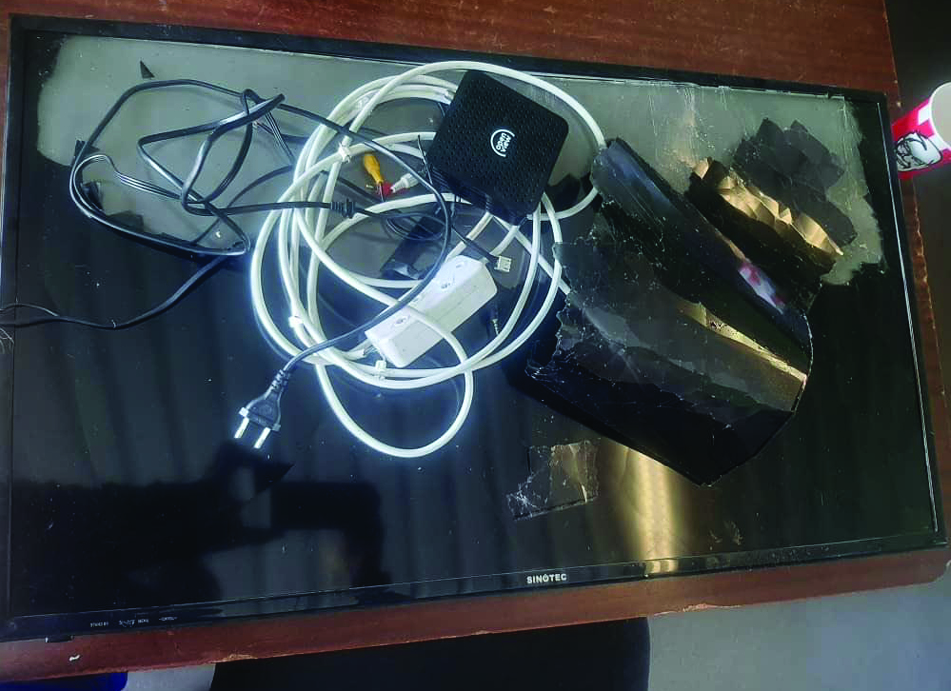
Insiders said the first two nights without the orderlies working had been chaotic, with some male patients vandalising a television set at the male rehab ward.
The TV was reportedly mounted on the wall where the patients removed it and smashed on the floor.
Meanwhile, NAPSAWU President Bawinile Ndlovu appreciated the ministry of public service for urgently attending to the Psychiatric Hospital orderlies’ matter.
She said while the ministry of health was not forthcoming in addressing issues reported by the organisation with the urgency they deserve, the ministry of public service ensured that they were addressed.
She cited last Friday’s communication on the approval to have the orderlies paid for overtime worked.
“As an organisation, we wish the orderlies could return to work while the payment process is underway. At least we now have the instrument from the ministry of public service on which the hospital administration can authorise the payments,” she said.
Govt approved orderlies’ overtime in April
THE ministry of public service approved overtime payments for orderlies at the National Psychiatric Referral Hospital in April.
This is despite the fact that the workers remained unpaid until they resolved to stop reporting for night duty last Friday.
The authorisation, which remains valid until March 31, 2027, was confirmed by the ministry of public service in a letter dated October 30, addressed to the National Public Services and Allied Workers Union (NAPSAWU).
In the letter, Principal Secretary Mthunzi Shabangu said the ministry of health had already been granted authority to pay the orderlies for approved overtime hours worked under the existing three-shift system.
The authorisation was issued through a memorandum dated April 14, covering the period from April 1, to March 31, 2027.
Despite the approval, the orderlies’ overtime claims for July and August remained unpaid, prompting them to withdraw their services during night shifts after months of unsuccessful efforts to resolve the matter.
However, Shabangu clarified that the approval applied exclusively to the current three-shift arrangement and did not extend to the proposed two-shift system, which has not been evaluated, adopted or sanctioned by the ministry of public service.
He further disclosed that the ministry had received a request from the ministry of health to assess the existing three-shift system at the hospital.
According to Shabangu, the workload assessment was ongoing to determine whether the current arrangement continued to meet the institution’s operational and service delivery requirements and to identify possible alternatives where necessary.
He said the assessment would consider operational, administrative, labour relations and service delivery factors before a decision was made.
The ministry would communicate its position and any subsequent decisions to the relevant stakeholders once the assessment had been completed.
The dispute over the shift system dates back to August, when the orderlies protested against what they described as unsafe working conditions and demanded the introduction of a two-shift arrangement.
The workers argued that the existing system left them overworked and exposed to violent patients without adequate support. They claimed that, under the three-shift arrangement, one orderly could be left responsible for more than 60 patients in a ward.
They also alleged that several orderlies had sustained serious injuries while attending to psychiatric patients, including injuries resulting in the loss of fingers and parts of their ears.
The workers maintained that the proposed two-shift system would help address their concerns about workload and safety. Efforts to get a comment from the ministry of health prove futile as the principal secretary did not answer his phone because he is reportedly out of the country. The ministry’s Under Secretary Anthony Masilela said he had also been out of the country and only arrived yesterday.
He was asked why it had taken the ministry so long to pay the workers’ overtime despite receiving approval from the ministry of public service in April. He was also asked if he was aware that the orderlies had stopped working night shifts.
“I’ve just arrived and not aware of the developments. May I please respond to your questions tomorrow (today) after returning to the office?” asked Masilela.