
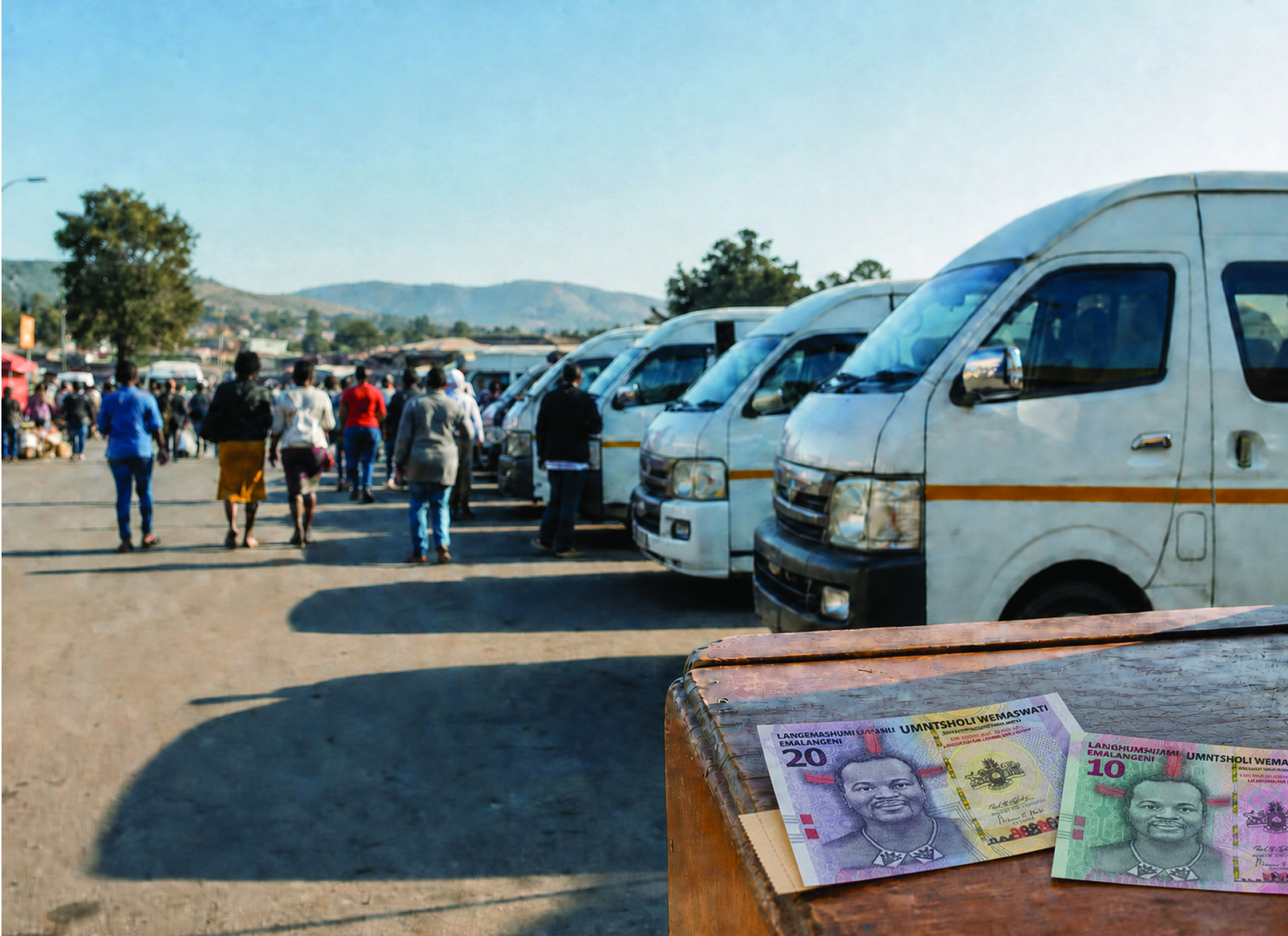
Public transport operators have proposed increasing the minimum bus fare from E10 to E15 for journeys of up to eight kilometres, citing rising operating costs and the depreciation of passenger service vehicles.
The proposal was submitted to government through the National Road Transport Council (NRTC), which represents operators in negotiations with the Ministry of Public Works and Transport.
The NRTC said fare adjustments were necessary because operators continued to face rising costs, compounded by poor road infrastructure and vehicle depreciation.
“In the midst of these balancing acts, the road transport service must be fundamentally safe and efficient, leading to a secure and reliable network,” reads the proposal report.
Under the initial proposal, a journey of up to eight kilometres would cost E15, while trips of more than eight kilometres but not exceeding 50 kilometres would be charged at E0.945 per kilometre. Journeys exceeding 50 kilometres would cost E0.858 per kilometre.
The council also proposed increasing taxi fares, with E90 for journeys of up to three kilometres and E20 per kilometre thereafter.
The NRTC said transport remained vital to the economy as it facilitated trade, connected communities, created jobs and supported productivity. It urged government and stakeholders to develop policies balancing growth, affordability, safety and efficiency.
The council further proposed reviewing the Maximum Bus and Taxi Fares (Amendment) Regulations, 2022, to allow different pricing of transport modes and zonal pricing. It also called for the urgent establishment of a tripartite technical committee, as per a 2022 Parliament resolution, to address industry issues and negotiate fare adjustments.
Alternatively, the NRTC suggested that government introduces a subsidy to assist operators. It requested that the proposed fares be gazetted and implemented from June 1.
However, the Ministry of Public Works and Transport rejected the initial proposal, saying it is unaffordable for commuters. Instead, the ministry proposed lower increases based on the last adjustment in 2022: E12.50 for journeys up to eight kilometres, E0.742 per kilometre for trips above eight kilometres but not exceeding 50 kilometres, and E0.693 per kilometre for journeys above 50 kilometres. For taxis, it proposed E72 for up to three kilometres and E12.50 per kilometre thereafter.
Following further engagements, the NRTC made a counter-proposal closer to the ministry’s position: E12.50 for the first eight kilometres, E0.77 per kilometre for journeys above eight kilometres up to 50 kilometres, and E0.726 per kilometre for journeys above 50 kilometres.
Taxi fares remained at E72 for the first three kilometres and E12.50 per kilometre thereafter.
The ministry said the counter-proposal was not far from the historical trend method it had suggested. The matter was presented to Cabinet on June 9, where the ministry’s requests were approved.
The ministry has since prepared an instrument for Minister Chief Ndlaluhlaza Ndwandwe to refer the matter to Parliament as per Section 36 of the Road Transportation Act, 2007. It has also sought approval for a consultancy to develop a formula for calculating fares, determining when increases or reductions should occur based on fuel prices and other variable costs.
The proposed fare changes follow sharp fuel price increases in April and May, which the NRTC cited as a key factor behind its demand for higher fares.
Meanwhile, the Swaziland Consumer Forum (SWACOF) opposed the proposed increase, arguing that higher costs would place further pressure on consumers already facing rising living expenses.
In a submission to the ministry of public works and transport dated May 15, SWACOF said the adjustment proposed by NRTC was unjustified and detrimental to consumers.
The organisation acknowledged fuel price increases but said the country’s economic situation, particularly its effect on low-income households, must be considered. SWACOF said many Emaswati were already struggling with rising costs and absorbing increases in electricity and water. It warned that higher transport fares would affect small businesses and community institutions through increased operating costs.
FARE COMPARISON TABLE
| Distance | Current Fare (2022 Gazette) | NRTC Proposal (May 2026) | Ministry Proposal (May 2026) |
|---|---|---|---|
| Buses, Midibuses, Minibuses | |||
| First 8km | E10 | E15 (50%) | E12.50 (25%) |
| More than 8 up to 50km | E0.70 | E0.945 (35%) | E0.742 (6%) |
| More than 50km | E0.66 | E0.858 (30%) | E0.693 (5%) |
| Taxis | |||
| First 3km | E60 | E90 (50%) | E72 (20%) |
| More than 3km | E10 | E20 (100%) | E12.50 (25%) |