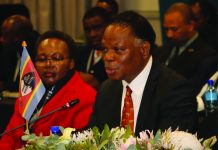

Minister of Housing and Urban Development Apollo Maphalala has defended Inyatsi Construction Chief Executive Officer Derrick Shiba’s appointment to the Eswatini National Provident Fund (ENPF) Board, aligning himself with his Labour and Social Security counterpart, Minister Phila Buthelezi, on the disputed interpretation of the law now at the centre of the board’s seven-month impasse.
In an interview with the Sunday Observer this week, Maphalala made it known that his ministry nominated Shiba to the board, rejecting claims contained in a confidential legal opinion commissioned by Business Eswatini (BE), which argues that the authority properly belongs to the Ministry of Home Affairs.
“Yes, we did appoint a member in the ENPF and we believe we followed the law,” Maphalala said.
“The old ministry was the Ministry of Local Administration and those duties now fall onto the Ministry of Housing and Urban Development. We do not take such decisions without consulting the relevant legal people, and we did so in this case as well,” he added.
While the minister did not mention individuals by name, it is understood that the dispute revolves around the nomination process that ultimately led to Shiba becoming a member of the ENPF Board before later being designated chairperson.
That appointment has since become one of the principal triggers of the deadlock that has left the board effectively unable to function since late last year.
Employer and employee representatives have boycotted board activities since December, arguing that aspects of the appointment process were irregular.
Because the two blocs together constitute the board’s voting majority, their withdrawal has left the Fund unable to convene substantive meetings or properly exercise oversight functions.
Members of Parliament (MPs) have now called for a formal investigation into the origins of the impasse.
According to tomorrow’s Order Paper issued by the Office of the Speaker, Lobamba Lomdzala MP Marwick Khumalo is expected to move a motion of urgent public importance seeking the establishment of a five-member select committee to investigate the deadlock. The motion will be seconded by Mbabane East MP Welcome Dlamini.
The proposed committee would engage all relevant stakeholders linked to the ENPF dispute, including Minister Buthelezi, before preparing a report with recommendations to be tabled before Parliament within 14 days.
The dispute stems from an obscure provision within the ENPF Order of 1974 requiring that one member of the Board be “a person nominated by the minister for local administration”.
That ministry no longer exists.
Employer and employee federations argue that the Ministry of Home Affairs is the rightful successor to the former Ministry of Local Administration, meaning the Housing Ministry may have exercised powers belonging to another ministry altogether.
A confidential legal opinion commissioned by BE from one of the country’s leading law firms supports that interpretation.
RELATED | Six months on, ENPF board still to convene
The opinion argues that the Ministry of Housing and Urban Development is not the lawful successor to the former Ministry of Local Administration. Instead, the lawyers conclude that the legal successor is the Ministry of Home Affairs.
Maphalala, however, rejected suggestions that the process lacked legal grounding.
“Even the assignment of responsibilities is clear on this, so while I may not know what was or what was not done before, I know that we followed the law in this decision,” he said.
His remarks reinforce the position already publicly advanced by Minister Buthelezi, who previously defended the appointments by arguing that local government functions historically migrated into the Housing Ministry portfolio.
“I followed the law. If anyone has questions, they should get a lawyer to properly break down the law for them,” Buthelezi previously told this newspaper.
The legal opinion obtained by BE disputes that interpretation both “legally and factually”.
According to the advisory analysis, historical constitutional restructuring shows that the former Ministry of Local Administration later evolved into the Ministry of Interior, then the Ministry of Interior and Immigration, before eventually becoming today’s Ministry of Home Affairs.
“The legal identity of the ministry is not altered merely by periodic changes in nomenclature or the reassignment of ministerial portfolios,” the lawyers wrote.
The opinion also argues that the board should first have convened and elected its own chairperson before the minister formalised Shiba’s appointment as chairperson.
Under Section 8(4) of the Retirement Funds Act of 2005, the chairperson of a retirement fund board is meant to be elected by board members themselves.
The lawyers argue that the newer legislation supersedes conflicting provisions contained in the older ENPF Order.
The lawyers further contend that the appointment process departed from an established rotational convention historically used to preserve equilibrium between labour, business and government representatives on the Board.
The dispute has meanwhile widened beyond the legality of the appointments themselves.
In a strongly worded statement issued last week, BE insisted that ENPF is fundamentally sustained by employers and workers rather than government.
“The ENPF is exclusively a private sector fund. It is funded entirely by private sector companies and their employees. Government does not contribute a single lilangeni to ENPF,” BE said in a resolution adopted during its final statutory sitting of the 2025/26 financial year.
Government later pushed back sharply against that claim.
In a formal statement, the Ministry of Labour and Social Security described BE’s position as “factually incorrect and misleading”, arguing that the State contributes more than E20 million annually to ENPF on behalf of fixed-term and temporary public employees who are not members of the Public Service Pensions Fund (PSPF).
Government further maintained that ENPF remains a Category A public enterprise established under national legislation and overseen through the Public Enterprises (Control and Monitoring) Act of 1989.
The ministry also defended government’s continuing oversight role, arguing that the State carries an obligation to safeguard the sustainability of the country’s social security architecture and would ultimately be required to intervene if the Fund became unstable.
The paralysis arrives at an especially delicate moment for the institution.
Government is simultaneously pursuing plans to transform ENPF into a compulsory National Pensions Fund, a proposal already generating tensions with the Public Service Pensions Fund over long-term sustainability concerns.