


I woke up early on Thursday, as I often do, with far too much on my mind. I have no idea why I snapped out of much-needed sleep, but sleeping fewer hours than the average person has become normal for me.
This time felt different. Perhaps it was the change in weather, after the welcome warmth we experienced this week. I was a little hot and uncomfortable and eventually decided there was no point trying to force myself back to sleep.
It did not take long for me to realise what was really occupying my mind: a video clip of Owen Nxumalo circulating on social media. This video of the education minister had been sent to me the previous night by one of our readers who was enquiring why this wasn’t making news.
I had watched it in utter disbelief just before retiring for the night. For a second, I regretted the idea for it had now cost me my sleep.
The clip returned to me the moment I opened my laptop to begin work and mind you I had so much workload for the day I needed to start early in the crack of dawn! But here I was now being irked by what I had seen the previous night and pre-occupied instead of focusing on much more important things – except, of course this was very serious, I concluded, given the minister’s comments and position on an issue you would have wished he had stayed away from, on the very least!
It was certainly not what I wanted occupying my thoughts at the start of another fast-paced day.
When I first watched it, I had hoped – for the minister’s own sake – that what I was seeing was merely banter. Perhaps some ill-judged humour. We all need a laugh now and again, after all – and Owen Nxumalo usually never disappoints as the joker.
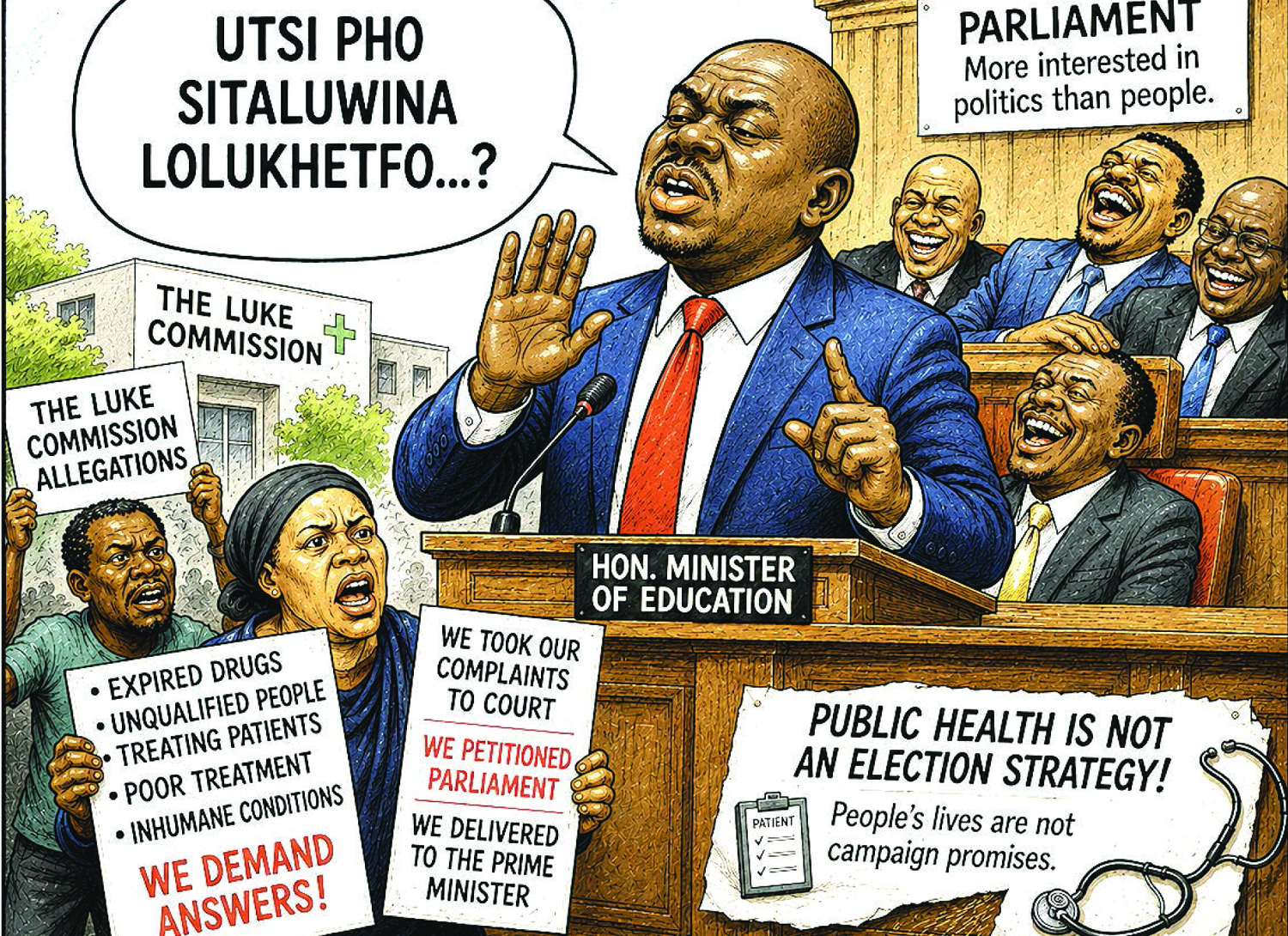
There were a few MPs in the House, from what can be gleaned from the video clip, and they certainly appeared amused. But then came the remark that made the exchange impossible to dismiss as harmless banter: there was, he suggested, an election to win. Against the backdrop of serious allegations involving The Luke Commission, that comment was deeply troubling.
Maybe, here is a disclaimer. I have stayed away from anything Luke Commission.
I have long since told myself that they can carry on and bully others – we have had our fair share bekunene, from all the social media attacks and threats that were issued against yours truly and this newspaper. They were not worth the trouble, and for all that’s worth, we had done our best to warn the public.
In fact, we saw it coming. There was good enough time too, when we called them out. And for that, we were confronted by the likes of Owen Nxumalo, who only see an opportunity to campaign for popularity at the expense of the taxpaying public. I walked away from anything that concerns The Luke Commission because I was convinced that someday, the truth would be revealed.
Ahem.
Anyway, for anyone who has not seen the clip, the controversy arises from the minister’s response to calls by his boss – the prime minister nogal – for scrutiny of allegations made by former employees of The Luke Commission.
Those former employees have made startling if not sensational claims about conditions at the institution, including allegations concerning the treatment of staff and patients, the qualifications of people treating patients, and the use of expired medication.
These remain allegations and deserve to be tested properly. But that is precisely the point; allegations of this seriousness should be investigated, not waved away because they are politically inconvenient or because those raising them are dismissed as disgruntled. Or simply because the calls for the inquiry is being made by the Prime Minister Russell Dlamini, who it appears must simply be opposed. Just!
The former employees first launched their complaints on social media and were then taken to court by The Luke Commission.
But they have not confined their complaints to social media. They are fighting the court action against them. They have petitioned Parliament and marched to Hospital Hill to deliver a petition to the prime minister. Whatever one ultimately makes of their claims, that level of persistence should surely be enough to persuade public representatives to ask questions rather than ridicule the call for scrutiny.
Instead, the impression created by the minister’s remarks was that Parliament should look away.
The suggestion that there are elections to win, or that there cannot be an inquiry every time young people raise complaints, is precisely the kind of response that should worry the public.
How does an elected MP – and a Cabinet minister at that – respond so casually to allegations concerning public health and the treatment of Emaswati? Friendship with, confidence in or admiration for an institution cannot be a substitute for accountability.
The issue is not whether The Luke Commission is guilty of every allegation levelled against it. The issue is whether Parliament is prepared to subject serious claims to independent scrutiny. If allegations concern people being ill-treated, unqualified personnel treating patients or expired medication being dispensed, the responsible response is to establish the facts.
Why is this such a hard thing for this country these days? One cannot help but wonder whether the reaction would have been the same had identical allegations been made against another hospital, such as the Raleigh Fitkin Memorial Hospital (RFM). Would the call then have been for restraint and silence, or would MPs have demanded an immediate investigation? Public institutions and private institutions performing public functions should be judged by the same standard – especially, and in this case, when we have now pumped in E100 million that the public was never taken into confidence about.
Surely, The Luke Commission is not beyond reproach?
The stakes are even higher where significant public funds are involved. If government has committed substantial resources to an institution, that should strengthen – not weaken – the case for transparency and accountability. Public money does not buy immunity from scrutiny.
What troubles me most is the ease with which legitimate questions can be recast as hostility towards the institution itself. For years, those who have questioned The Luke Commission have risked being portrayed as enemies of the hospital.
That is unhealthy. No institution serving the public should be beyond criticism, and no public representative should make citizens feel that asking difficult questions is somehow an act of disloyalty.
This is partly why this issue has drawn me back from my writing sabbatical. This newspaper and I personally – have faced criticism and personalised attacks for warning that an institution widely celebrated for the work it does may nevertheless have questions to answer.
Those warnings should never be treated as a verdict; they are a call for scrutiny.
If The Luke Commission has nothing to hide, a credible investigation should strengthen public confidence in it. If there are shortcomings, then an investigation creates an opportunity to correct them. Either way, looking away serves no one – least of all the patients who depend on the institution.
Truth has a stubborn way of emerging eventually. It may take time, but public officials should not place themselves on the wrong side of that process by appearing to discourage scrutiny before the facts have been established.
Owen Nxumalo’s remarks, in my view, were not merely embarrassing. They revealed the danger of political power becoming too comfortable with institutions it should be prepared to question.
Parliament’s duty is not to protect reputations or electoral prospects. Its duty is to the public.
And there is another uncomfortable dimension to all of this: this was a Cabinet minister publicly taking a position that appeared to cut across the concerns being raised within government itself.
That, perhaps, is a story for another day. For now, the question is simple: when serious allegations involving the health and safety of Emaswati are placed before Parliament, will our representatives investigate them – or calculate first what is best for the next election?
But then again, we know the answer. It is right there lining the pockets of the politicians. Sadly, the cost is lives lost.