
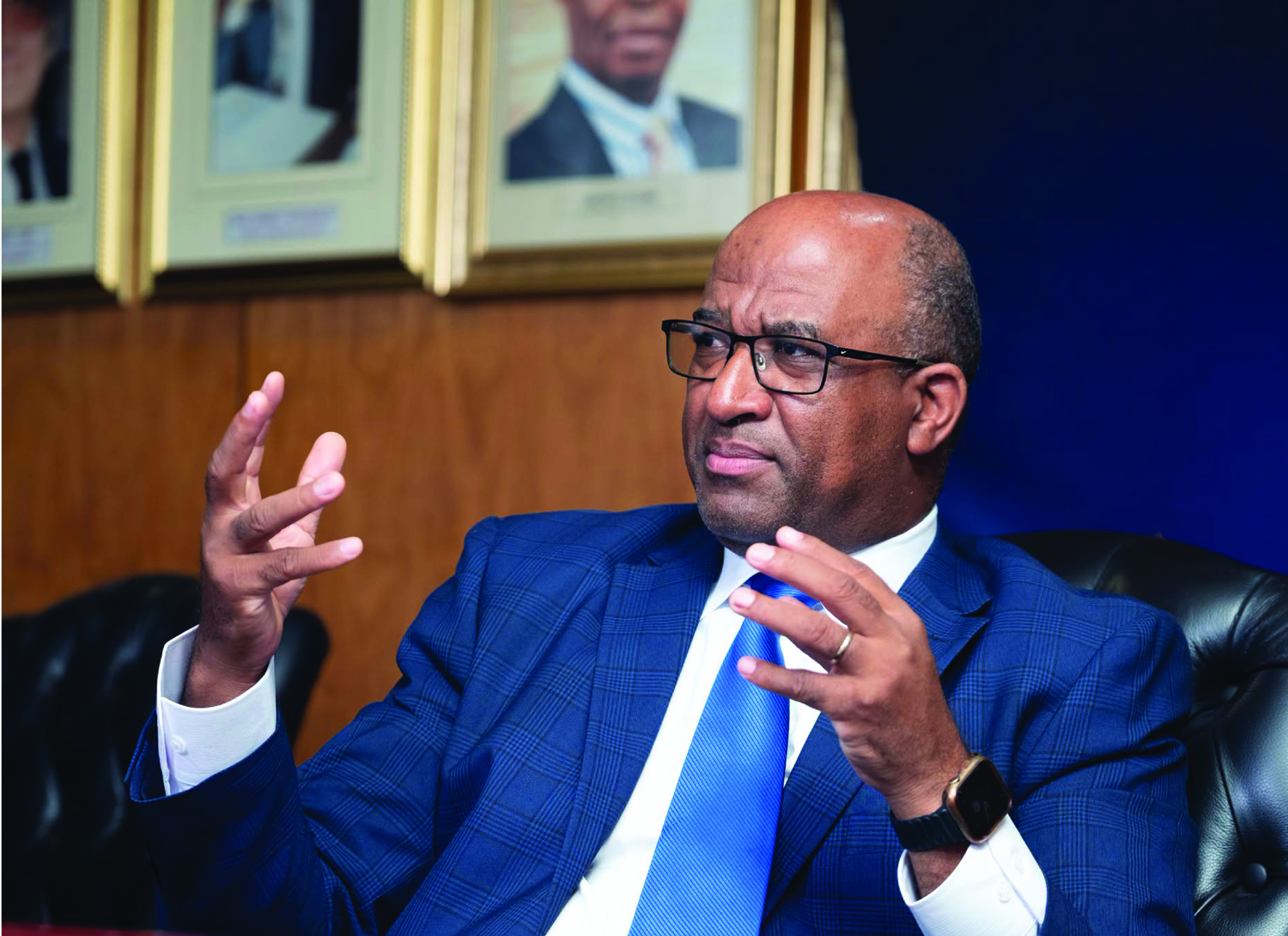
Central Bank of Eswatini (CBE) Governor Phil Mnisi has urged locals to avoid using paper money for high-value purchases and instead use secure electronic payment platforms.
He said this during the Committee of Central Bank Governors (CCBG) Subcommittee on Banking Supervision and Financial Stability meeting held at the CBE headquarters in Ezulwini last week.
Mnisi said electronic payment platforms were safer, more efficient and provided a traceable record of transactions.
Such platforms in the country include internet and mobile banking, debit and credit cards, electronic funds transfers (EFTs) and point-of-sale (POS) card payments.
There are also mobile money services such as MTN MoMo and E-Mali.
“Utilise electronic platforms that have been put in place. They are much more efficient, much more reliable and traceable,” he said.
The Governor also cautioned against withdrawing large sums of cash for expensive purchases, warning that this could expose individuals to criminals who monitor customers’ banking habits.
“Do not go to the bank and withdraw a lot of money because some people start tracing you. They know your pattern and your trend,” he said.
He pointed out that the traceability of electronic transactions was one of their biggest advantages, adding that the country’s payment systems were now interoperable, allowing customers to transfer money more easily across different financial institutions.
According to Mnisi, technology should be used to make banking more affordable, faster and reliable.
The Governor also urged consumers to be cautious when investing their money, advising them to use trusted financial systems, ask the right questions and avoid investment schemes promising unrealistic returns.
“Do not run for all these quick, fast returns, supernatural returns from any kind of investment,” he said, adding that consumers should consult the relevant regulator before making financial decisions if they were uncertain.
Despite encouraging greater use of digital payments, Mnisi said paper money would remain an important part of the kingdom’s financial system.
He explained that “fiat money” — a term referring to government-issued currency such as banknotes and coins that is recognised as legal tender and whose value is backed by government rather than a commodity such as gold — was unlikely to disappear in Eswatini or elsewhere.
“I do not think Eswatini will ever get rid of fiat money and certainly not in my tenure,” the Governor said.
Dr Mnisi said cash carried national identity and heritage, noting that the lilangeni features the portrait of His Majesty and design elements that reflect the country’s history.
“It is our pride to carry the lilangeni with Ingwenyama’s portrait there. What a joy. And also the features that are there that tell the story of how deep and rich this kingdom is,” he pointed out.
The Governor added that modern banknotes were also produced with advanced security features to combat counterfeiting.
As his parting shot, he said: “You know what? You will always need fiat money and you look at the world over, it is something that is going to be there.
“You need it. You will go to places where you have to pay using fiat money.”
THE GOVERNOR’S THREE MONEY TIPS
Be vigilant: Protect yourself, your money and your wealth by staying alert to potential financial risks and scams.
Use trusted financial systems: Ask questions, avoid investment schemes promising unrealistic or “supernatural” returns and consult the relevant regulator before making financial decisions.
Use electronic payments: Avoid carrying large amounts of cash, especially for high-value purchases. Instead, use secure electronic payment platforms, which are more efficient, reliable and traceable.