



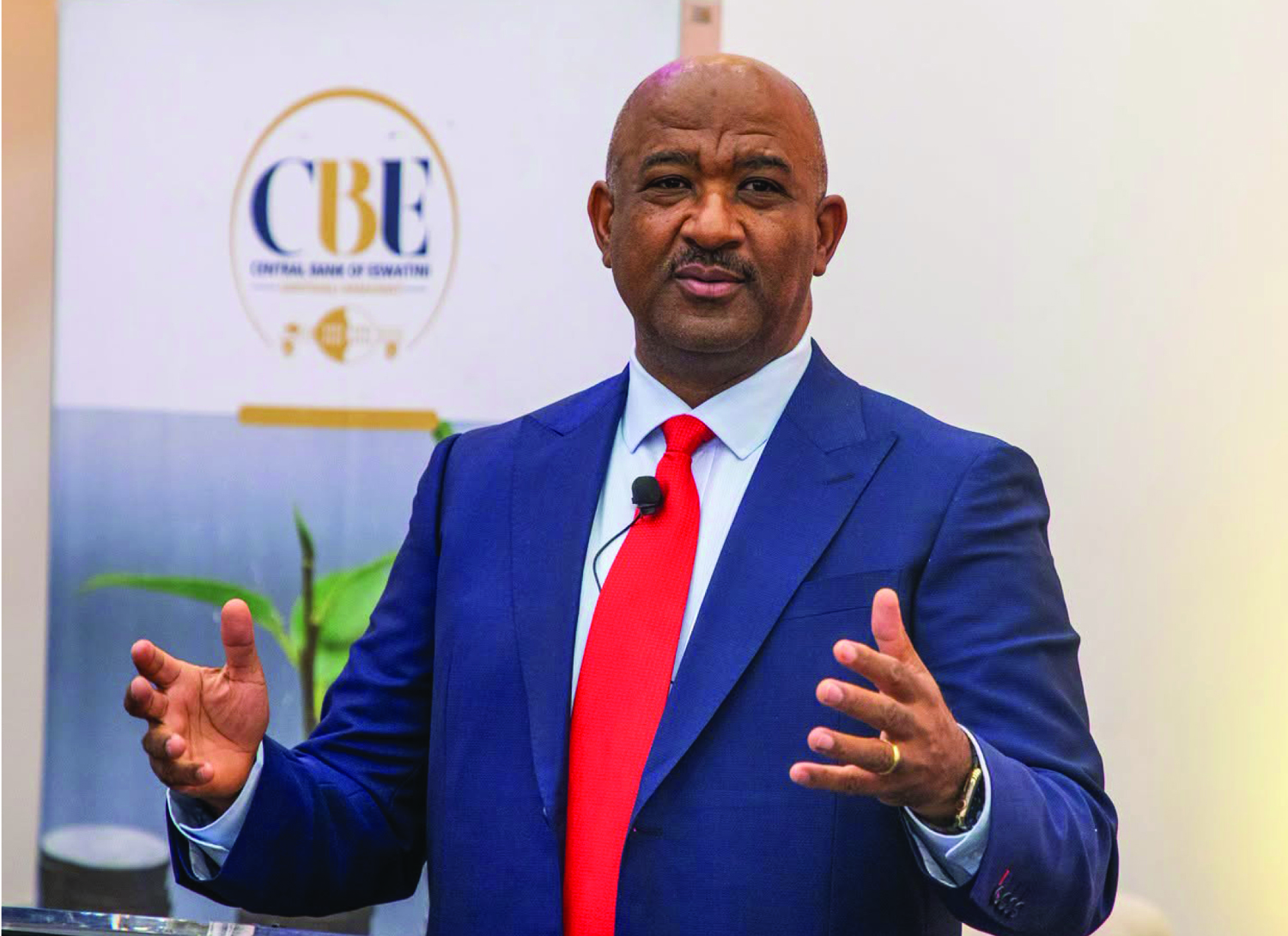
CENTRAL Bank of Eswatini (CBE) Governor Dr. Phil Mnisi says the bank will soon roll out retail bonds, opening trusted investment opportunities to more locals.
Mnisi made the announcement at the inaugural Eswatini Financial Markets Forum at the CBE Complex in Ezulwini yesterday, saying the initiative would broaden participation in the country’s financial markets.
“I am particularly thrilled by this initiative because I got confirmation on Tuesday, when we had our EXCO meeting, that in the immediate and very near future we shall be rolling out retail bonds,” Mnisi said.
Retail bonds are investment instruments designed to make it easier for members of the public to invest their money in bonds. In simple terms, an investor lends money to the issuer for an agreed period and receives interest in return, before the principal is repaid according to the terms of the bond.
For households, retail bonds can provide an additional avenue for saving and investing beyond conventional bank deposits. For businesses and other investors, they can contribute to a broader investment market and help diversify available financial assets. The initiative is therefore expected to strengthen participation in the country’s domestic financial markets.
Mnisi said the CBE would ensure ‘active participation’ by the wider population of locals through access to ‘trusted and reliable investment assets’.
The retail bond announcement represents a potential expansion in public participation in a market where the CBE has long supported the issuance and management of government bonds. Government bonds remain debt instruments issued by government to raise funds for public financing, while retail bonds, as the new initiative is being framed, are specifically intended to make bond investment more accessible to ordinary members of the public.
The move formed part of Mnisi’s broader call for a financial system that supports inclusive growth, competitiveness and resilience. He identified four priorities: deepening and modernising financial markets, accelerating safe innovation, strengthening inclusion with purpose, and investing in institutional capability.
On inclusion, the governor said the country must move beyond simply providing access to financial services and instead ensure finance helps individuals and businesses participate more productively in the economy. This includes improving financial intermediation, widening opportunities for small and medium enterprises, as well as supporting enterprise, savings, investment and resilience.
He also stressed that innovation must remain grounded in “consumer protection, stability and policy coherence”, while highlighting developments such as the fast payments module of the Eswatini payment switch, the digital Lilangeni design paper and the CBE’s regulatory sandbox.
Institutional capability, he said, was equally important. “No financial system can outperform the institutions that sustain it,” Mnisi said, pointing to governance, technical skills, policy credibility, operational efficiency and leadership depth as essential to long-term competitiveness.
He acknowledged partners and service providers including Crown Agents, the Well-Being Programme and Standard Bank for providing CBE staff with opportunities to access technology, exchange knowledge and strengthen their capabilities in reserve management.
The governor also linked financial-market development to the safeguarding of local reserves, which he said must continue to be managed according to the principles of safety, liquidity and return. Reserves, he noted, are a national buffer that protects confidence, supports external obligations and strengthens the country’s ability to withstand uncertainty.
Mnisi said the Financial Markets Forum should become a working platform rather than a ceremonial event, bringing together policymakers, financial institutions, regulators, market participants, development partners and thought leaders.
“The future of Eswatini’s financial system will not be shaped by global trends alone,” he said. “It will be shaped by the choices we make.”
The retail bond initiative is expected to be an important part of those choices, potentially bringing more locals directly into the country’s investment landscape while supporting the broader goal of a more inclusive, resilient and competitive financial system.
87% FINANCIAL INCLUSION BUT…
THE country has reached an 87% adult financial inclusion rating, but CBE Governor Dr Phil Mnisi says the next challenge is turning access into economic participation.
Speaking at the inaugural Eswatini Financial Markets Forum in Ezulwini, Mnisi said inclusion should no longer be measured simply by whether people can access formal financial services.
“Access must lead to empowerment and empowerment must lead to participation in growth,” he said.
The governor said the focus should now shift towards whether financial services are affordable, useful and capable of improving the economic prospects of households and businesses. For small and medium enterprises (SMEs), this means ensuring that finance is available on terms that enable businesses to invest, expand and create economic opportunities. For households, it means a financial system that supports meaningful saving, investment and resilience rather than simply providing an account or payment facility.
Mnisi said the country must therefore improve the quality of financial intermediation and widen opportunities for groups that have historically faced greater barriers to finance, including young people, entrepreneurs, SMEs and women-led businesses.
The emphasis on productive inclusion comes as the kingdom seeks to build a financial system capable of supporting broader economic development. Rather than treating financial inclusion as an end in itself, the governor’s message was that access should ultimately translate into stronger participation in the real economy.
This includes enabling people to save securely, access appropriate financing and build financial resilience, while giving businesses better opportunities to mobilise capital for productive activity.
Mnisi also linked inclusion to the broader development of financial markets, arguing that a modern financial system must serve more than large institutions.
“A modern financial system cannot be judged only by the sophistication of its products,” Mnisi said. “It must also be judged by the breadth of its access, the fairness of its opportunities, and the extent to which it supports real economic participation.”