
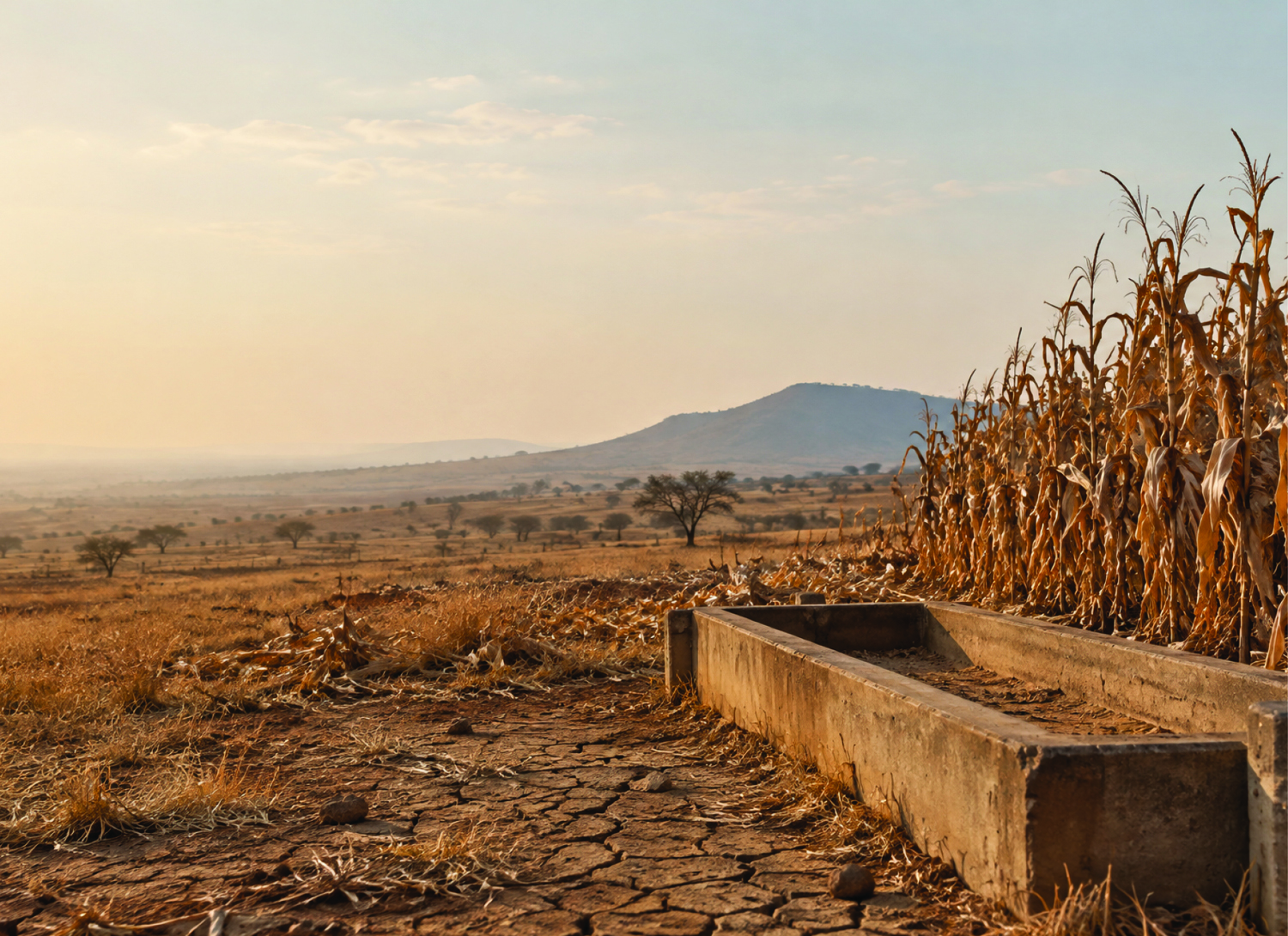
Government plans to make financial provision for the anticipated impact of El Niño in its 2027/28 national budget, as warnings of another severe drought raise fears of a repeat of the 2015/16 disaster that cost the economy an estimated E3.84 billion.
According to Minister of Finance Neal Rijkenberg, government would assess the need for additional drought-response funding during the forthcoming budget preparation process, depending on how the anticipated weather conditions affect agricultural production and livestock grazing.
The move comes as government grapples with mounting public debt, cash-flow constraints and competing expenditure commitments, raising questions about its ability to finance another major climate-related emergency.
The previous El Niño-induced drought inflicted economic losses equivalent to approximately 7% of Gross Domestic Product (GDP), according to World Bank estimates, while devastating maize production, killing thousands of cattle and leaving more than half the population in need of humanitarian assistance.
The prospect of another disaster has also drawn concern from His Majesty King Mswati III. Addressing the 81st session of the General Assembly in New York last month, His Majesty warned that governments would have to draw on strained resources to protect vulnerable populations and livelihoods from the consequences of adverse weather conditions.
The king’s caution comes against the backdrop of forecasts pointing to below-normal rainfall, unusually high temperatures and heightened risks of agricultural drought across Southern Africa.
For the kingdom, the economic implications are particularly significant. The 2015/16 El Niño-induced drought remains one of the country’s most destructive climate-related disasters in recent history.
According to World Bank assessments, the drought caused economic losses estimated at E3.84 billion, representing approximately seven per cent of GDP and nearly 19% of government expenditure at the time.
Agricultural production suffered considerably, with maize output declining by approximately 67% between the 2014/15 and 2015/16 planting seasons.
The livestock industry also suffered devastating losses as grazing conditions deteriorated and water sources dried up. More than 80 000 cattle reportedly died, resulting in direct livestock losses exceeding E480 million.
Water shortages affected communities, agricultural operations and essential services, while approximately 620 000 people required food or cash assistance.
The experience demonstrated how quickly an agricultural drought could become a national economic and fiscal emergency. This time, however, government enters the period of heightened climate uncertainty with limited fiscal flexibility.
The national budget continues to face pressure from rising public debt, cash-flow constraints and competing expenditure commitments. The International Monetary Fund has raised concerns about the country’s fiscal position, with public debt projected to increase to approximately 50% of GDP during the 2026/27 financial year.
Government has simultaneously been working to secure additional financing to meet existing commitments, and it is against this financial backdrop that the Sunday Observer sought clarification from Rijkenberg on government’s preparedness to absorb another potentially severe drought.
Asked how concerned he was about the financial implications of El Niño, particularly given government’s existing fiscal pressures, the minister acknowledged that the threat was receiving serious attention.
“First of all, yes, government is very concerned,” he said.
He explained that several ministers were already issuing warnings and encouraging precautionary measures before the anticipated weather conditions materialised.
“As you will notice on many different fronts, one is doing warnings and is trying to alert everybody about it and where we can start putting measures in place,” he added.
The minister disclosed that government currently has E120 million available for emergency response through existing national disaster-management arrangements.
“If you look at the DPM’s office and the ministry of agriculture, and NDMA, where we obviously do still have a budget of 120 million for emergency response, which is all in place,” he stated.
Rijkenberg, however, highlighted that the timing of the anticipated drought would be central to determining when additional resources might be required.
The minister identified maize production and livestock grazing as two areas, where the country could experience delayed economic consequences.
“Normally, if there’s a problem, we have a problem with the growing of maize. The problem, again, even with grazing, will not hit us in the summer, it will hit us in the winter,” he said, adding that this meant the financial implications of poor rainfall during the current planting season could become more apparent during 2027, when reduced harvests and deteriorating grazing conditions begin affecting farmers and households.
Rijkenberg said government would, therefore, use the forthcoming budget preparation process to assess the developing situation.
“The 2027/28 budget will be formulated over the coming months, providing an opportunity to incorporate additional expenditure should the forecasts translate into an actual drought,” he explained.
The minister did not provide an estimate of how much additional funding government might require if the country experiences another severe drought.
He also did not specify whether the resources would come from domestic revenue, borrowing, expenditure reallocations or development partners.
| Sector / Indicator | 2015/16 El Niño Impact (World Bank) | Current Outlook & Response (2026/27) |
|---|---|---|
| Macroeconomic Loss | E3.84 Billion (~7% of GDP) | Fiscal flexibility constrained; public debt projected near 50% of GDP |
| Cereal / Maize Output | Plunged by ~67% | Harvest shortfalls expected to materialize toward winter 2027 |
| Livestock Industry | 80,000+ cattle deaths (>E480m direct loss) | Early advisory warnings issued to livestock farmers by ministries |
| Humanitarian Need | ~620,000 people assisted | King Mswati III alerted UN General Assembly to impending climate pressure |
| Current Contingency Liquidity | Depleted rapidly; required external appeals | E120 Million available across NDMA, DPM, & Agriculture |
Comparative assessment of historical 2015/16 drought costs versus baseline contingency measures reported for the upcoming fiscal cycle.