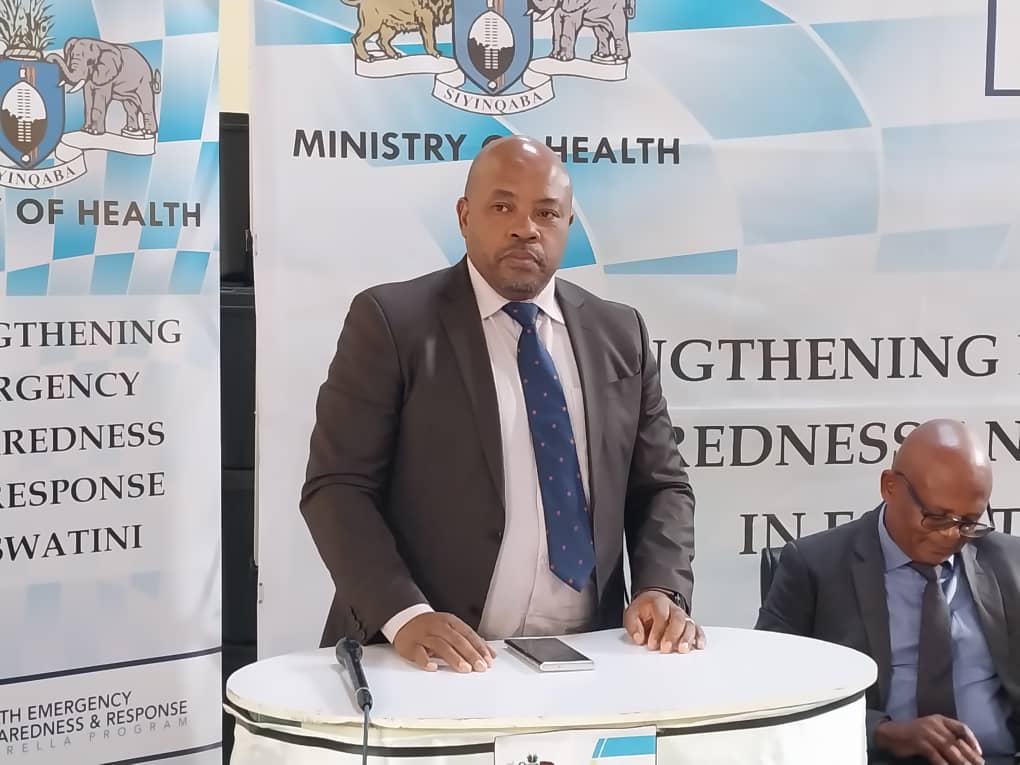
Minister of Health Mduduzi Matsebula says Cabinet can be an emotional environment, sometimes getting hot and personal, as he gives a rare glimpse into high-level political pressure.
In an unusually candid reflection on life inside government, Matsebula described Cabinet not only as a space of decision-making and policy direction, but also sometimes an emotionally charged environment where pressure can escalate quickly and affect ministers on a personal level.
Speaking in a recent interview about his experience as a first-time Cabinet minister, Matsebula said the reality of political leadership was far more intense than it may appear from the outside.
He noted that while Cabinet ministers hold equal constitutional status in principle, experience and seniority create natural differences in how they navigate stress, pressure and responsibility.
According to Matsebula, these dynamics become especially important during moments of differing views or crisis, when tensions rise and discussions can become deeply personal.
This is where, he said, Deputy Prime Minister (DPM) Thulisile Dladla becomes the go-to person in Cabinet for protection and advice and provides ‘motherly love’ for the newbies at that high level of political office.
“There are a lot of emotions involved, but then Dladla plays a role that is beyond her role as the DPM who is also our immediate supervisor,” Matsebula said.
He explained that in such moments, some ministers — particularly those new to Cabinet — often rely on her for guidance, reassurance and emotional grounding.
He described her as a stabilising presence within Cabinet, someone who steps beyond formal duties to offer mentorship and support when pressures escalate.
Matsebula said in high-pressure government environments, it is not uncommon for disagreements or policy tensions to intensify to the point where they affect interpersonal relationships.
“Sometimes it gets so ‘hot’ that it even touches the personal level,” he said, underscoring the emotional intensity that can emerge behind closed Cabinet doors.
He added that in these moments, informal support structures become crucial.
While the prime minister carries ultimate responsibility for government leadership, Matsebula suggested that it is not always practical for all issues to be escalated to his office.
Instead, he said the DPM often becomes a key point of counsel and mediation within Cabinet dynamics.
For Matsebula, this internal support system has been particularly important given his relatively recent entry into Cabinet.
He acknowledged that ministers without long-standing political experience often face a steep learning curve, not only in policy and governance, but also in managing emotional and psychological pressure.
He said he and some others have experienced what he described as ‘motherly love’ from Dladla, which extends beyond her official responsibilities.
Her role is not limited to assisting vulnerable communities through her portfolio, but has also availed herself to support her Cabinet colleagues when the going gets tough.
“Uyasikhulisa (helps us mature). This is why we are grateful to His Majesty King Mswati III for giving us a DPM like Dladla. We look up to her,” he added.
Matsebula framed this support as an important part of Cabinet cohesion, particularly in an environment where decisions can be contested and outcomes politically sensitive.
He suggested that such interpersonal support helps ministers remain functional and focused despite pressure.
He also reflected more broadly on the nature of political decision-making, stressing that leadership requires decisiveness even under uncertainty.
This is one of the political lessons he has learned so far.
“In politics, it does not help to be always sitting on the fence,” he said, adding that ministers must eventually take positions, whether popular or not.
He noted that decision-making inevitably carries consequences, and not all choices will be well received by colleagues or the public.
However, he argued that indecision is often more damaging than making the wrong call because it prevents learning and adjustment.
“What I’ve also learnt in politics is that a decision you make will not necessarily be liked by everybody,” Matsebula said.
“Also, taking a decision is better than not taking a decision because you will not get proper guidance if you haven’t.”
He acknowledged that mistakes are part of governance, but insisted that correction and guidance are possible only after action has been taken.
Without decisions, it becomes difficult to assess direction or effectiveness.
“You can try and turn a blind eye on issues that have become personal, but in politics you need to make a decision,” he added.
Matsebula also addressed the emotional resilience required in Cabinet, noting that ministers must develop a “thick skin” to withstand public scrutiny and internal pressures.
He said while the work environment can be intense, it is necessary to focus on delivery rather than external commentary.
“Being in Cabinet is not for the faint-hearted,” he implied, describing it as a space where ministers must continually navigate pressure, criticism and expectation.
The minister admitted that he does read social media content about him and Cabinet, and that over time he has learned to filter criticism constructively.
While some feedback can be useful in helping one see and correct some mistakes, it can sometimes be distracting and emotionally draining.
“In some cases you learn many things from criticism and unmet expectations,” he said.
“But on some days you just need to protect yourself by not checking into social media.”
Meanwhile, the DPM confirmed the supportive role described by Matsebula.
She acknowledged that ministers do approach her for counsel and protection when challenges arise.
Pressed about the nature of these issues, she described them broadly as “Ema challenges emhlaba,” referring to difficulties arising from life’s challenges.