


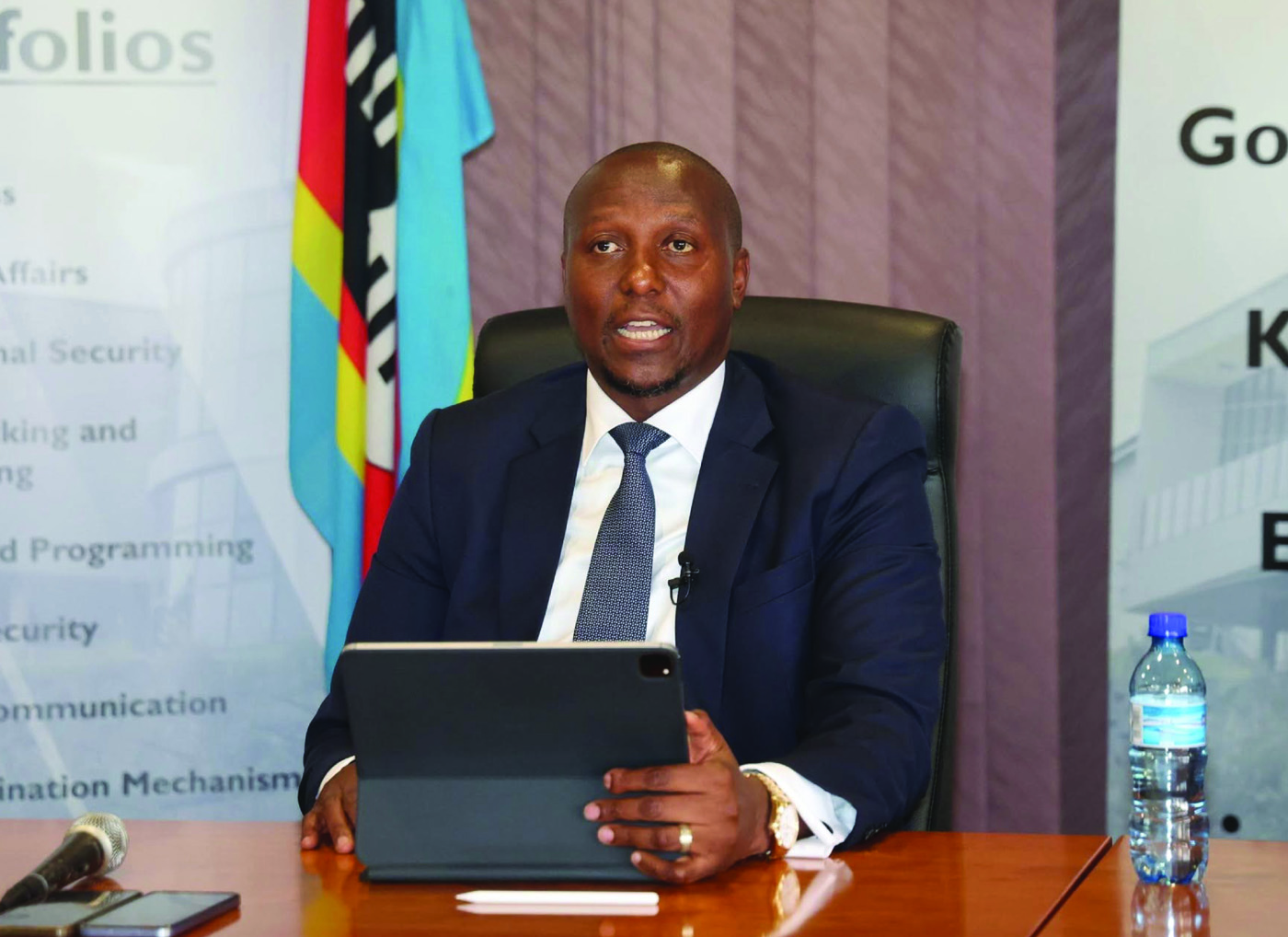
Prime Minister Russell Mmiso Dlamini says the disruptive style of leadership was entrusted to the Executive by His Majesty and the people at Sibaya.
The prime minister said it was not a mere administrative posture, but a transformative mandate.
According to the premier, disruptive leadership, properly understood, was a visionary approach that challenges entrenched norms and resists complacency.
He said it is not content with the preservation of existing systems or the status quo but rather seeks to redefine them through innovation, calculated risk and principled decision-making.
“It is leadership anchored in fact rather than popularity and in substance rather than rhetoric. In plain terms, it requires a change of pace and method. It calls upon us to examine not only the manner in which we work, but also the speed, quality and measurable effect of that work in advancing the goals we have set for the nation,” he said.
This was shared by Dlamini in response to a motion moved by Mbabane East MP Welcome Dlamini and seconded by Ngudzeni MP Charles Ndlovu yesterday.
The MPs had asked the prime minister to outline how his disruptive style of leadership was consistent with and fitted into the Tinkhundla system of governance as established under the Constitution of the Kingdom of Eswatini and the Tinkhundla framework, which emphasises consensus-building, traditional authority and collective decision-making at both national and local level.
They also asked how this leadership style affected the doctrine of collective responsibility within Cabinet, particularly whether it upheld or undermined the principle that all ministers were jointly accountable to His Majesty the King-in-Parliament for the policies and actions of government.
The PM, in his 11-page response, said disruptive leadership was far removed from the definition advanced by the proponents of the motion.
He said the administration, in faithful execution of His Majesty’s vision, had translated that mandate into tangible priorities, including investment in mega-projects to stimulate growth and reduce unemployment, strengthening governance to enhance service delivery and improving livelihoods to secure the welfare of the people.
“My insistence on disruption is informed by the diagnosis of the poly-crisis identified at Sibaya, as the highest national policy-making forum, and during the development of the Programme of Action,” he said.
He added that the approach was firmly grounded in the reality that the country could not transform if it remained comfortable with a slow pace and continued doing things the same way they had been done for decades.
Dlamini said the pace in the rest of the world, scarcity of resources and the country’s relatively small size required citizens to think harder, work harder, increase efficiency, reduce waste and corruption, uphold patriotism and set aside individual interests.
He added that he was a firm believer in and proponent of the country’s unique Tinkhundla system.
He said there should be no suggestion that his call for disruptive leadership constituted a challenge to traditions or the system of governance.
“Such an interpretation is wholly misplaced. On the contrary, if we heed His Majesty’s directive of Nkwe, a call to urgency and speed in the development of our country, we shall strengthen our system of governance and accelerate transformation,” he said.
Dlamini added that it was this government that had successfully promoted and defended the Tinkhundla system of governance in international forums.
He said the country received the Award for Effective Governance – Peace Division from the African Union Department of Political Affairs, Peace and Security, in recognition of the administration’s effective utilisation of the Tinkhundla system in promoting and sustaining national unity, peace and domestic stability.
He said the achievement had further given the country a place in the global political dispensation following its award of the presidency of the Global Council for Political Renewal for the period 2025 to 2028, in recognition of its advancement of the system in international forums.
‘DISRUPTIVE LEADERSHIP HAS BROUGHT SPEED’
The disruptive leadership style, according to Prime Minister Russell Mmiso Dlamini, has brought speed, innovation and an outcome-based ethos to the Nkwe mandate, while rejecting corruption, mediocrity and inertia.
The PM said when His Majesty issued the Nkwe directive, he was commanding government to disrupt the ordinary manner of doing things, which had too often been painstakingly slow.
He said the King was not merely directing government to quicken its pace, but was commanding it to rise and run.
He said His Majesty, as Head of State, had set before the nation a clear vision of transformation and entrusted government with the solemn duty of giving practical effect to that vision.
“The fruits of disruptive leadership, as espoused in the Programme of Action 2024–2028, are already becoming manifest. Although it is commonly accepted that the results of a change in government policy may only become visible after three years of implementation, we have already begun to reap the dividends,” he said.
He said progress had been registered in translating His Majesty’s vision into actionable policy, embracing mega-projects as engines of growth, strengthening patriotism and national identity, and advancing prudent fiscal discipline and innovative financing models.
He said results had also been recorded in resolving the health crisis through improved drug availability, from approximately 30 per cent when the administration assumed office to around 90 per cent currently.
Dlamini said government had also improved the welfare of tertiary students, attracted investments exceeding E30 billion, established the Business One Stop Centre and enacted critical legislation to secure health, decentralisation, empowerment and the protection of citizens.
“Government has created more than 16 000 jobs since taking office, 11 000 of which have been filled by young people. The national unemployment rate declined from 35.4 per cent to 33.5 per cent and government also allocated 500 hectares of land for the establishment of the Taiwan Innovation Park at Phocweni, a strategic investment expected to attract US$6 billion in investments across high-value sectors and create approximately 10 000 additional jobs,” he said.
He said notable progress had also been made in strengthening food security and advancing the country’s journey towards food sovereignty through increased maize and bean production.
He said government had effectively contained the country’s worst Foot and Mouth Disease outbreak in recent years through interventions that included the rehabilitation of cordon fences and vaccination of the national herd.
“Government has constructed 1 033 houses for vulnerable households across the country, thereby significantly improving the living conditions of disadvantaged citizens,” he said.
He added that scholarship beneficiaries increased by 1 000 students, while the monthly scholarship allowance was raised from E1 690 to E2 000.
He said government had also taken decisive steps to curb rising electricity costs while making significant progress towards achieving energy self-sufficiency.