



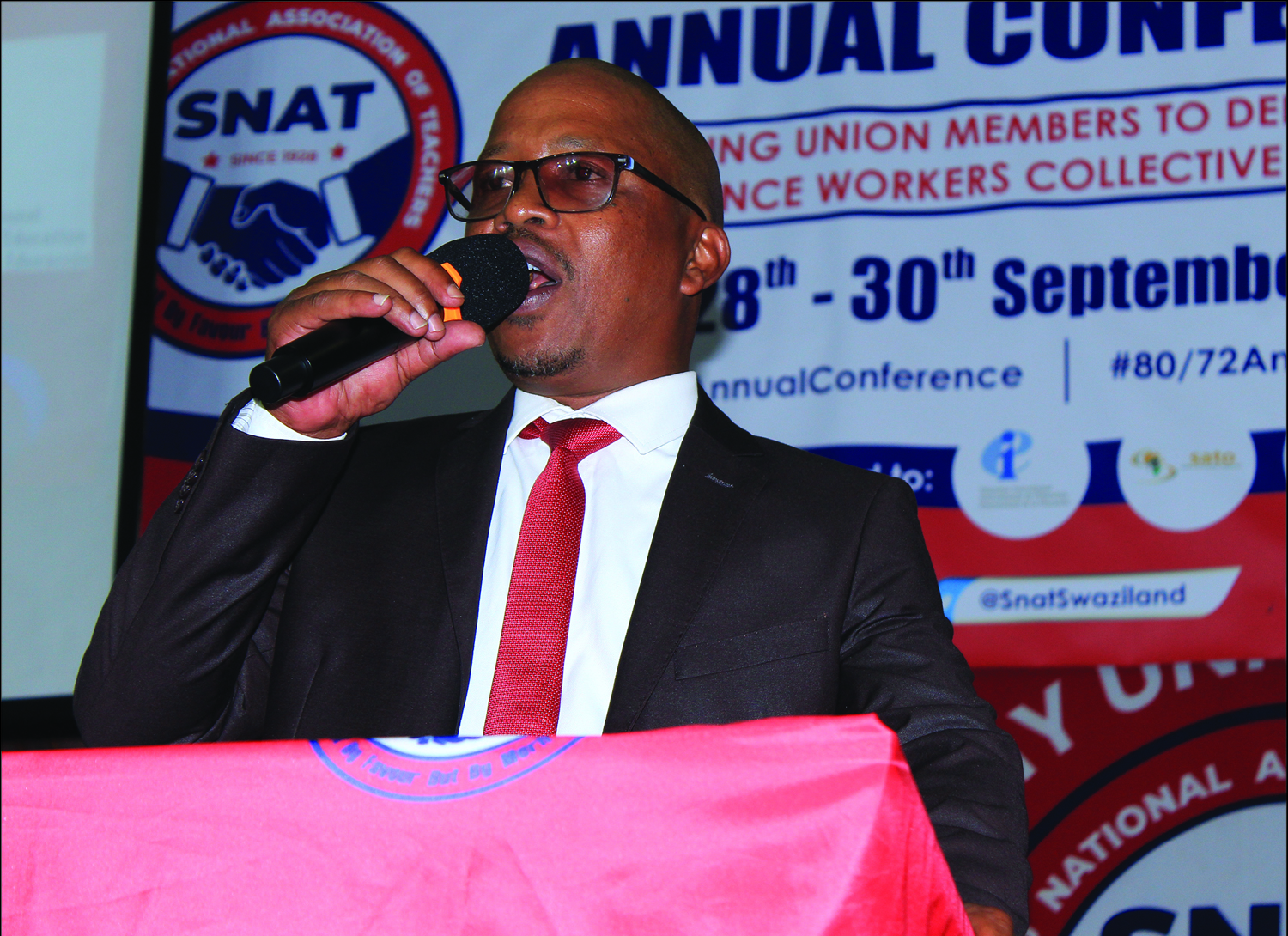
Outgoing Swaziland National Association of Teachers (SNAT) President Mbongwa Dlamini has challenged the union’s incoming leadership to raise the bar on teachers’ demands by moving beyond cost-of-living adjustments (COLA) towards a living wage and stronger employment conditions.
Dlamini made the call yesterday during the 2026 SNAT Annual Conference held at Esibayeni Lodge in Matsapha, where teachers gathered to elect a new National Executive Committee (NEC) and deliberate on issues affecting the union.
The conference, which started yesterday and will end tomorrow, themed, ‘Empowering Union Members to Deepen, Defend and Advance Workers’ Collective Bargaining.’
In his address, Dlamini reflected on what he described as eight years of “trial and triumph” at the helm of the teachers’ union.
“You entrusted me with this banner for eight years, from 2018 to 2022 and again from 2022 to (yesterday). It was not a normal journey,” he said.
He recalled being suspended in May 2019, saying this came after he stood up for teachers’ interests.
According to Dlamini, he was reinstated in October 2021 but was subsequently transferred from Mhubhe High School to Moyeni High School.
He further said his salary was stopped in September 2022 before he was dismissed in August 2023 for alleged absenteeism.
Dlamini, however, maintained that his absence from the classroom was linked to his involvement in negotiations on behalf of teachers.
“In August 2023, I was dismissed for ‘absenteeism’ while I was sitting at the negotiation table fighting for your salaries,” he said.
He claimed that he had won every court case relating to his disputes with Government but alleged that the orders had not been honoured.
Despite the challenges, Dlamini said he was leaving office without bitterness.
“I stand before you today not bitter but proud because you empowered me and together we turned trials into triumphs. We put money in teachers’ homes,” he said.
Dlamini also highlighted what he described as some of the union’s major achievements during his tenure, including salary improvements.
He said SNAT secured COLA adjustments in 2022, 2023 and 2024, followed by a salary review in 2025.
“For years government said there is no money. We forced them to the table and we delivered real improvement in the economic life of every teacher,” he said.
Dlamini also pointed to the construction of the E39 million SNAT Conference Centre, saying the project represented the union’s determination to build its own institutional infrastructure despite the challenges it faced.
“It will be our own home and this is proof that even under persecution, an empowered union can build,” he said.
On pensions, Dlamini urged the incoming leadership to remain vigilant in defending the Public Service Pension Fund (PSPF), warning that the issue remained unresolved.
He said SNAT had fought what he described as attempts to alter the pension system through the courts, streets and bargaining structures.
“I urge the incoming leadership to keep up the fight and defend the PSPF at all costs,” he said.
As delegates prepare to elect a new NEC, Dlamini urged them to view the conference as more than an electoral contest.
“This conference is not just an election. It is a renewal of our vow,” he said.
He challenged delegates to deepen their understanding of collective bargaining and protect the independence of the union.
He also called for SNAT to broaden its demands from COLA to a living wage, from a housing allowance to what he termed a meaningful 13th cheque and from fixed-term contracts to permanent employment.
He further called for the reinstatement of teachers he described as having been victimised, insisting that court orders should be respected.
Reflecting on his departure from the presidency, Dlamini said his journey had taken him from the classroom at Mhubhe High School to leaving office as a dismissed and unpaid teacher.
“I leave it dismissed, unpaid but undefeated,” he said.
Dlamini thanked the teachers who supported the union, as well as his family and the NEC.
‘FEMALE TEACHERS FORCED TO SHARE WITH MALE COLLEAGUES’
Some female teachers are allegedly being forced to share accommodation with male colleagues due to shortage of teachers’ houses, Swaziland National Association of Teachers (SNAT) Secretary General Lot Vilakati has revealed.
Vilakati made the allegations yesterday during the 2026 SNAT 80th–72nd Annual Conference at Esibayeni Lodge in Matsapha.
The issue arose after a SNAT member raised concerns about teachers sharing houses who had been denied housing allowances by government on the grounds that they were already accommodated.
Vilakati acknowledged that the shortage and poor condition of teachers’ accommodation remained a serious challenge, particularly in rural schools, but said some urban schools were also affected. He said the shortage had reached a point where female teachers were sometimes compelled to share houses with male colleagues.
“You will find that in that room, there are two males sharing those houses with a female and all of them are contract teachers, while in other instances one will be permanent,” he said.
Vilakati explained that some teachers’ houses had only two bedrooms, a dining room, kitchen and toilet, forcing educators to share the limited space.
Where one occupant was permanent while others were temporary or contract teachers, he said the permanent teacher would generally be regarded as the occupant, leaving the others without accommodation.
He said teachers living in one-room houses were also sometimes denied housing allowances because government considered them accommodated.
Vilakati said the shortage made it difficult for SNAT to mobilise teachers around the issue, as those with decent accommodation often did not feel directly affected.
He also highlighted tensions over the allocation of teachers’ houses, saying some permanent teachers expressed frustration when houses were allocated to temporary teachers while they remained without accommodation.
He said the crisis required urgent attention as teachers continued working in schools where accommodation was unavailable, overcrowded or in poor condition.