



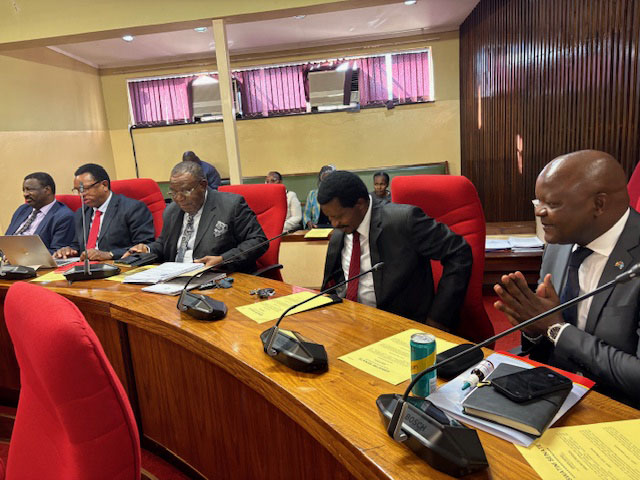
IN a move aimed at cushioning businesses and the public, the Senate has passed the Finance (Amendment) Bill of 2025 with significant reductions to the previously proposed hiked user fees.
The most notable reversal was the reduction of road user fees for commercial vehicles entering and exiting Eswatini.
The original proposal had suggested an increase from E50 to a maximum of E400. After some consultations with stakeholders, the Ministry of Finance Portfolio Committee scaled the fee down to a maximum of E150, settling on a figure they deemed fair and reflective of current economic conditions. Initially, the Senate Portfolio Committee had proposed an increase to E400, while the House of Assembly proposed an increase to E200.
The ministry’s Portfolio Committee Chairperson Senator Tony Sibandze, when moving a motion for the adoption of the Finance (Amendment) Bill No.3 of 2024, said user fees in the country had not been reviewed since the year 2019.
He said during consultations with stakeholders, trucking operators under the National Road Transportation Council (NRTC), had decried the increase of toll fees from E50 to E400 as proposed by the ministry for heavy duty vehicles, which they deemed too steep. He said they requested for a hike to E150 instead.
Sibandze also informed the House that the stakeholders also requested that government should hike the user fees gradually. Under the revised structure, fees for light commercial government vehicles will be E80, down from the proposed E130. Senator Sibandze stressed that the revisions aimed to balance cost recovery with affordability.
“The intention is not to financially drain Emaswati, but to align the fees with the cost of service delivery,” Sibandze said.
Senator Siphelele Mkhonta, who seconded the motion, highlighted the importance of reducing reliance on government funding. “The public needs to pay a fair share of the services offered by the State. The review of the fees is aimed at addressing the culture of dependency on government,” he said.
Senate President Lindiwe Dlamini underscored the need to heed concerns raised by local businesses, many of which had submitted that the original hike would threaten their viability. Other stakeholders including the University of Eswatini (UNESWA) and Piggs Peak Catholic Church, which were engaged by the ministry, also called for transparency on how collected user fees are used, with many stakeholders urging for equity in the distribution of the funds.
Senator Linda Nxumalo noted that it had been a while since government reviewed service fees, and said such had negative impacts on the country’s revenue. She also highlighted that the country’s roads were damaged and that for maintenance, government needed the funds collected for services afforded to citizens. Nxumalo also stressed that the user fees needed to be reviewed periodically.
Alcohol and Tobacco Levy (Amendment) Bill can curb access to products
EASY access to vaping products by children has concerned Senators who have supported the call to expand the definition of ‘Tobacco’ in the Alcohol and Tobacco Levy (Amendment) Bill.
Senator Princess Ntfombiyenkhosi said she was surprised to learn that children as young as those in primary school had access to vaping products, some of which they took to school.
She said during the stakeholder engagements on the Bill, she learned that the vapes or vaping devices in which the nicotine that is heated into an aerosol inhaled by users, can be in a form of any normal product such as pens. With the inclusion of vaping products in the definition of tobacco, the senator said the Bill, after being passed into a law, could help prevent easy accessibility of the products, especially to minors.
The senator said this in Senate, where Senator Tony Sibandze, who is also the chairperson of the Ministry of Finance Portfolio Committee, had moved a motion for the adoption of the Alcohol and Tobacco Levy (Amendment) Bill No.4 of 2025. Meanwhile, Senator Sibandze also said concerns from consulted stakeholders, including the National Liquor Association (SNLA), was that the levies should not be increased more than 30 per cent.
He said they cited that some liquor businesses had closed down during the period of the COIVID-19 pandemic while the existing ones were struggling. They also reportedly requested for meaningful consultation from government because they had Intel on how alcohol and tobacco were smuggled into the country.
“Otherwise, there were no amendments made to the Bill save for the one on the definition of ‘tobacco,” stated Sibandze. Government had proposed a 4.5 per cent increase in taxes on alcohol. However, following extensive engagements with stakeholders in the industry, the committee opted for a more manageable two per cent increase for local manufactures.
Meanwhile, the cost for importing the same products has been hiked to 10 per cent from seven per cent while the cost of importing tobacco products has increased from seven per cent to 12 per cent.
Local manufacturing costs for the same products have hiked to 12 per cent from 10 per cent. The Bill was passed by Senate last Thursday.