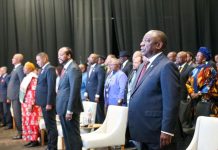




In the humid, high-stakes theatre of regional politics — where grandstanding often substitutes governance and interventionism masquerades as leadership — the King’s recent approach to the Madagascar crisis offers a study in restraint.
As incoming Chairman of the Southern African Development Community (SADC) Troika on Politics, Defence and Security Cooperation, His Majesty King Mswati III has called for the immediate return to constitutional normalcy in Madagascar.
This statement followed his meeting with Andry Rajoelina, who had been unconstitutionally removed.
Occupying a position from which he could have opted for theatrical pronouncement or blunt imposition of external will, the King instead chose dialogue over decree — engagement over enforcement. It is a choice that speaks to four decades of accumulated political wisdom.
The Madagascar situation, following bouts of constitutional volatility, presented a familiar temptation: maximalist intervention. To many international observers, the script is always pre-written — immediate reinstatement and forceful restoration.
Yet His Majesty eschewed spectacle. Rather than demanding rigid reset, he advocated restoration through dialogue. To some, this appeared insufficiently forceful. But it reflected a deeper understanding: sustainable political settlements cannot be imposed; they must be constructed.
This is leadership concerned with second-order consequences — what happens after mediators depart and headlines fade.
Marking 40 years on the throne, the King’s leadership philosophy remains remarkably consistent. While many African heads of State have risen and fallen with ideological fashions, he has maintained a steady commitment to what might be termed peace through process.
It is this consistency that has earned him sustained influence within SADC and beyond. Institutional memory and measured judgment are assets forged only through longevity.
Former South African President Jacob Zuma, former Botswana President Ian Khama and other regional leaders have frequently sought his counsel.
The irony, of course, is that this influence emanates from a monarch whose domestic governance model often sits uncomfortably with Western multiparty frameworks.
Yet what Eswatini exports to the regional stage is not constitutional replication — but philosophical extraction.
Sibaya — the traditional gathering place where matters of national concern are openly debated — embodies inclusive deliberation.
Legitimate governance, within this framework, requires space for all voices and patient dialogue rather than imposed verdicts. Extracted from its monarchical context, this principle has proven portable.
This past week, South African President Cyril Ramaphosa, during his State of the Nation Address (SONA), called for a national dialogue — a space where all South Africans can have their say.
The language bore unmistakable resemblance to Sibaya thinking.
During Eswatini’s 2021 unrest, Ramaphosa’s intervention did not merely mediate — it exposed him to a governance model where breakthroughs are achieved through collective conversation.
That he now proposes similar processes within South Africa’s complex multiparty democracy suggests something significant: dialogue as a transferable governance principle.
A democracy borrowing from a traditional system — not to dilute pluralism, but to deepen legitimacy through inclusive deliberation.
The King’s handling of Madagascar signals that regional stability depends less on swift imposition of outcomes than on the patient construction of domestic political settlements.
Longevity in leadership creates forms of wisdom that rapid electoral turnover cannot replicate.
We often mistake drama for decisiveness. Yet effective leadership sometimes manifests as quiet advocacy for processes that allow societies to craft their own durable solutions.
As the region faces new pressures, this quiet wisdom may prove more valuable than many yet realise.
THE HIGH COST OF LIGHT
It came as no surprise, but the recent decision by the Eswatini Energy Regulatory Authority (ESERA) to grant the Eswatini Electricity Company (EEC) a 13% tariff increase is more than fiscal adjustment — it is a rupture in the social contract.
For the average Liswati, already burdened by global inflation, this double-digit surge is an exercise in the impossible.
Small business enterprises have warned that come April, some will lock their doors and walk away.
We have entered a surreal era where citizens are expected to live beyond their means to subsidise a parastatal that has forgotten its own mandate.
Minister of Natural Resources, Prince Lonkhokhela, must reckon with a foundational truth: the EEC was conceived as a pillar of public service, not a predatory merchant.
When the State transfers infrastructure deficits and regional power shortages onto struggling households, it abdicates its role as a buffer against volatility.
The structural debt required to finance the grid belongs to government — not to families budgeting with sighs.
To ask households to subsidise inefficiency with hunger is to misunderstand the purpose of a parastatal.
It is time to return the EEC to its mandate of service — before the cost of light becomes a luxury the nation, and its soul, can no longer afford.
Awu, sesibakho Nkhosi!