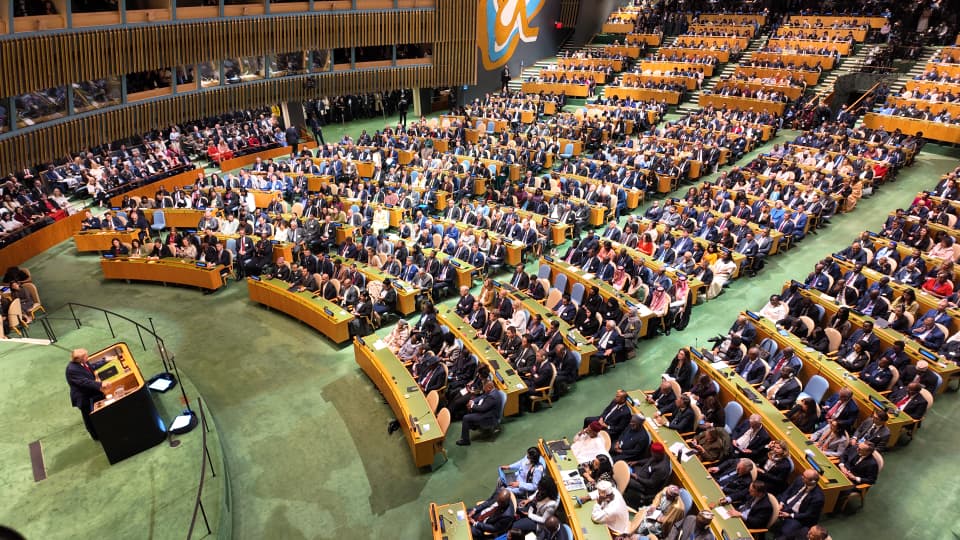
WORLD leaders at the 81st Session of the United Nations General Assembly raised critical issues that threaten the effectiveness of the United Nations under the theme: ‘Restoring trust, managing transformation: A United Nations that delivers for all.’
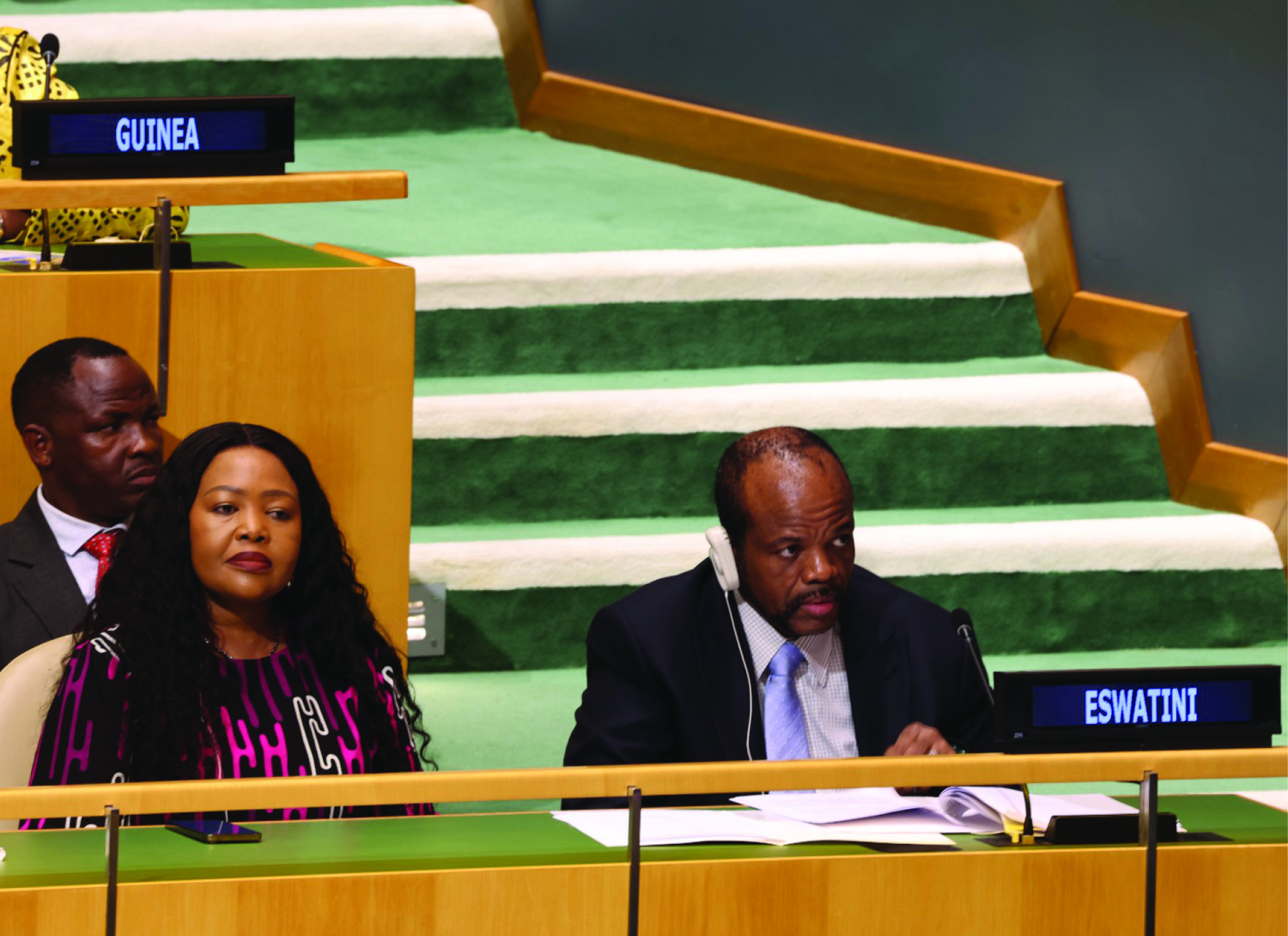
His Majesty King Mswati III, who takes the floor today, was amongst the throngs of world leaders who attended the 81st Session of the United Nations otherwise known as UNGA.
Outgoing UN Secretary General António Guterres delivered a wide-ranging speech that framed the world’s most pressing crisis as not just isolated problems, but different expressions of the same underlying struggle over how power is exercised and by whom.
Guterres said the greatest power is not the power to dominate, when delivering his report, he said it is the power to build a future that works for everyone.
The UNSG described the past decade of his reign as of eroding international norms – from civilians targeted in war, and humanitarian workers killed, to international law “cast aside” and fraying trust between nations.
He said power itself is being fundamentally reshaped in three ways: Emergence of new State powers; Significant transfer of authority from governments to private corporations and individuals and the growing role of AI and autonomous weapons in decisions once reserved for humans.
“The faultlines in our world are widening,” he said. “Cracks have become canyons.”
Guterres said rather than accepting fragmentation as inevitable, he called for galvanising cooperation and a truly global network built on interdependence and shared rules while warning against sliding into rival blocs with separate economic and security systems, a scenario he has termed in recent years the Great Fracture.
Meanwhile, the Emir of Qatar Tamim bin Hamad Al Thani said the current crisis in the Gulf should come as no surprise to anyone.
“It is the cumulative result of years of postponing crisis management through temporary solutions and unrealistic policies,” he said of the war between the US and Iran which has sprawled to impact a series of Gulf states.
“At the heart of the dangerous situation we are witnessing lies an absence of a regional system of collective security. One that respects the sovereignty, security and territorial integrity of States. One that promotes the peaceful settlement of disputes and the non-interference in the internal affairs of States,” Al Thani said.
He said Qatar had recently called “from this very podium” for such a system and was now reiterating the appeal “after recent events have demonstrated the urgent need for it.”
Iran has sometimes been accused of striking targets in neighbouring Gulf countries with close ties to the US.
Al Thani said the restrictions on passage through the Strait of Hormuz amounted to the “lifelines of the global economy” being turned into bargaining chips, “with people on every continent bearing the cost, despite being far removed from the causes of the conflict.”
The 46-year-old head of State said this was driving up prices not just for fuel but also for core other goods like food and medicine.
United States President Donald Trump said America will never allow Iran, whom he described as the bully of the Gulf states, to own a nuclear weapons.
“They were the, but they are the bully no more,” Trump said, adding that he had given Tehran numerous opportunities to drop its nuclear programme and stop its support of militant groups across the regions.
“They refused, which was a big mistake.”
The US leader mentioned both the September 11 attacks and the October 7 attacks in Israel, the latter being carried out by Iran-backed Palestinian militant group Hamas.
“Just imagine such a vile regime was able to carry out terror attacks from behind a nuclear shield,” Trump said.
Trump concluded by saying he was facing a choice of whether to allow Iran to regrow or to ‘annihilate’ it.
“Freedom was not a gift that Americans won easily after 250 years,” he said. “And it is not one that we will ever, ever surrender.”
He went on to tell of George Washington ordering the Declaration of Independence to be read to his troops in New York in 1776 as a British fleet approached the shore.
Trump said the first Americans “knew that it was not enough merely to believe in great principles, we must also have the will and the courage and the strength to defend them.”
He said this was the challenge “for every nation in this room,” saying they should “go forward strong against the enemies of all humanity” and “refuse to shrink from” their duties to their people.
US aid cuts welcomed by Kyrgyzstan’s president
Zhaparov has welcomed United States President Donald Trump’s decision to halt funding for NGOs globally.
While many governments and aid agencies have criticised the United States for withdrawing support that sustained health, humanitarian and development programmes across the developing world, Zhaparov has argued that the move has reduced external interference in the internal affairs of developing states.
Addressing the 81st United Nations General Assembly, he said the move had created conditions for stronger national sovereignty, which are allowing countries to choose their own development paths. His Majesty King Mswati III is among those in attendance.
The remarks come against a backdrop of steep declines in American assistance. US foreign aid disbursements fell from roughly $73.5 billion in the year 2024 to $47.3 billion in 2025.
Preliminary OECD data shows that US official development assistance dropped to about $29 billion in 2025, which is a nearly 57% reduction that drove most of the overall 23 percent decline in global donor aid that year.
For Eswatini, the reports indicate that in 2024 the United States provided approximately $76.6 million in assistance to the kingdom, the bulk of which was directed toward HIV/AIDS programmes under PEPFAR and related health systems.
It states that US support to Eswatini since 2007 reached an estimated $800 million to nearly $1 billion, which helped transform the country’s response to what was once the world’s highest HIV prevalence. This saw adult infection rates decline, life expectancy rise by more than a decade from the lows of early 2000s. Thereafter Eswatini became one of the first African nations to reach the UNAIDS 95-95-95 targets on testing, treatment, and viral suppression.
However, in 2025 funding fell to roughly $20–21 million, which is a cut of more than 70% and equivalent to nearly E1 billion in local currency.