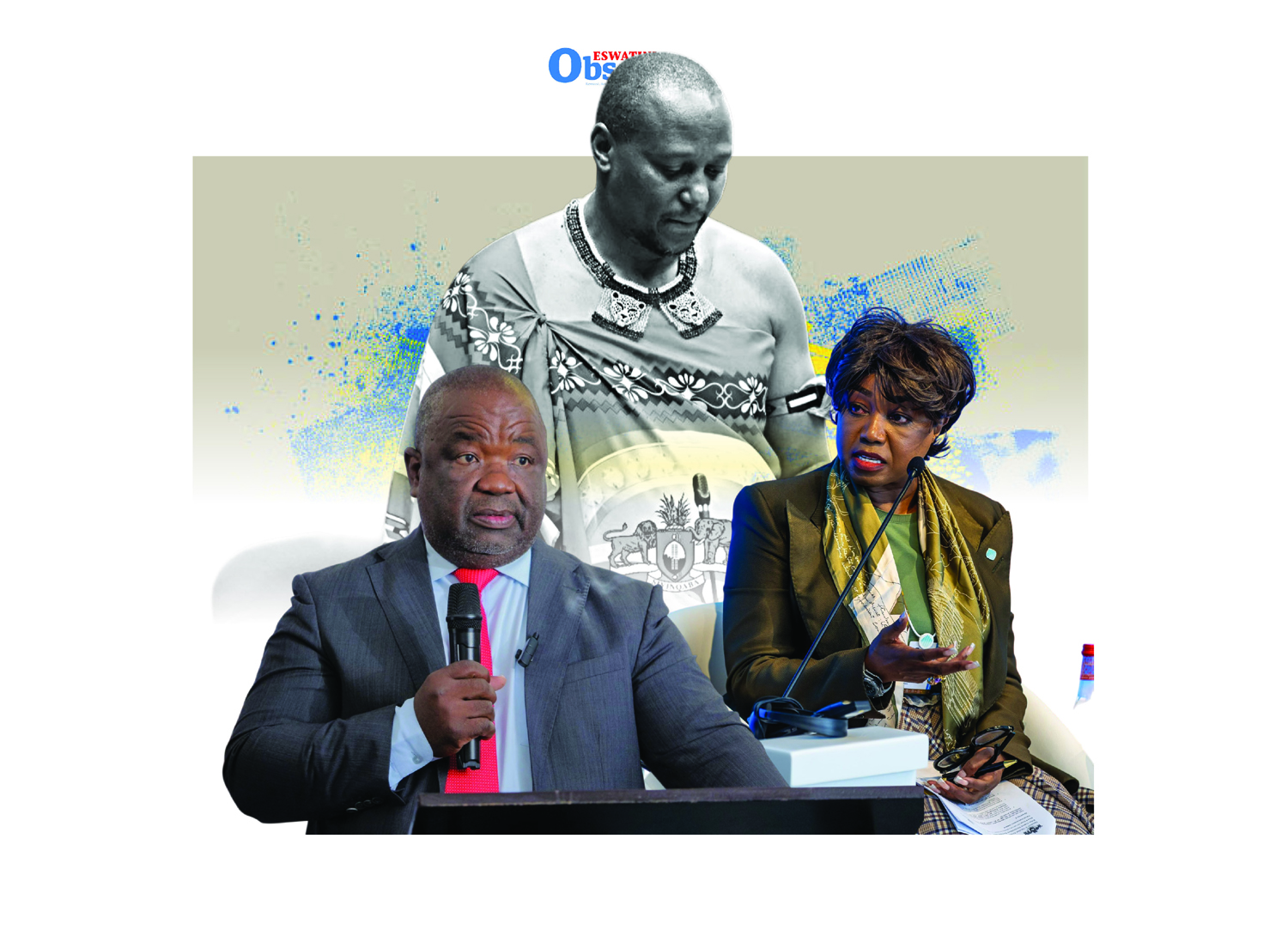
The issue of Cabinet division has lingered almost from the moment the current executive took office and nearly three years on, it has not gone away.
When the first signs of strain surfaced less than a year into the current Executive’s term, Prime Minister Russell Dlamini largely dismissed them as the natural friction of a new executive still finding its footing.
In an interview with this newspaper at the time, he argued that differing views were not only expected, but essential to effective governance.
Today, more than two years later, the premier continues to frame tensions within Cabinet as part of what he has described as the natural evolution of leadership, a process in which different personalities, approaches and viewpoints are gradually aligned behind a common national vision.
That explanation may still hold in theory. In practice, however, the political reality has become far more complicated.
What began as murmurs of unease has steadily developed into ministers publicly challenging the prime minister on matters of policy, process and authority, not in private, but in Parliament and other public forums.
To date, at least four of the PM’s 19 Cabinet colleagues have, in different ways, openly diverged from his stance on major national issues.
ALSO READ | Cabal pushing for State capture – PM
That has fuelled a growing perception, both inside Parliament and among the public, that Cabinet is not merely managing ordinary internal differences but is contending with deeper tensions over authority, procedure and direction.
The Sunday Observer today examines some of the clearest public examples of ministers breaking ranks with the prime minister.
Minister of Information, Communication and Technology Savannah Maziya
Among the tensions that have surfaced within Cabinet, none has played out as publicly, or as repeatedly, as the fraught relationship between Prime Minister Dlamini and ICT Minister Savannah Maziya.
When she entered Cabinet, Maziya was largely an unknown figure in local political circles, coming from a business background rather than a conventional political path. It did not take long for that to change.
The first major signs of friction emerged early when Members of Parliament raised concerns that the minister had been funding her international work trips.
In response, the PM made his position clear.
He said Maziya’s travel requests had been formally assessed and rejected in line with government procedures and that her decision to proceed regardless, even using personal funds, amounted to defiance of executive authority.
A minister, he argued, could not represent government without official approval. Doing so, even at personal expense, undermined governance principles and the authority of the prime minister’s office. In his view, Maziya had crossed that line.
The tensions did not end there. A second major flashpoint emerged around the prolonged delay in appointing a substantive chief executive officer for the Royal Science and Technology Park.
Appearing before Parliament, Maziya disclosed that her ministry had effectively reached a deadlock and was now awaiting guidance from the PM’s office before proceeding with the appointment.
Compounding matters further, she revealed that Cabinet had rejected two separate attempts to fill the post, including a fully conducted external recruitment process.
Over time, the relationship appeared to deteriorate further.
NOW READ | We signed Google agreement – Commerce Minister
The most dramatic moment came when Maziya told Parliament that she had, in fact, been fired by the PM, a claim that sent shockwaves through the political establishment.
The PM has denied this, saying there is no official record or instrument to support such a dismissal and maintaining that the minister remains in office.
Most recently, the tensions have extended into the digital policy space, particularly around a Memorandum of Understanding (MoU) between Eswatini and Google, facilitated by the ICT ministry.
Again, the PM has taken a sharply critical position, raising concerns over the process and saying the agreement was signed without Cabinet approval, without the involvement of the minister of foreign affairs and while he was out of the country.
Beyond process, he has questioned the substance of the deal, arguing that the MoU carries no tangible value, may expose the country to risk and may not even involve Google as the direct signatory.
Taken together, the disputes point to an ongoing and escalating feud between the two.
Minister of Education and Training Owen Nxumalo
Unlike Maziya, whose entry into Cabinet came from outside traditional political circles, Owen Nxumalo was, by many insider accounts, initially regarded as one of the prime minister’s closer allies within the Executive.
In the early days of the administration, those familiar with internal dynamics described a working relationship that was not only functional, but politically aligned.
That alignment, however, did not hold for long.
What began as quiet divergence has, over time, developed into a series of increasingly public confrontations, positioning Nxumalo as another minister willing to openly challenge the authority and decisions of the premier.
The turning point in the relationship can be traced to the ongoing legal dispute surrounding the attempted privatisation of Bahá’í mission schools, which the minister allowed after claiming he had consulted Cabinet.
In an affidavit before the High Court, however, the prime minister directly refuted that claim, stating that the matter had never been presented to, deliberated on, or resolved by Cabinet and that any suggestion the minister had acted with Cabinet authority was without foundation.
The PM argued that allowing the privatisation of mission schools would set a dangerous precedent, potentially destabilising the education system and undermining access for thousands of pupils.
He further emphasised that no Cabinet resolution existed to support such a move and that decisions of this nature fall within the mandate of technical authorities in the ministry, not unilateral ministerial action.
Following the PM’s stance on the Bahá’í matter, Nxumalo’s posture towards him appeared to shift.
One of the clearest examples came during debates linked to the Royal Science and Technology Park, where Nxumalo aligned himself with positions advanced by ICT Minister Savannah Maziya.
As Maziya raised concerns in Parliament about delays and decision-making bottlenecks, including the role of the prime minister’s office in the stalled appointment of a substantive CEO, Nxumalo’s stance suggested a broader coalition of ministerial frustration.
ALSO READ | SADC University row: Princess Ncengencenge defends PM
In engagements around the rollout of the Grade 0 early childhood education programme, Nxumalo has also voiced frustration, telling Parliament that the initiative risked faltering because of internal politics within Cabinet.
“Egos are at play here,” he said.
While he did not name individuals directly, the wider context of Cabinet tensions led many to interpret the remark as part of a broader critique of the prime minister’s leadership style.
The most recent and perhaps most direct confrontation has come over control of the long-delayed SADC University of Transformation project.
Here, Nxumalo’s position has been unambiguous.
Appearing before both Houses of Parliament, he argued that the project properly belongs under the ministry of education and training, both in terms of legal mandate and institutional competence.
“We are and have been ready to deal with the issue of the SADC University, but it should come back to the rightful ministry,” he said.
That position places him in direct opposition to the PM’s approach, which has seen the project driven from the prime minister’s office and framed as a cross-government initiative.
The disagreement has not remained confined to the executive.
It has spilled into Parliament, with the House of Assembly finance committee going as far as removing E8.75 million allocated to the project