



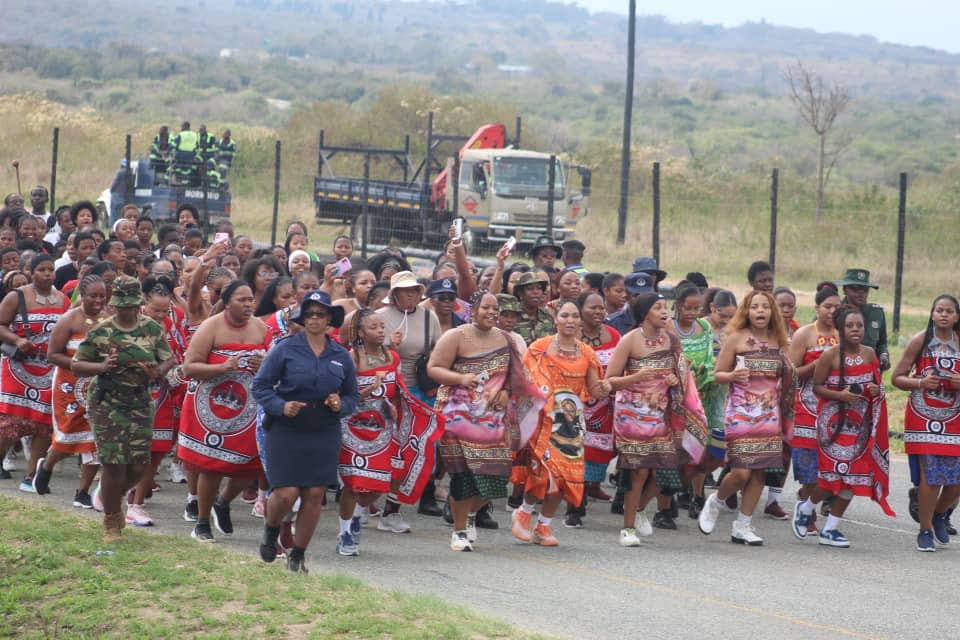
For approximately an hour and a half, the road from Mpisi Farm to Mafutseni became a moving celebration of Eswatini’s culture as thousands of Imbali marched more than six kilometres in song and dance.
Led by Inkhosatana Sakhizwe, Liphovela LaZuma and Indvuna YeMbali Bongiwe ‘Vivane’ Hlatjwako, the maidens transformed what could have been a physically demanding journey into a spirited display of endurance, discipline and unity.
Donned in colourful emahiya, the Imbali marched under temperatures of about 23 degrees Celsius, their voices carrying across the countryside as they made their way towards Mafutseni.
The journey came a day after the maidens had gathered at Mpisi Farm to cut reeds that would be used to make windbreakers, or emaguma, at the royal residences.
Despite having camped at the farm since Thursday and undertaking the physically demanding reed-cutting exercise, fatigue appeared to do little to dampen their spirits.
Every so often, groups of maidens broke into song and dance, while others ran ahead for a few minutes before stopping to encourage those behind them to keep moving.
Among the songs that reverberated along the route were ‘Mswati uyinkhosi’ and ‘Silibutfo lembali uyanyakata umhlaba wakaNgwane’, providing a steady rhythm that appeared to carry the maidens forward.
The march was more than a journey. It formed part of the practical and symbolic traditions at the heart of the annual Umhlanga Ceremony, where shared labour, physical endurance and collective participation brought together Imbali from across the country.
For the older maidens in particular, the journey offered an opportunity to demonstrate camaraderie and unity as they walked together, sang together and encouraged one another along the way.
The spectacle reflected one of the defining features of Umhlanga, the ability of thousands of young women from different chiefdoms and regions to come together as one collective.
On Thursday, Princess Sakhizwe officially opened the reed-cutting exercise by becoming the first to cut the reed, before Liphovela LaZuma and thousands of maidens followed.
The exercise brought together Imbali from across Eswatini, including contingents from the security forces, while participants from South Africa also joined the cultural exercise.
The reeds cut during the exercise are presented as tribute labour for the Queen Mother, Indlovukazi, and are used in maintaining and reinforcing the royal residences.
But the physical journey involved in collecting and returning with the reeds carries meaning beyond the labour itself.
The marching tests endurance and discipline, while the shared effort strengthens bonds between participants from different communities.
Through the songs, chants and coordinated movement, the maidens affirm a sense of belonging that extends beyond individual chiefdoms. It is also a visible expression of commitment to the traditions that have been passed down through generations.
Umhlanga, an eight-day annual ceremony held around late August and early September, has its modern form rooted in the 1940s during the reign of King Sobhuza II, developing from the older umcwasho custom involving age regiments and chastity.
The ceremony is associated with preserving chastity, paying tribute through labour to the Queen Mother and fostering solidarity through shared work.
Against that backdrop, the march to Mafutseni takes on a deeper significance. The physical exertion represents endurance and resilience, while the collective nature of the journey reinforces discipline and responsibility.
The movement from the reed beds back towards the royal destinations can also be understood as part of a broader rite of passage, with the journey, reed-cutting and communal participation marking important stages in the maidens’ social and cultural development.
Yet on the road to Mafutseni, there was little sense of solemnity. There was laughter, singing, dancing and encouragement.
The Imbali did not simply walk the distance; they sang their way through it.
As the colourful procession continued towards Mafutseni, the road became a vivid reminder that in Eswatini’s Umhlanga tradition, culture is not merely observed. It is lived, carried and celebrated together.