



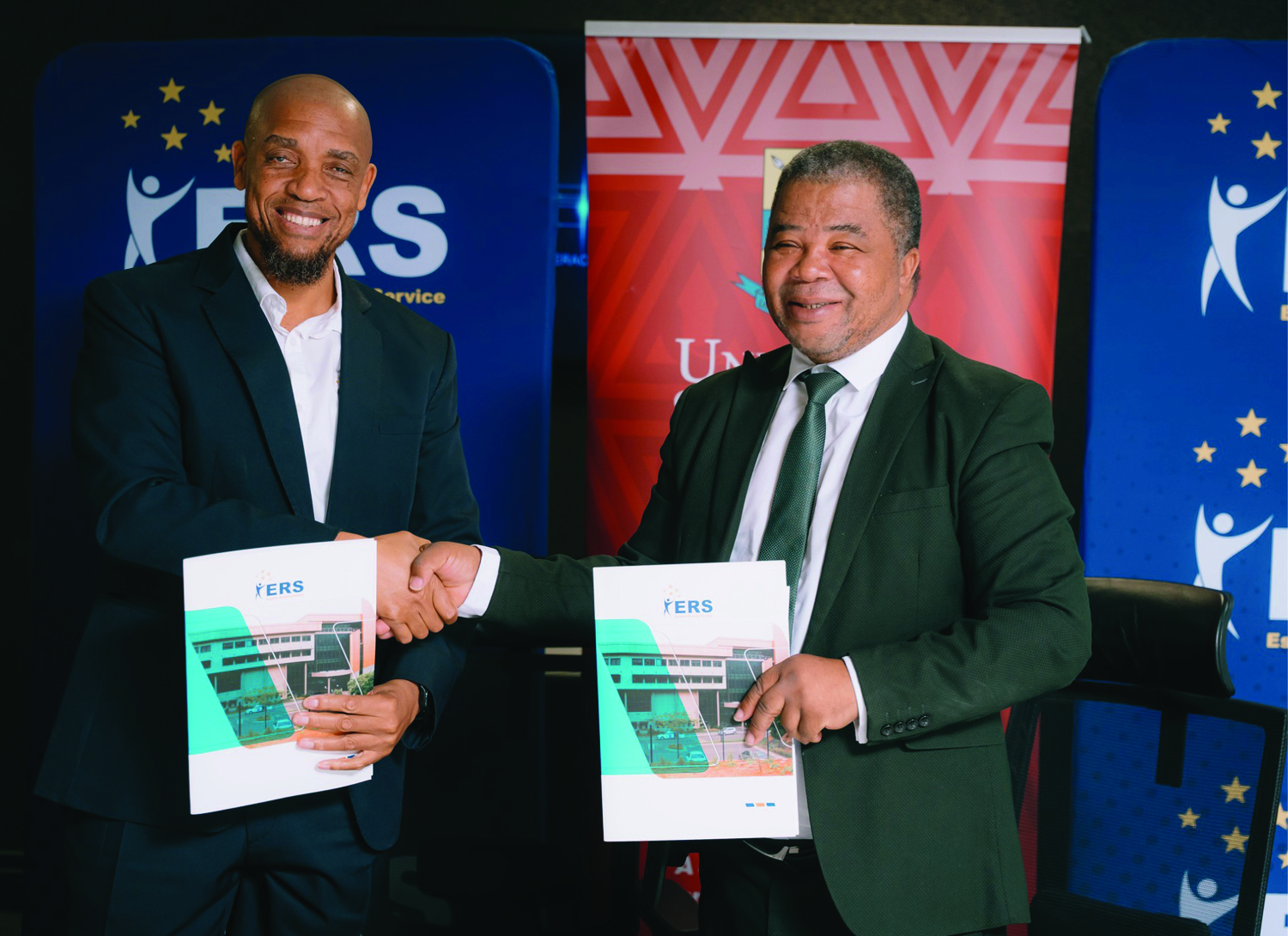
The Eswatini Revenue Service (ERS) has signed a memorandum of understanding (MoU) with the University of Eswatini (UNESWA) to spearhead an Artificial Intelligence (AI) literacy and capacity-building initiative.
The partnership aims to equip 650 ERS employees with both foundational and practical knowledge of AI. This will help foster innovation and strengthen the institution’s readiness for a rapidly evolving digital landscape, while strengthening collaboration in AI and digital transformation.
The agreement paves the way for the implementation of a tailor-made AI literacy programme for ERS staff, to be developed and delivered through the UNESWA AI Academy, equipping employees with the knowledge and skills needed to responsibly embrace the opportunities of the AI era.
This was revealed during the signing of a memorandum of understanding (MoU) of the AI Literacy Capacitation Initiative between the two entities and the launch of ERS AI Literacy Programme held at the ERS Headquarters at Ezulwini yesterday.
ERS Commissioner General Brightwell Nkambule said the partnership was not just about ensuring that the employees were not left behind, but also about equipping them to understand and apply AI responsibly to be able to support their mandate. He said the occasion marked the beginning of what could develop to a strategic partnership between two institutions that share a common commitment to national development.
He noted that their mandates differed, but said the purpose was aligned to contribute meaningfully to the sustainable growth and prosperity of the country. He said both their visions and missions were united by a common thread to improve the lives of Emaswati and strengthen the nation.
He also noted that around the world, leading universities were increasingly becoming engines of innovation, research and problem-solving for society, government and industry, while partnering with organisations to address real-world challenges, develop practical solutions and contribute directly to national development.
“It is encouraging to see UNESWA positioning itself in this manner. By partnering with organisations such as ERS, the university is demonstrating its commitment to ensuring that academic knowledge translates into practical impact. This model has been successfully adopted in many countries. As a country, we stand to benefit enormously when our universities become active participants in solving national challenges. Whether through research, technology development, data analytics, policy studies, artificial intelligence or innovation, universities possess a wealth of intellectual capital that can help institutions such as ERS improve service delivery and achieve better outcomes,” Nkambule said.

Nkambule emphasised that the partnership was a strategic alliance that demonstrates how academia and industry can work together to advance the national development agenda. He said ERS believed that sustainable revenue collection was not achieved through enforcement alone, but was achieved when taxpayers willingly comply because they understand their obligations, trust the tax system and find compliance simple and convenient.
However, he said achieving voluntary compliance required a deep understanding of taxpayer behaviour, hence the need to make decisions informed by evidence, research and data. Through the partnership, he said they envisaged a future where researchers, academics and students would collaborate with ERS to generate insights that would help shape taxpayer service delivery, taxpayer education programmes and compliance strategies.
He said there were opportunities for taxpayer perception studies, behavioural research, economic analysis, policy evaluations and innovation projects that would help them to better understand taxpayer needs and design interventions that improve voluntary compliance.
“Around the world, Artificial Intelligence is transforming the way organisations operate. It is changing how services are delivered, how decisions are made and how work is performed. For revenue administrations, AI presents a tremendous opportunity to improve efficiency, strengthen compliance management, enhance taxpayer services and automate repetitive processes.
“At ERS, our digital transformation journey is evolving from automated processes to autonomous processes. We envision a future where intelligent systems and AI agents perform routine and repetitive work, enabling our employees to focus on higher-value activities such as taxpayer education, customer service, compliance management, innovation, and strategic decision-making,” added Nkambule.