



No one can quite recall how it all began, but the strained relationship between the minister and the principal secretary at the ministry of education eventually became a thing.
At some point, they simply stopped seeing eye to eye. Exactly when, how, or why remains unclear. And yet, in government, a minister and principal secretary are expected to work in tandem; aligned, cooperative, almost like partners in a marriage still waiting for its honeymoon phase. They are meant to complement each other, finishing each other’s sentences (and memorandums, as government business demands).
When that relationship breaks down, it inevitably becomes a thing. For Owen Nxumalo and Naniki Mnisi, their ‘fallout’ threatened to become a very big thing.
The fallout divided the ministry into camps. It spilled into the public domain and even into the courts, with the minister and principal secretary publicly at odds over the Baha’i school’s application to separate from government.
From there, tensions only escalated. The working environment grew so tense that staff found themselves walking on eggshells – a familiar and uncomfortable déjà vu reminiscent of the final months under former principal secretary Bheki Gama.
Before long, the relationship appeared damaged beyond repair – fractured, frail and seemingly unsalvageable. It was even said that the two were no longer speaking, nor appearing together at ministry events.
And so, it became a thing. Everyone knew about it, yet no one wanted to say it aloud. It felt like a matter of time before it exploded – or before something gave.
But we are talking about two strong-willed individuals, each with their own measure of stubbornness. Neither was likely to concede. Neither would admit fault. This, in many ways, reflects a broader culture within government: everyone has power, everyone has a voice, and no one is accountable.
Which is to say, if anyone was at fault, it hardly mattered, because consequences are rare, if they exist at all.
It is what it is, nje. Finish.
ALSO READ | MoU is real – Google
And so, if there was ever to be a solution, it could only come from the two of them. No outsider could fix what was broken. No amount of persuasion from those who still believe in doing what is right would change things. That is not how government works.
These days, politicians seem to have it all and enjoy it thoroughly. They operate beyond reproach. They answer to no one. Too often, their priorities are self-serving: their stomachs, their pockets, their interests. Everyone else can fend for themselves.
But I digress.
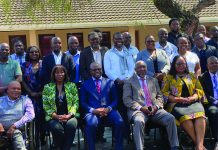
What matters today is this: it was genuinely refreshing to see an image of the minister and his principal secretary smiling together; warm, composed, and seemingly at peace. It suggests that the past, at least for them, may finally be behind them. It suggests that they are finally aligned, as they should be. It suggests they are back to sharing tea and biscuits in the boardroom and that staff at the ministry can now once more be able to walk into either of the officials’ offices without any fear of reprisal.
It suggests all is well.
That single image tells a powerful story, if not refreshing, of political maturity – particularly on the part of Owen Nxumalo, who, by most accounts, appeared to be on the losing end of this standoff.
And he has not had an easy time of late. From controversial remarks about same-sex relations in schools, to clashes over the SADC university budget and its redeployment to the prime minister’s office, to the controversy surrounding the Eswatini Medical and Christian University (EMCU). Owen Nxumalo’s return to politics has definitely not been quiet.
Yet there he was this past week, his principal secretary on tow. Looking like a changed man; looking composed, confident and – true to his nickname – ‘Handsome’.
You couldn’t help but betray a smile. At least I did and suddenly I thought, this is beautiful.
This for me, was the thing, then.
It is a reminder that his charm and likeability remain intact. This is, after all, a man who can break into a sibhaca dance at a public event and win over a crowd of teachers, even while maintaining a stern public image.
His apparent reconciliation with Naniki Mnisi offers an important lesson, one that is increasingly rare in today’s political climate: the ability to adapt, to recalibrate, and to survive.
Because at its core, politics is about survival. Politicians, by nature, are often self-interested. They play the game. They seek advantage.
And sometimes, that means bringing adversaries closer rather than pushing them away.
A politician, one might say, is a chameleon, constantly adapting, shifting positions, and navigating contradictions. If we are being charitable, we might instead call this diplomacy.
There are no permanent enemies in politics, only permanent interests. I once knew someone who insisted on engaging even his harshest critics. His reasoning was simple: in politics, you cannot afford to give your enemies a platform you cannot control.
Owen Nxumalo appears to understand this well. Since returning to public life after a brief sabbatical, he has reinvented himself, earning admiration for his energy, charisma and willingness to confront difficult situations, even at personal risk.
You could say, for instance, that after last week’s statement by His Majesty on the controversial issue of same-sex relations, no one would beam with a smile bigger than the minister’s smile. No one would feel vindicated, if anything, considering the strong criticism he received just earlier this year.
Anyway, that same willingness to confront difficult situations, of course, invites conflict. But it also reveals something else: an ability to navigate storms and, when necessary, find a way through them.
Unfortunately, many of his colleagues remain trapped in a politics of arrogance, unable to move beyond ego, unwilling to rise above petty disputes. And so, we are left with unresolved tensions and missed opportunities, simply because too many leaders cannot bring themselves to reach across the divide.
NOW READ | Being a soldier is a sacred vow – King