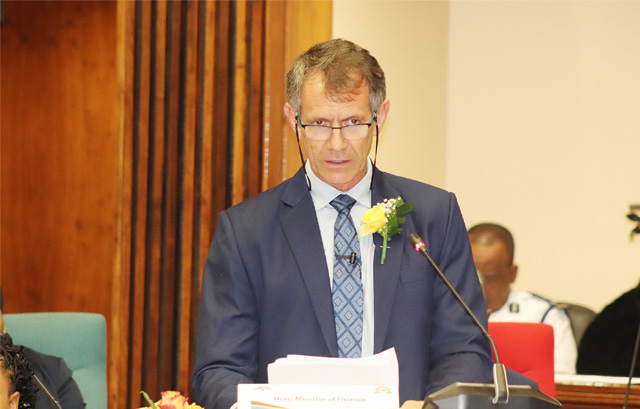
MINISTER of Finance Neal Rijkenberg has revealed that contingency measures have been sought in anticipation of potential shortfalls from the Southern African Customs Union (SACU) receipts.
He said due to the debt to GDP ratio, Eswatini would be in a position to acquire a loan amounting to E20 billion so as to provide for the transitional period in case there were no more SACU receipts.
The minister revealed this during the debate of a private members motion moved by Ngudzeni MP Charles Ndlovu who was seconded by Kubuta MP Masiphula Mamba on Thursday.
Ndlovu had asked the minister for finance to appraise the House on the rationale behind fixing the local debt to GDP ratio at 40 per cent, especially in light of the fact that the average debt to GDP ratio for the top 10 global economies was approximately 110 per cent, and for the top 10 African economies, it stood at around 62 per cent.
He also enquired about the strategies that the ministry, in collaboration with that of economic planning and development, were implementing to enhance the Infrastructure Development Index.
Ndlovu further wanted an explanation on why the vital projects, including the 500 kilometres road network, the E2.4 billion housing project, and the FIFA approved stadium, had not yet commenced.
Rijkenberg was requested to table a comprehensive report on the matters within 14 days of the approval of the motion. Ndlovu raised a concern that government was acquiring loans for consumption purposes as opposed to sourcing funds for investment. Lobamba Lomdzala MP Marwick Khumalo enquired if there was a plan in place to support the economy should Eswatini lose out on the SACU receipts.
Minister Rijkenberg revealed that the ministry had put in place a ‘SACU Plan B’ because Eswatini relied heavily on SACU receipts to fund the national budget. The minister mentioned that there was a possibility that SACU receipts would end, hence the need to have a contingency plan.
He said the plan was to keep the debt to GDP low because in the eventuality that SACU receipts would be lost, there was a possibility to increase the debt to GDP ratio by acquiring a loan amounting to about E20 billion.
“In case we lose SACU, we will be able to take our debt to GDP ratio to 60 per cent through a loan while we try to recover from the SACU loss over a period of about five years,” said the minister. He said if the country’s debt to GDP increased to about 60 per cent as per the suggestions by MP Ndlovu, losing the SACU receipts could be detrimental for the economy. He said international financial institutions had confidence in Eswatini due to the lower debt to GDP ratio. The country’s economy was growing due to the private sector confidence in the debt ratio.
Rijkenberg emphasised that Eswatini was on the right track, adding that the approach was conservative and allowed for GDP growth.
MP Khumalo enquired what it would mean for the economy should Eswatini lose out on the SACU receipts.
The minister explained that SACU rules provided that any member could issue a year’s notice to exit.
He explained that there was a high risk that South Africa could opt out of SACU. In the event that was the case, there would be no more SACU, receipts for Eswatini.
“We see their political situation in the news and we must be alive to the fact that they may decide to exit SACU, hence the need for the Plan B.”
He said it would not be wise for Eswatini not to recognise the possibility of SA exiting SACU, thus the need for a risk mitigation plan.
He said about 30 per cent of the country’s expenditure came from SACU receipts. Adding, Rijkenberg said the country currently had lending power for about E20 billion, which could come in handy should the SACU receipts end. “We could use the E20 billion in the transitional period while we learn how to survive without SACU.”
He admitted that the transitional period would be tough for Eswatini, emphasising the importance of having the caution to incur more debt.The minister further cautioned the MPs against comparing Eswatini’s debt stock with other countries.
He said in Africa, it was a different story because African countries tend to have high inflation environments and the currencies slide versus foreign currencies.
He said the other issue was that for African countries, the moment the debt stock went up, it was difficult to keep up with the payment of the acquired loans.
He acknowledged that there were some African countries with a slightly higher debt to GDP ratio, but warned that such used cash from taxes to repay the debts.
The minister further explained that the debt to GDP ratio only reflected the debt that was drawn down. The country had about E17 billion worth of loans that were yet to be drawn down. He said the loans were not reflected in the debt to GDP ratio as they had not yet been drawn down.
The loans included the E5.2 billion that was recently approved for the construction of the strategic oil reserve.
Eswatini Observer Press Reader