
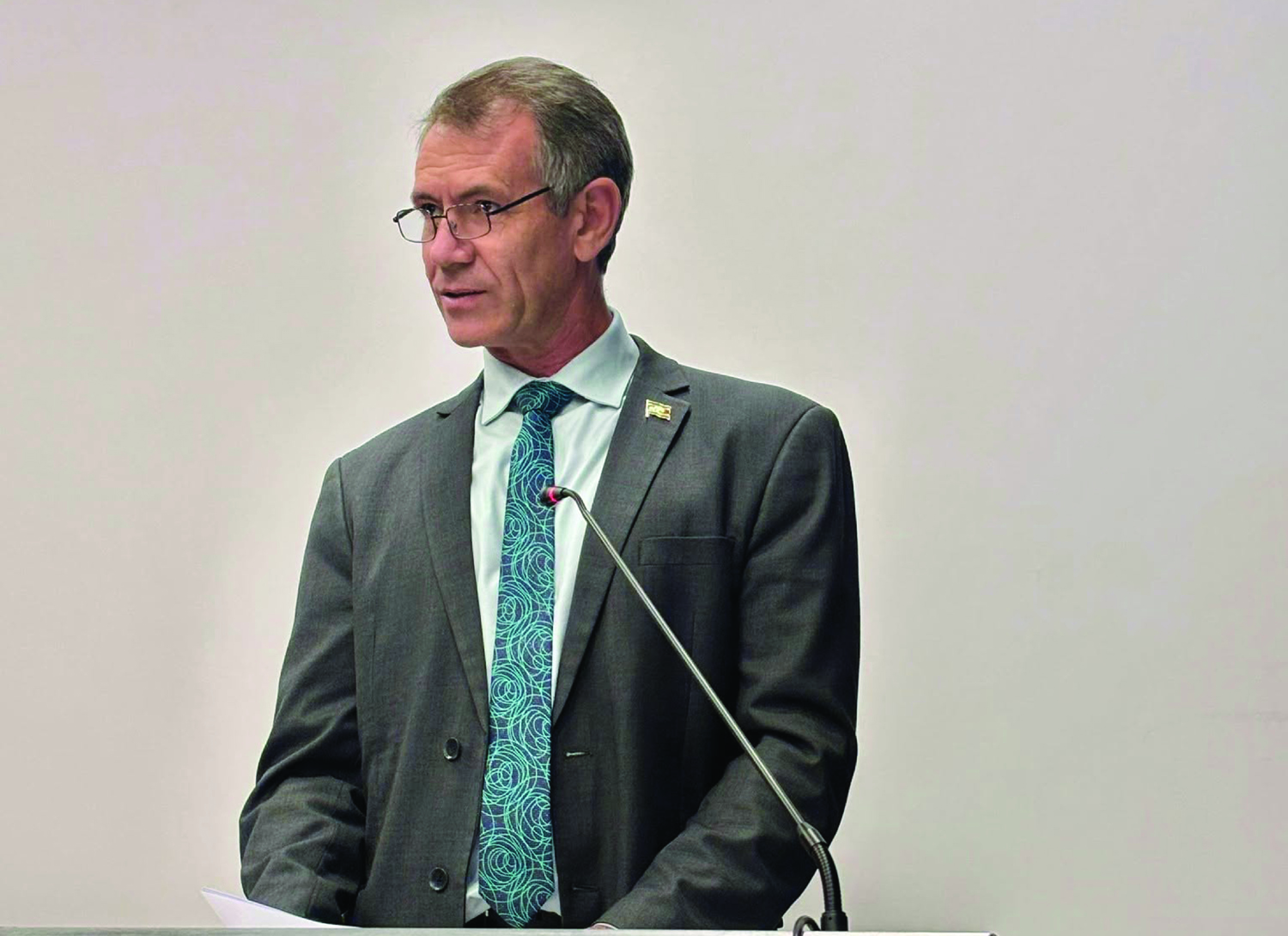
MINISTER of Finance Neal Rijkenberg says government is facing financial constraints and will need an additional loan of E4.5 billion to stay afloat.
This is regardless of the expected revenue from the Eswatini Revenue Service (ERS) and Southern African Customs Union (SACU) and other taxes.
The minister noted that they were trying to raise more budget support. He said it takes longer to raise this funding and to be able to get a concessional debt, hence starting the exercise early.
For the budget support, he said they were going back to the Johannesburg Stock Exchange with the hope of raising something there. He said as weeks go by, government will start getting more payments, and on a weekly basis they will pay what they can regardless of battling to keep up with the bills.
He emphasised that they were busy with a plan to raise the money so that they can get on top of things properly and pay all the suppliers that are outstanding.
Speaking on Eswatini TV’s Market View, the minister said he would approach the World Bank and Johannesburg Stock Exchange (JSE) for loans.
He said last year government went for a supplementary budget that increased the ceiling for the year to E3.8 billion, which he said was a large amount.
He said it was raised from the Strategic Oil Reserve as they decided that there was need to accelerate it due to the fuel crisis, completion of the International Convention Centre (ICC), salary review exercise, additional travel expenses and more.
He said the challenge was that out of the E3.8 billion, only E1.5 billion was funded and the E2.3 billion was not funded, which created a cashflow pressure.
At the same time, he said the tax collection was less than what was expected. He explained that they had projected tax collection to be at E16.5 billion, but they collected E15.8 billion which was E700 million less.
“The E2.3 billion with the E700 million total E3 billion negative balance from last year. At this year’s budget I mentioned that we needed E1.5 billion to fund the budget. This means by the end of the year the country will need E4.5 billion for budget financing.
The budget is increasing because we are focusing on building more roads, doing a lot of good things for the budget and the supplementary, and a lot of it is capital expenditure.
We are going into the market for E4.5 billion and it will increase the debt-stock that we have. If we do not raise it, it will mean that we are sitting with suppliers that are not paid, unfunded projects in government and more,” said Rijkenberg.
He said the suppliers might submit all the documents at the treasury department, but it usually takes 42 to 45 days and they were working on reducing that to 30.
He noted that government was paying suppliers, but was running a bit behind schedule with that process. In the short-term, he said they would find means to pay and reduce the arrears.
“Taxes come in every week and we will use that money to pay suppliers, but cash is tight.
The E2.9 SACU revenue will bring relief to settle the 85% salary review as we had signed with the public sector unions (PSU) that we will pay the backpay in July.
We stated July because we knew that the SACU receipts will be coming in. It will be very wrong for now to use that money for something else because it was earmarked for the civil servants salaries’ backpay.
We will keep our commitment for the E850 million and cash will be more tight within government,” said Rijkenberg. Economist Sanele Sibiya said the country is still to experience tough months as the money that comes in is spent for government business, until the minister gets the E4.5 billion.
He said the country does not have much scope to continue borrowing, instead should manage better the already available resources.
He further noted that the debt-to-GDP ratio was already around 47%. If more budget support loans are sought, then the debt-to-GDP ratio will increase to over 50%, which is an unsustainable range. The SACU receipts play a huge role in ensuring that government’s cashflow continues its operations effectively.
Sibiya added that government might need one or two budget support loans, which is not good because it has no returns.
Instead, he suggested that government seeks loans that will unlock the productive capacity in the economy, approach the private sector for capacity and be able to pay the loan back.
He said at some point if the country does not change the fundamentals of the economy, the economy will literally hit rock bottom. He said if this amount was taken to pay off last year’s debt, going forward there will be pressures on government finances and how government businesses will be funded.
Sibiya clarified that the SACU receipts make over 30% of government’s budget, which is a huge chunk to ensure that government stays afloat to run day-to-day business.
“Government is already starting in a summary of a negative situation in terms of salaries.
The country is already working with a 3%-4% debt deficit as a percentage of the gross domestic product (GDP),” said Sibiya.