


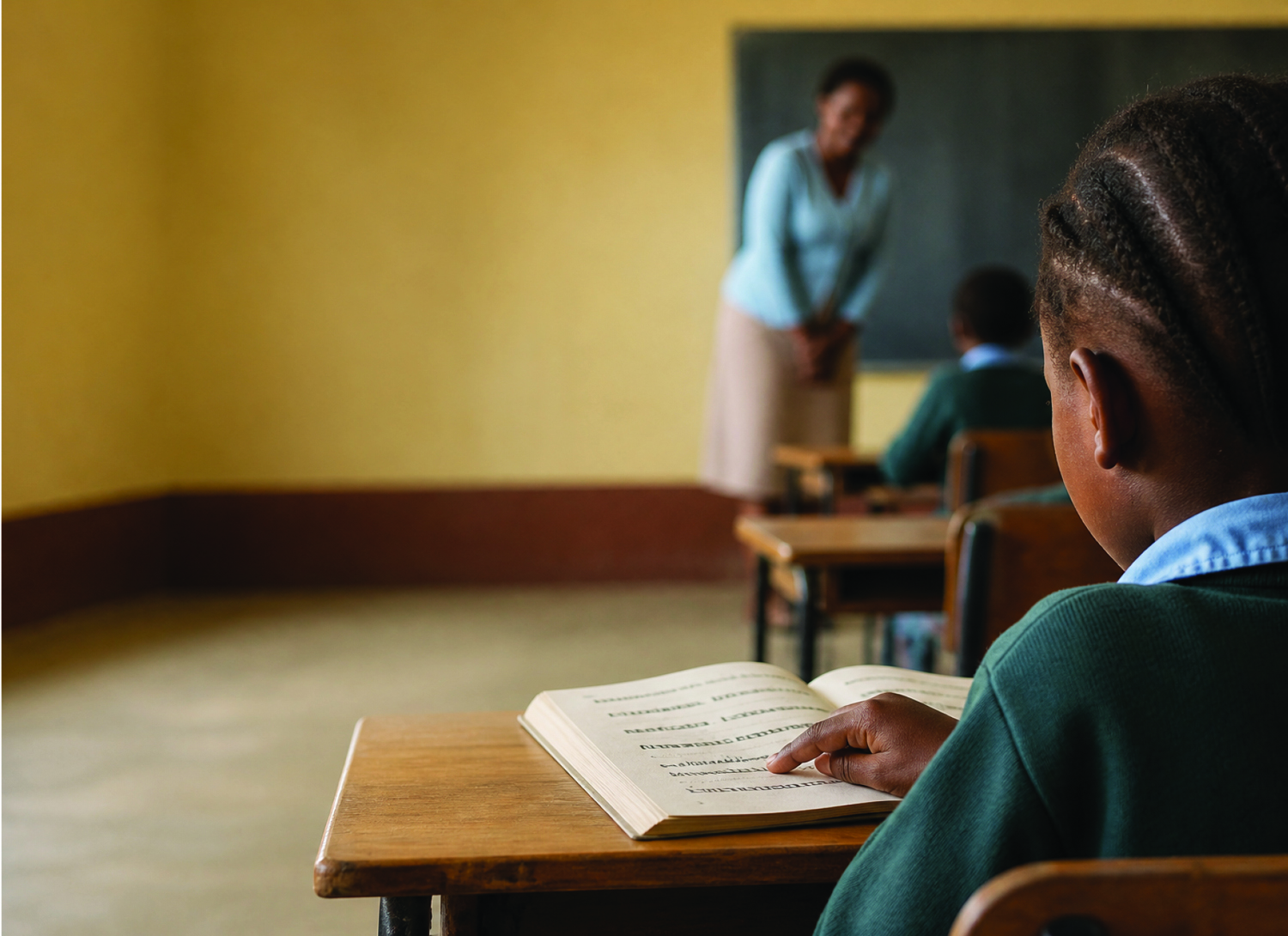
The country is facing a reading crisis, with thousands of children progressing through the early years of primary school without mastering the basic literacy skills needed to learn.
A Grade III pupil reads, on average, just three English words correctly in a minute, according to a 2025 learning assessment cited by the World Bank. In Siswati, the figure rises to only eight words per minute.
How far behind that is becomes clearer when measured against the international measure of where children are expected to be at around this stage of their education.
The International Association for the Evaluation of Educational Achievement’s Progress in International Reading Literacy Study (PIRLS), regarded as a global standard for measuring reading achievement, assesses pupils in their fourth year of schooling, an important transition point when children have typically learnt how to read and are beginning to read in order to learn.
Singapore emerged as the world’s leading performer, recording an average of 100 to 120 words correct per minute aloud.
The local figures are contained in an article published by the World Bank detailing government’s efforts to address what has become a serious foundational learning problem in the kingdom.
The problem appears to begin early. According to the World Bank, only 16% of Grade II and III children in the country demonstrated foundational reading skills in 2022, while just 8% displayed the expected proficiency in mathematics.
That matters because reading is not a skill children leave behind during the early years of their education. It becomes fundamental to almost everything else they are expected to learn as they progress through school.
The United Nations Educational, Scientific and Cultural Organisation (UNESCO), the UN agency responsible for promoting international cooperation in education, identifies literacy and numeracy developed in the early years as foundations for later learning.
In a 2025 working paper examining literacy and numeracy development from birth to age eight, researcher Rebecca Merkley highlights the importance of those formative years, when children begin recognising words, making sense of sentences and developing the ability to understand what they read.
“What children master at this stage helps lay the foundation for how they learn and perform as they progress through school,” she emphasises.
Foundational literacy, therefore, is not simply another milestone to be achieved in the first years of school. It forms part of the basis upon which subsequent learning is built, making weaknesses established in the early grades increasingly consequential as children move through the education system.
Beyond the classroom, those consequences can follow children into adulthood. The World Bank warns that children who fail to develop foundational learning skills can struggle later in school and eventually in the workplace.
It links literacy and numeracy to human capital, productivity and the ability to reskill as economies change, while warning that poor foundational literacy can contribute to the intergenerational transmission of poverty and vulnerability.
It’s not surprising – SNAT SG
For the Swaziland National Association of Teachers (SNAT), however, the numbers are not surprising. Secretary General Lot Vilakati said the assessment figures were believable and argued that they reflected deeper weaknesses within the country’s education system.
“The foundation of our education system has collapsed and it is now dead,” Vilakati said.
He pointed to recent pupil performance in Siswati as another warning sign, saying more than 1 000 Grade VII pupils failed the subject last year.
Vilakati warned that the challenges facing the education system could worsen with the introduction of Competency-Based Education (CBE), arguing that the curriculum was being implemented before government and schools were sufficiently prepared.
“Things are only going to get worse because of the introduction of this curriculum and the way it has been introduced,” he added.
He argued that addressing the reading problem would require government to employ more teachers and improve their welfare and working conditions, saying adequately supported teachers would be better positioned to improve learning outcomes.
The Ministry of Education and Training itself acknowledges that substantial work remains.
Speaking to the World Bank, Director of Education Dr Tholakele Mngometulu-Dlamini said government had looked beyond the country for interventions capable of addressing the weaknesses.
“A lot of work needs to be done to improve early learning in our country. Having observed the Teaching at the Right Level (TaRL) approach in South Africa, we felt that this approach could be effective in Eswatini as well,” she stated.
Supported by the World Bank’s Accelerator Programme and Montrose International, TaRL challenges a basic assumption that has traditionally governed the classroom: that children in the same grade are necessarily learning at the same level.
Instead of teaching strictly according to where the curriculum says a pupil should be, teachers first establish what each child can actually do. Children are then grouped according to their abilities and taught at a level appropriate to their existing literacy or numeracy skills.
The pilot was introduced in 30 primary schools, reaching nearly 1 900 pupils and training more than 90 teachers. Two approaches were tested: one incorporated into normal classroom instruction and another delivered through after-school sessions.
Govt extends formative assessment materials across early grades
Chief Inspector for Primary Education Dr Thamie Mduduzi Dlamini has said government is also extending formative assessment materials across the early grades.
“We are rolling out formative assessment material to all early grades. Teachers are now better informed about gaps in pupils’ learning. TaRL will equip teachers with strategies to effectively address these gaps,” he explained.
Traditionally, according to the World Bank, classrooms followed a largely one-size-fits-all model in which pupils were expected to keep pace with the curriculum irrespective of their actual learning level. Without regular formative assessments, teachers often depended on end-of-term assessments to determine how pupils were performing. By then, some children were already behind.
Early results from the TaRL pilot are reportedly encouraging, with teachers reporting improvements in literacy and numeracy and pupils moving into higher competency groups.
“Children who previously struggled to recognise letters progressed to reading words and constructing simple sentences, while teachers reported greater participation and confidence among some of the weakest learners,” the World Bank article states.
The pilot nevertheless exposed practical problems that could become more significant if the programme is expanded nationally.
Large classes made managing several ability groups difficult in some schools. Teachers called for additional learning materials and teaching assistants, while the after-school model presented logistical difficulties, including having children from different grades grouped together.
Despite those constraints, all 30 participating schools implemented the programme, and the ministry is now working towards extending the approach to lower primary classrooms across the country.
The country’s reading crisis is not occurring in isolation. Across Sub-Saharan Africa, the World Bank says nearly 90% of 10-year-olds cannot read and understand a simple text, while 83% lack basic mathematics proficiency.
Neighbouring South Africa is confronting its own severe literacy problem. PIRLS results released showed that 81% of South African Grade IV pupils could not read for meaning in any language, with the country ranking last among 57 participating countries.