


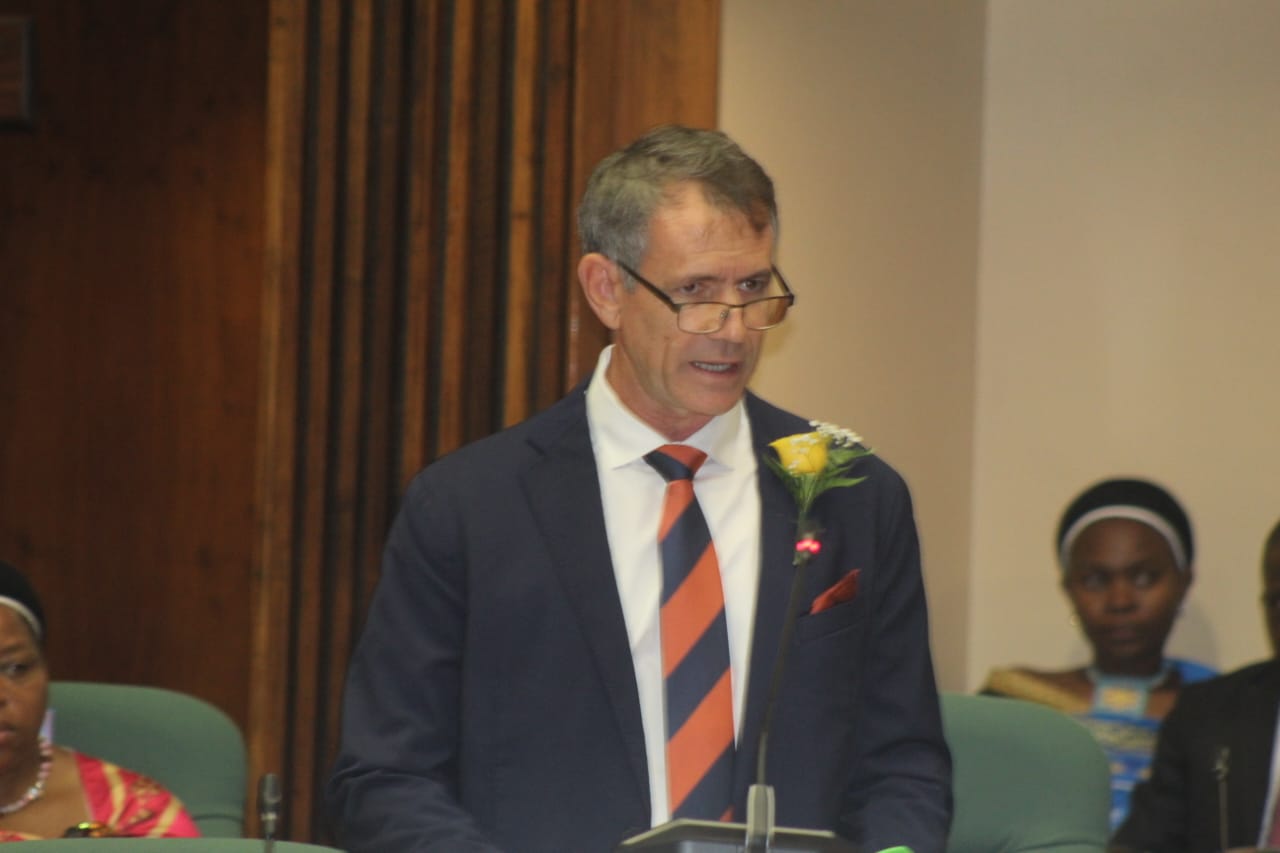
In a landmark address to Parliament, Minister of Finance Neal Rijkenberg unveiled a record-breaking national budget of E36.92 billion for the 2026/27 financial year — describing it as the most significant fiscal expansion in the country’s history.
The allocation marks a staggering E4.3 billion increase from the E32.6 billion approved in the previous year.
Anchored in the theme of agape love — defined by the minister as “love in action” — the budget seeks to transform the economy through sacrificial service and disciplined investment.
The primary engine behind this historic rise is the long-awaited public service salary review.
By implementing Scenario 3 of the review, government has significantly increased recurrent expenditure to accommodate phased salary adjustments and back pay for civil servants.
According to Rijkenberg, the move is designed to:
-
Boost morale
-
Restore purchasing power
-
Strengthen the workforce described as the backbone of service delivery
However, this commitment comes amid mounting fiscal pressures. Interest payments on public debt have climbed to approximately E800 million.
While the minister assured the nation that debt levels remain sustainable, he acknowledged the strain such obligations place on the national fiscus.
Education once again secures the largest allocation, rising to E6.40 billion.
The funding will support:
-
A four-year secondary school pilot programme
-
The rollout of Competency-Based Education
The health sector follows with a robust E3.24 billion, with a significant focus on restructuring the Central Medical Stores.
The transformation into a stand-alone entity is aimed at addressing persistent drug shortages raised in the 2025 budget speech — ensuring pharmaceutical funds translate into medicines reaching patients.
Job creation remains central to the fiscal strategy, particularly through completion of flagship infrastructure projects.
The International Convention Centre (ICC) is nearing completion and is expected to be officially opened by King Mswati III in April.
To ensure operational success, an additional E100 million has been allocated.
Meanwhile, Phase II of the Lower Usuthu Smallholder Irrigation Project is reaching completion — a major agricultural investment aimed at increasing rural incomes through sugar cane production.
In the south, the Mkhondvo-Ngwavuma Water Augmentation Project is progressing steadily, promising enhanced water security for both households and large-scale irrigation.
Industrialisation efforts are also gaining momentum, with several large factory shell buildings nearing completion. These ready-built facilities are designed to attract foreign direct investment by lowering entry barriers for manufacturers.
The energy sector received a substantial E1.73 billion allocation.
The goal: achieve 100% electricity access by 2030.
This includes new 40MW biomass and solar power agreements, aimed at reducing reliance on imported electricity and shielding the economy from volatile energy costs.
The minister emphasised that the budget represents more than numbers — it is a moral commitment to “love in action.”
Agriculture has been allocated E2.2 billion, with a strong focus on agribusiness and food security.
The Hamba Ubuye Revolving Fund continues to play a central role in advancing food sovereignty.
Under the stewardship of Eswatini Water and Agricultural Development Enterprise, the programme has:
-
Supported 402 farmers over four seasons
-
Cultivated 3,141 hectares nationwide
In the latest season, 7,634 metric tonnes of maize were produced.
Currently:
-
248 farmers (192 men, 56 women, 21 youth) are supported
-
E18 million has been invested in farm inputs
-
1,861 hectares are under cultivation
-
7,444 metric tonnes of maize are projected for harvest
The programme is reducing dependence on external grain markets while strengthening rural livelihoods.


![Government Spokesperson Alpheous Nxumalo with Prime Minister Russell Mmiso Dlamini. [Courtesy pic]](https://www.eswatiniobserver.com/wp-content/uploads/2025/12/480955224_940003644989639_6961938701189516981_n-218x150.jpg "‘Alpheous rejected E1.2m offer, cannot claim contempt of court’")